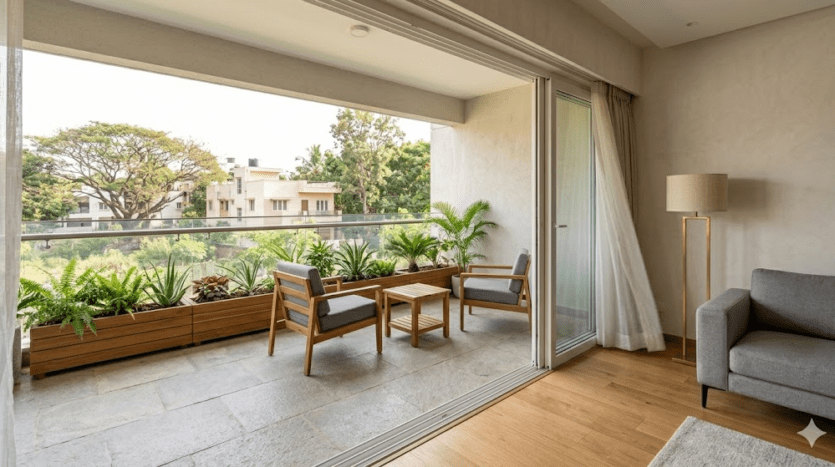
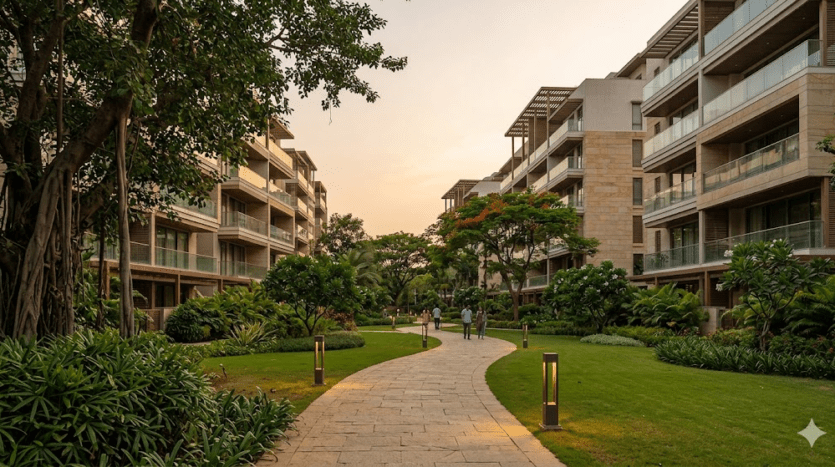
Premium Apartments in Sarjapur Road: Are They Actually Worth the Price?
The word “premium” does a lot of work on Sarjapur Road. It appears on hoardings for projects priced at ₹8,000 per sq ft and projects priced at ₹19,800 per sq ft. It describes boutique low-density developments with 110 units and township launches with over 5,000. It’s applied to projects with IGBC certification, functioning water infrastructure, and no shared walls — and to projects with none of those things.
For a buyer trying to make a ₹1.5 crore to ₹3.5 crore decision, this ambiguity is more than a marketing nuisance. It’s a genuine obstacle. The question isn’t whether premium apartments in Sarjapur Road are worth buying. It’s whether the specific premium you’re being asked to pay is justified by what you’re actually getting: in construction quality, liveability, appreciation potential, and long-term value.
This guide works through that question systematically. It looks at what drives pricing on Sarjapur Road, where the genuine value sits in the current market, and how to tell the difference between a justified premium and an inflated one.
TL;DR
- Premium apartments in Sarjapur Road span ₹8,000 to ₹19,800 per sq ft, a range wide enough to contain genuinely different products, not just different brands
- The corridor’s appreciation case is real: prices rose from ₹6,050 per sq ft in 2021 to over ₹10,800 per sq ft by mid-2025, per Anarock data — but future gains will be sub-location and project-quality dependent
- Gross rental yield runs 4.0–6.0% on Sarjapur Road — above Whitefield (3.8%) and comparable to Electronic City (4.3%)
- The KIADB SWIFT City — a 1,000-acre employment hub on the Sarjapur-Attibele axis — is one of the most underreported demand catalysts in the corridor
- Projects priced at ₹7,900–₹9,200 per sq ft with IGBC certification, no shared walls, and sustainable infrastructure can deliver comparable liveability to projects priced 40–50% higher without the compressed appreciation headroom
- The premium worth paying is defined by construction quality, density, sustainability credentials, and sub-zone growth runway, not by brand name alone
What’s Actually Driving Premium Pricing on Sarjapur Road
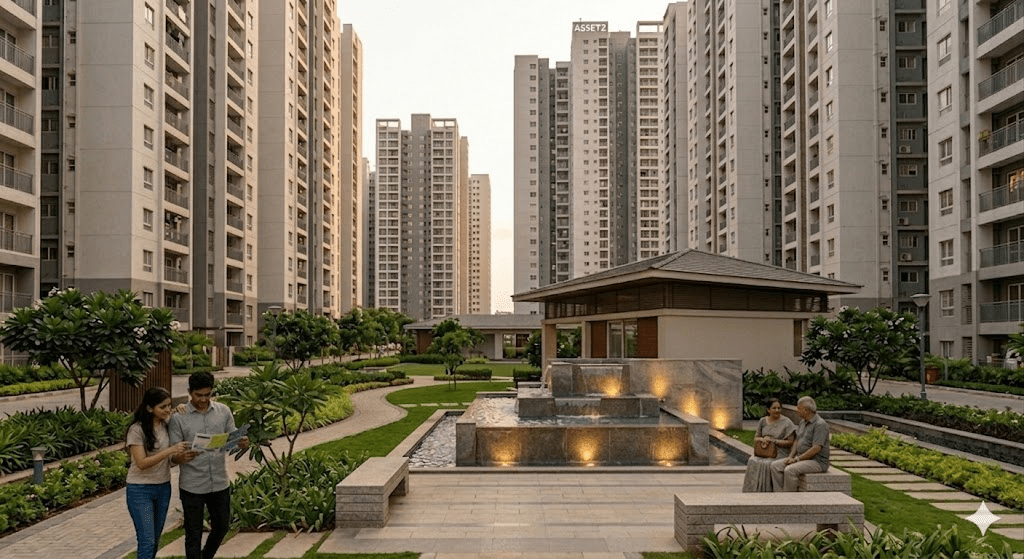
Premium apartments in Sarjapur Road are not priced uniformly — and understanding what drives the variance is the first step toward evaluating whether a specific project’s pricing is justified.
The legitimate drivers of premium pricing:
- Sub-zone maturity: Projects in Bellandur, Kaikondrahalli, and the mature western cluster command higher prices because of established social infrastructure, strong rental demand, and proximity to the ORR tech belt. The premium here reflects genuine fundamentals
- Developer brand and construction quality: Tier-1 developers with consistent OC delivery records, better material specifications, and stronger balance sheets command a premium that is partially justified — they carry lower execution risk
- Design differentiation: Projects with no shared walls, IGBC certification, low unit density, and genuine sustainability infrastructure command premiums that reflect long-term liveability and maintenance cost advantages
- Floor height and views: In a high-rise project, upper floor units in taller towers command premiums of 3–8% over lower floors; a premium that is real and resale-backed
The less legitimate drivers:
- Brand markup without fundamentals: Several projects on Sarjapur Road price at ₹13,700–₹19,800 per sq ft on the strength of developer name recognition and launch marketing — not on construction quality, density, or sustainability credentials that meaningfully differentiate them from mid-premium alternatives
- Location inflation: Projects marketed as “Sarjapur Road” can sit 15–20 km from the ORR, in sub-zones with limited BWSSB connectivity, thin social infrastructure, and no confirmed metro station proximity. The address premium isn’t matched by the underlying fundamentals
- Amenity theatre: A 60,000 sq ft clubhouse listed as a premium feature means little if the project has 3,000 units — the amenity-to-resident ratio is what determines daily quality of life, not the absolute clubhouse size
The practical implication: two projects can sit within 3 km of each other on Sarjapur Road, carry the same “premium” label, and represent entirely different value propositions. Price per sq ft alone tells you nothing without the underlying variables.
The Economics: Appreciation, Yield, and What the Data Shows
The financial case for premium apartments in Sarjapur Road rests on three compounding variables: appreciation trajectory, rental yield, and the gap between current pricing and where confirmed infrastructure will take values.
The appreciation trajectory:
Per Anarock data, property values on Sarjapur Road rose from approximately ₹6,050 per sq ft at end-2021 to over ₹10,800 per sq ft by Q2 2025 — an 84% appreciation over 3.5 years. JLL projects 10–12% annual capital growth for premium homes in 2026, driven by sustained IT sector demand and infrastructure progression.
What this means for buyers entering now: the easy phase of uniform corridor appreciation is largely behind them. Future gains will be sub-location specific, infrastructure-driven, and project-quality dependent. A project priced at ₹15,000 per sq ft today has less appreciation headroom than a comparable project priced at ₹9,200 per sq ft — regardless of brand.
The rental yield comparison:
| Market | Avg Price (₹/sq ft) | 2 BHK Monthly Rent | Gross Rental Yield |
| Sarjapur Road | ₹10,200–₹11,000 | ₹35,000–₹39,000 | 4.0%–6.0% |
| Whitefield | ₹12,112 | ₹37,915 | 3.8% |
| Electronic City | ₹7,426 | ₹26,450 | 4.3% |
Sarjapur Road outperforms Whitefield on yield despite a lower average price — a function of the corridor’s employment density and the depth of its rental tenant pool. The 4.0–6.0% range reflects genuine sub-zone variance: Bellandur-adjacent projects yield higher; eastern corridor projects yield lower. Projects priced above ₹13,000 per sq ft see yield compression — the rent market hasn’t kept pace with the upper end of the price curve.
The appreciation headroom calculation:
For a project purchased at ₹9,200 per sq ft with projected annual appreciation of 10%, the five-year value projection is approximately ₹14,820 per sq ft. For a project purchased at ₹15,000 per sq ft with the same appreciation rate, the five-year value is approximately ₹24,158 per sq ft — a larger absolute gain but from a much higher base with significantly compressed yield in the interim. For most buyers, the mid-premium entry point delivers a better risk-adjusted return than the luxury tier.
Sub-Zone Analysis: Where the Growth Runway Actually Remains
Sarjapur Road is a 21-kilometre corridor with meaningfully different investment profiles at different points. Paying a premium for the wrong sub-zone is one of the most common and costly mistakes buyers make.
| Sub-Zone | Avg Price (₹/sq ft) | Investment Status | Key Growth Catalyst |
| Gunjur / Kasavanahalli | ₹8,000–₹10,950 | Mature; largely priced in | High developer absorption; established demand |
| Carmelaram | ₹7,500–₹9,000 | Developing; steady growth | ORR proximity; Metro Phase 3A station alignment |
| Dommasandra | ₹6,500–₹7,800 | Emerging; strong runway | Metro Phase 3A; STRR alignment |
| Sarjapur-Attibele Road | ₹4,500–₹6,500 | Early stage; budget-friendly | KIADB SWIFT City; 100,000+ projected jobs |
The sub-zone insight that changes the premium calculation:
A luxury apartment in Sarjapur Road priced at ₹19,800 per sq ft in the mature Bellandur cluster has its appreciation largely priced in. The same quality of construction, sustainability credentials, and amenity access — delivered in Carmelaram or the Sompura Gate mid-corridor zone at ₹9,200 per sq ft — has a materially longer appreciation runway ahead of it, with the same infrastructure catalysts benefitting both.
This is the core of the value-arbitrage case on Sarjapur Road: the premium worth paying is the one that buys genuine quality in a sub-zone that hasn’t yet fully priced in its own fundamentals.
The Infrastructure Catalysts Repricing the Corridor
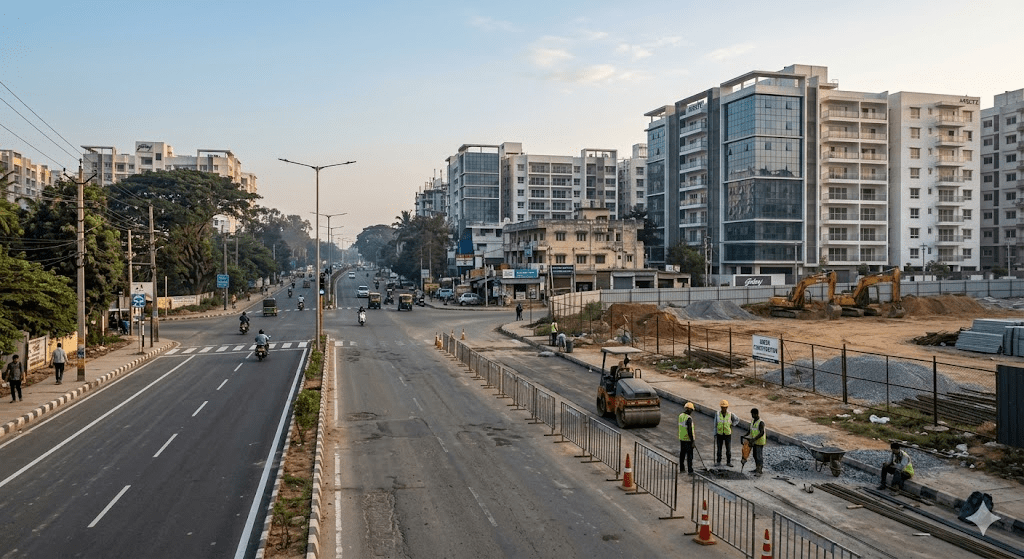
Infrastructure on Sarjapur Road is real, substantial, and unevenly distributed. Understanding which projects sit in the path of genuine catalysts — and which are using infrastructure proximity loosely — is essential for evaluating any premium pricing claim.
Metro Phase 3A — The Hebbal–Sarjapur Red Line:
The proposed 36.5 km, 28-station Red Line received state finance department approval in November 2024. Construction is scheduled for 2029–2031, with an operational window around 2033. The value mechanism is well-documented: Bengaluru micro-markets have historically seen 15–25% appreciation in the 18–24 months before a metro line commissions.
What matters for premium pricing: projects within 1–1.5 km walking distance of confirmed stations (Iblur, Agara, Carmelaram, Dommasandra) are genuinely positioned to capture that appreciation window. Projects that claim “metro proximity” at 4–5 km distance are not.
KIADB SWIFT City — The Most Underreported Catalyst:
The 1,000-acre KIADB SWIFT City development on the Sarjapur-Attibele Road axis is projected to create over 100,000 technology and industrial jobs upon full development. This is the kind of employment catalyst that drove Sarjapur Road’s original appreciation — a large-scale job creation engine within commuting distance of the residential corridor.
For buyers evaluating apartments in Sarjapur Road in the eastern sub-zones, SWIFT City is a fundamental that most competitor content ignores entirely. Projects in Dommasandra and Sarjapur-Attibele that are accessible to this employment hub will benefit from structural rental demand that is independent of the existing ORR tech belt.
PRR, STRR, and road infrastructure:
- The Peripheral Ring Road (PRR/BBC) Phase 1 tendering began in 2026; when operational, it will cut inter-zone travel between Sarjapur Road and North Bengaluru by up to 50%
- The STRR diverts heavy freight from the corridor — directly addressing the dust and congestion quality-of-life concerns that Reddit threads consistently raise
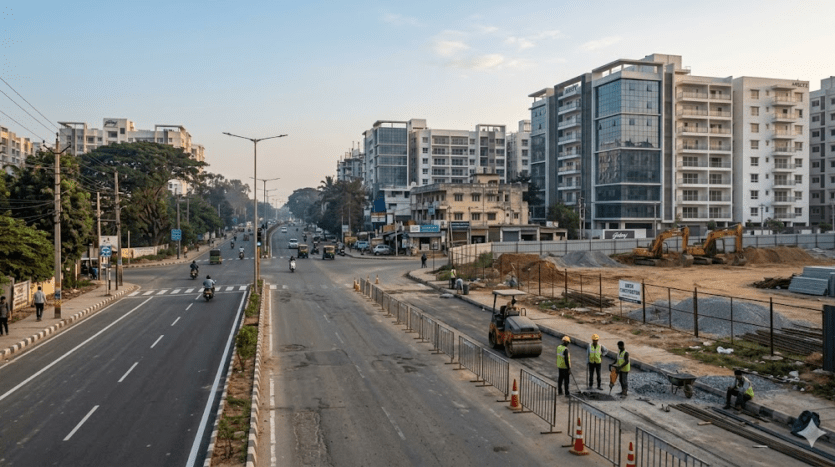
- Sarjapur main road widening is active; meaningful improvement expected within 2–3 years
The Liveability Equation: What Premium Should Actually Deliver
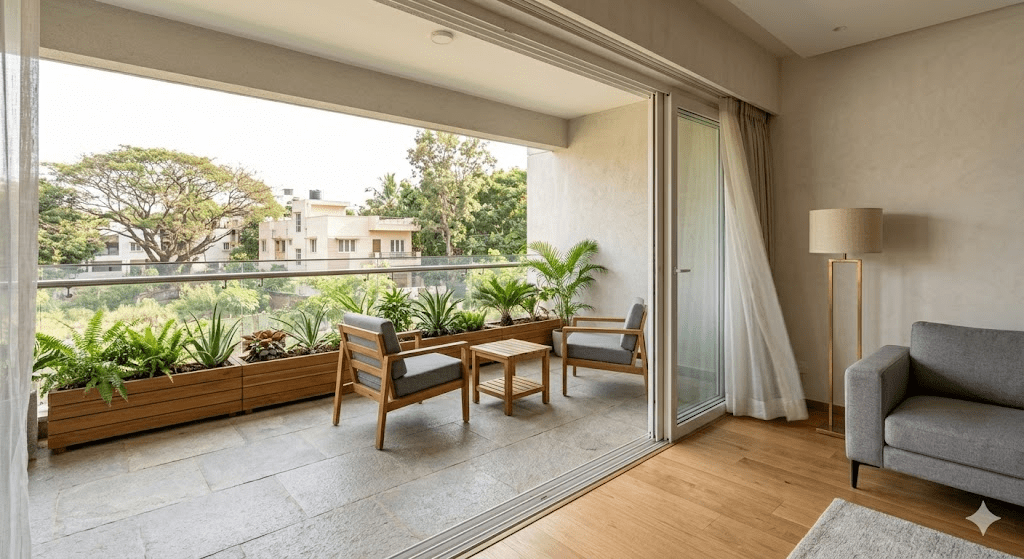
A premium price tag should translate into a measurably better living experience — not just a better brochure. Here’s what genuine premium liveability looks like on Sarjapur Road, and how to verify whether a project delivers it.
Schools and healthcare:
The school ecosystem — Oakridge International, Indus International, Greenwood High, TISB, NPS East, Inventure Academy — is concentrated in the mid-corridor zone and represents one of the strongest lifestyle anchors in Bengaluru. For families, living within 15 minutes of this belt is a durable quality-of-life and resale value advantage. Sakra World Hospital, Manipal Hospital, and Motherhood provide the healthcare density that joint families and buyers with elderly parents require.
Premium projects that charge significantly above corridor averages but sit 20+ minutes from this ecosystem should be evaluated critically — the lifestyle premium they claim may not be geographically supported.
Water and sustainability infrastructure:
This is where the gap between genuine premium and marketed premium is widest on Sarjapur Road. What sustainable infrastructure actually looks like:
- Confirmed BWSSB connection or functioning RWH system with verified storage capacity
- STP output meeting KPCB standards for toilet flushing and landscape reuse
- Smart water metering that monitors consumption per unit in real time
- Dual plumbing networks that separate potable and recycled water streams
Projects with IGBC Silver pre-certification have had these features independently verified at the design stage. Projects without it — regardless of price — require buyers to ask these questions directly and get written answers, not verbal assurances.
Density and design:
Genuine premium delivers:
- No shared walls between apartments — acoustic privacy that no amenity list compensates for
- Minimum 5-foot balcony depth — usable outdoor space, not a standing ledge
- Ceiling heights of 2.75 metres minimum — air volume and vertical storage potential
- Units per acre below 70 — open space per resident that feels like it was designed, not squeezed in
A project with 159 units per acre and a 60,000 sq ft clubhouse is delivering a different product than one with 44 units per acre and a 19,000 sq ft clubhouse. The ratio of amenity to resident matters more than the absolute amenity size.
The Value-Arbitrage Framework: High-End Living Without the Brand Markup
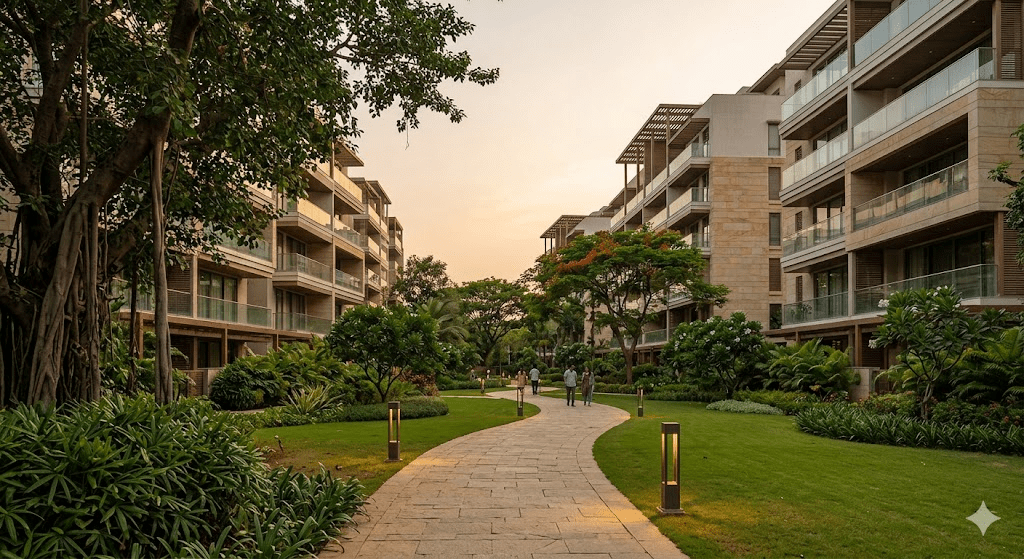
The most important insight in evaluating premium apartments in Sarjapur Road is this: construction quality, sustainability credentials, and liveability design are not exclusive to projects priced at ₹13,700–₹19,800 per sq ft. They are available at ₹7,900–₹9,200 per sq ft in projects that have made deliberate choices about density, certification, and design — and have more appreciation headroom ahead of them.
The value comparison:
| Project Type | Price Range (₹/sq ft) | IGBC Certified | No Shared Walls | Units/Acre | Appreciation Headroom |
| Typical Tier-1 Brand Premium | ₹13,700–₹19,800 | Rarely | Sometimes | 80–160+ | Compressed |
| Suyug Saffron | ₹7,900 | Yes | Yes | ~44 | Strong |
| Suyug The 1 | ₹9,200 | Yes | Yes | ~67 | Moderate–Strong |
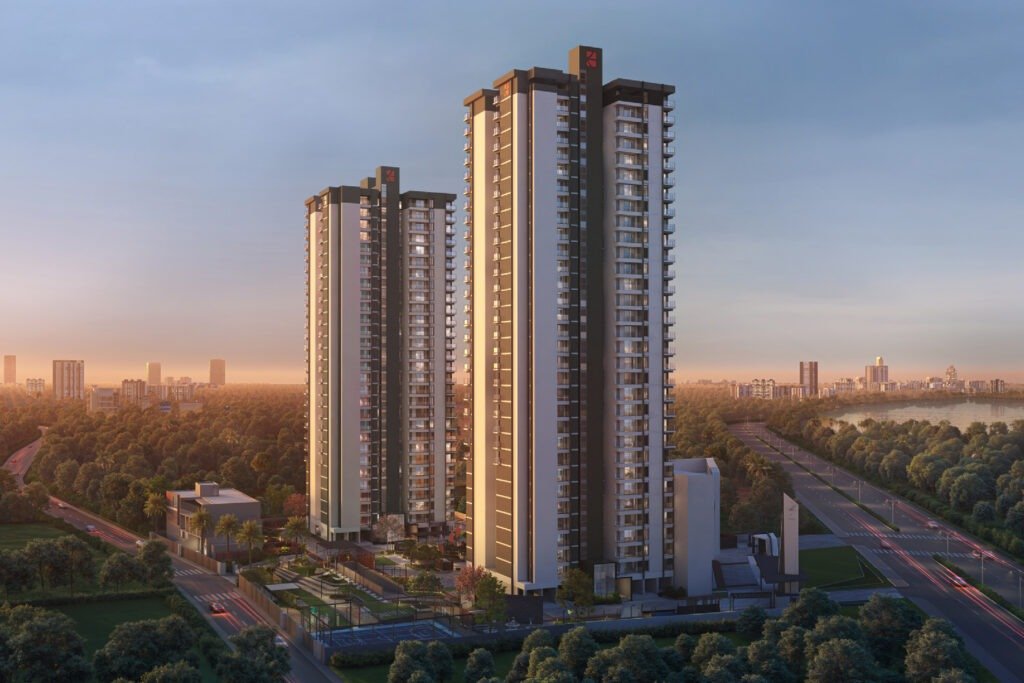
Suyug Saffron — 110 units across a single 14-storey tower on 2.51 acres at Sompura Gate — delivers IGBC Silver pre-certification, no shared walls, solar power, smart water metering, zero organic waste to landfill, and a 19,000 sq ft clubhouse at ₹7,900 per sq ft. Suyug The 1 — 235 units across two towers on 3.5 acres, among the taller high-rise towers on the corridor — delivers the same certification standard, 65,000+ sq ft of clubhouse infrastructure, 100% power backup, and smart-enabled homes at ₹9,200 per sq ft.
Both projects are RERA approved (The 1: PRM/KA/RERA/1251/310/PR/051224/007268; Saffron: PRM/KA/RERA/1251/308/PR/140825/008000) and sit at Sompura Gate — directly adjacent to Wipro’s corporate campus, mid-corridor on Sarjapur Road, with access to the school belt and emerging infrastructure catalysts.
The value-arbitrage case is not that cheaper is better. It’s that ₹7,900–₹9,200 per sq ft with verified sustainability credentials, low density, and a longer appreciation runway is a stronger investment than ₹15,000+ per sq ft without those fundamentals — particularly for buyers with a 5–7 year horizon who want both liveability and capital growth.
Want to understand how Suyug’s projects compare against specific alternatives you’re evaluating? The team works through these comparisons with buyers regularly — reach out for a straightforward conversation.
One Thing Worth Sitting With
The premium worth paying on Sarjapur Road is not the one with the biggest hoarding or the most recognisable developer name. It’s the one where you can verify — through RERA filings, IGBC certificates, OC history, and a site visit during construction — that the price reflects genuine quality, not brand markup. That verification takes a few hours. The decision it informs lasts a decade.
FAQ’s
The corridor’s fundamentals are strong — 84% appreciation over 3.5 years per Anarock data, gross rental yield of 4.0–6.0%, and confirmed infrastructure catalysts including Metro Phase 3A and the KIADB SWIFT City. The investment case holds, but entry price matters: projects priced at ₹7,900–₹9,200 per sq ft with verified sustainability credentials have more appreciation headroom than those priced at ₹15,000+ where the brand premium has already compressed the growth runway.
In practice, the distinction is often marketing rather than construction. Luxury apartments in Sarjapur Road typically refer to projects priced above ₹13,000 per sq ft with high-end finishes, larger configurations, and Tier-1 developer branding. Premium refers to the broader mid-to-upper segment from ₹8,000 upward. What genuinely separates the two is not price but verifiable features: IGBC certification, no shared walls, low unit density, and sustainable water infrastructure — features available at both price points in the right projects.
The KIADB SWIFT City is a 1,000-acre industrial and technology development on the Sarjapur-Attibele Road axis, projected to create over 100,000 jobs upon full development. For buyers evaluating apartments in Sarjapur Road in the eastern sub-zones — Dommasandra, Sarjapur Town, Attibele — this represents a structural employment catalyst that will drive residential rental demand independent of the existing ORR tech belt. It is one of the most underreported growth drivers in the corridor.
Start with units per acre — divide total units by total land area. Projects below 50 units per acre are commonly considered low-density; above 100 begins to compress liveability. Then verify IGBC certification status, OC history on the developer’s completed projects, and BWSSB water connection status. Finally, calculate gross rental yield: (monthly rent × 12 ÷ total acquisition cost) × 100. If the yield is below 3.5% at the asking price, the premium requires a strong appreciation thesis to justify — verify that thesis against sub-zone fundamentals, not developer marketing.
Three things: appreciation headroom, yield, and verified fundamentals. A project priced at ₹9,200 per sq ft with IGBC certification and no shared walls has more room to grow than one priced at ₹17,000 per sq ft with the same annual appreciation rate. It also yields better in the interim and attracts a more sustainable tenant pool. The brand premium at the top of the market reflects developer reputation and marketing spend — not always a proportional difference in construction quality or liveability.
Verify RERA registration tower-wise on the K-RERA portal (rera.karnataka.gov.in), confirm A-Khata status, check the Encumbrance Certificate for any active mortgages or liens, verify the DC Conversion Certificate if the land was previously agricultural, and confirm the access road is at least 9 metres wide — the minimum required for multi-storey residential approvals. For ready-to-move units, confirm the OC has been obtained before accepting possession.