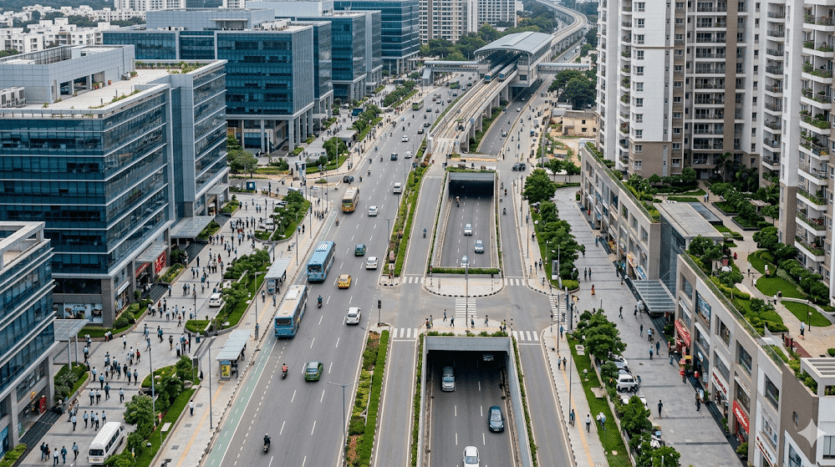
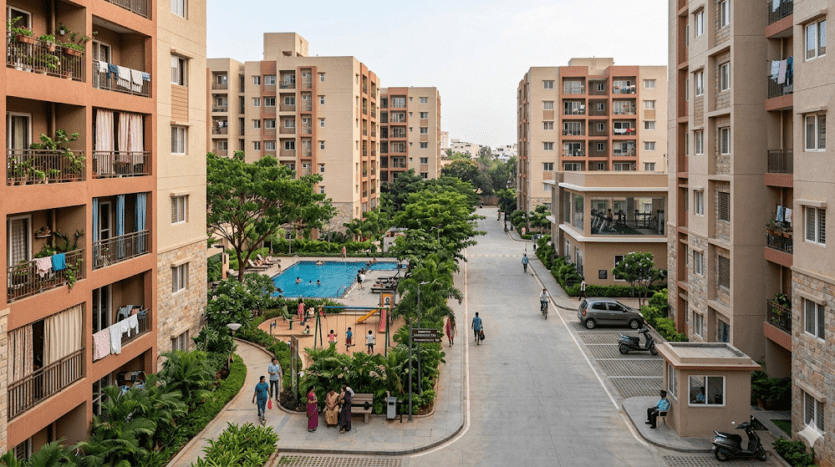
Why NRI Real Estate Investment from the Middle East Is Concentrating on Sarjapur Road
There is a particular logic driving Gulf-based NRI capital toward Indian real estate in 2026 that doesn’t apply in the same way to NRIs in the US or UK. The UAE Dirham is pegged to the US Dollar. The Indian Rupee has depreciated approximately 3–4% annually against the dollar over the last decade, and over 5% in 2025 alone. For an NRI holding savings in AED, this means Indian property is structurally getting cheaper in real purchasing power terms every year.
That currency dynamic, combined with regional geopolitical uncertainty in the Middle East and a maturing premium residential market in Bangalore, has produced a structural shift in how Gulf-based professionals are allocating capital. NRI investment in India real estate from GCC countries has moved from occasional to systematic and from a sentiment-driven connection to a wealth-preservation strategy. NRI real estate decisions that were once deferred indefinitely are now being made with financial precision. And within Bangalore, the capital is concentrating on one corridor more than any other: Sarjapur Road.
TL;DR
- The AED-USD peg means Gulf NRIs benefit directly from rupee depreciation, and Indian premium property gets structurally cheaper in dirham terms every year
- NRI share of Indian residential transactions has grown from 7–10% in 2015–2018 to an estimated 18–20% in 2025, with GCC buyers leading
- Sarjapur Road has delivered over 63% appreciation between 2021 and 2024, from ₹6,050 to approximately ₹9,850 per sq ft, per Anarock data
- Luxury apartments in Sarjapur Road in premium IT corridors yield 3.5–5.5% annually, with the corridor’s school ecosystem and employment density creating durable rental demand
- Ready-to-move-in assets eliminate the execution risk that most concerns remote Gulf buyers, with no construction delays, no remote furnishing coordination, immediate rental income
The Dirham-Rupee Advantage: Why Gulf NRIs Have Structural Purchasing Power
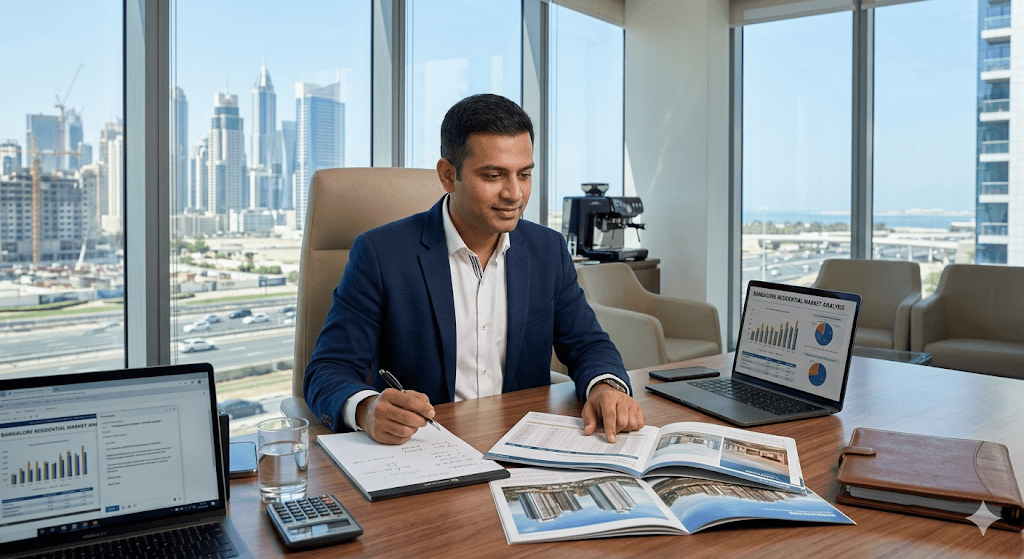
The currency arithmetic is the starting point for any Gulf NRI considering Indian real estate. The UAE Dirham is pegged to the US Dollar at a fixed rate of approximately AED 3.67 per USD. The Indian Rupee has depreciated against the dollar at approximately 3–4% annually over the last decade. In 2025, that depreciation ran at approximately 5%.
What this means in practice:
A premium 3 BHK apartment on Sarjapur Road, priced at ₹1.5 crore in 2022, costs approximately AED 673,000 at the prevailing exchange rate. The same apartment, having appreciated to approximately ₹2.44 crore by 2025, costs approximately AED 1,027,801 at current rates. In AED terms, the price has risen approximately 52.7%, while in INR terms, it has appreciated 62.7% — significantly more. The dirham buyer captures rupee appreciation while their purchasing power base slowly strengthens in relative terms.
For NRIs holding liquid savings in NRE fixed deposits, denominated in INR and earning 6.25–7.25%, the picture is different. That yield, eroded by 4–5% annual rupee depreciation, delivers a real AED-denominated return that approaches zero or turns negative for long holding periods. Physical real estate in an appreciating corridor provides the inflation and currency hedge that liquid INR instruments cannot.
The Gulf Capital Shift: What’s Driving NRI Investment Back to India
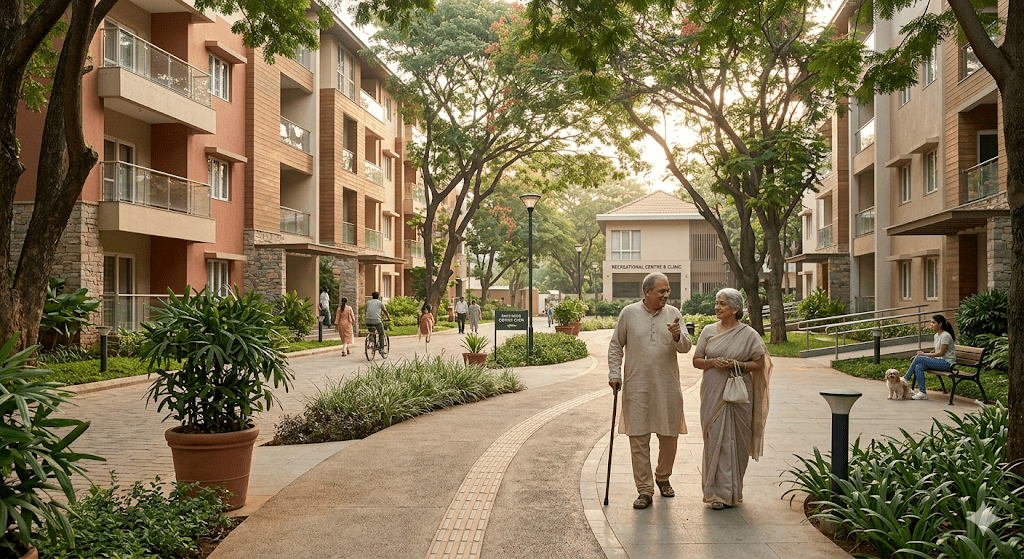
The surge in foreign investment in real estate in India from GCC countries isn’t random. Several structural factors have converged to make 2025–2026 a particularly active period for Gulf NRI property acquisition.
Geopolitical wealth preservation
Regional instability in the Middle East has heightened income and job uncertainty among Indian expatriates, many of whom work in sectors directly exposed to oil price cycles and geopolitical risk. Building a secure asset base in India, specifically a premium residential apartment in a stable, appreciating corridor, has become a priority for professionals who previously deferred the decision indefinitely.
The retirement anchor
Approximately 9–10 million Indians reside in GCC countries. Most are on employment visas with no permanent residency pathway. Retirement means returning to India, and the question of where to live and what financial foundation to return to becomes pressing for professionals in their forties and fifties. A premium apartment in Bangalore’s IT corridor, generating rental income in the interim and ready for personal use upon return, addresses both the investment and the lifestyle requirements simultaneously.
The eldercare driver
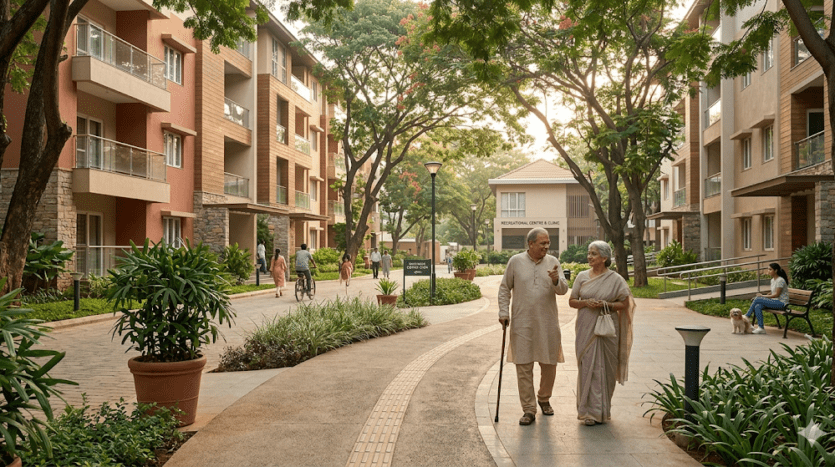
Many Gulf-based NRIs maintain aging parents in India. Securing a premium, well-managed apartment in a gated community with healthcare proximity rather than leaving parents in a family home that requires active management is an increasingly common motivation for property purchase in corridors like Sarjapur Road.
Why Bangalore, and Specifically Sarjapur Road
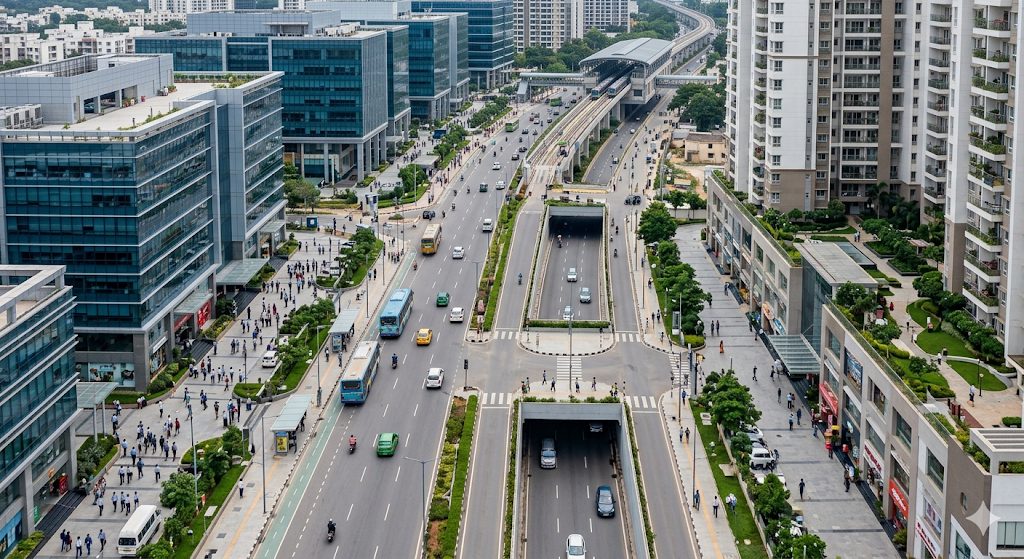
Among India’s tier-1 cities, Bangalore leads NRI real estate investment from the Gulf for reasons that go beyond sentiment. The city’s IT employment base, with the highest concentration of Global Capability Centres in India, creates a structural rental tenant pool that Dubai-based investors understand instinctively: the same companies employing colleagues in Gulf tech parks are headquartered in Bangalore’s ORR corridor.
For Gulf-based professionals evaluating NRI investment in India real estate, Bangalore consistently ranks first on employment density, school infrastructure, and appreciation track record.
Within Bangalore, Sarjapur Road has emerged as the premier destination for NRI capital in 2026 for three specific reasons:
Employment gravity
The corridor sits at the intersection of three major IT employment zones of Wipro’s corporate campus at Sompura Gate, the ORR tech belt (RMZ Ecoworld, Ecospace, Embassy Tech Village), and Electronic City via Dommasandra. Multi-employer demand means rental occupancy doesn’t depend on a single company’s hiring decisions.
School ecosystem
Oakridge International, Indus International, Greenwood High, TISB, and NPS East together create one of the densest international school concentrations in India. For Gulf NRI families planning eventual return, the ability to transition children into IB, IGCSE, or CBSE programmes without compromising on school quality is a meaningful pull factor.
Appreciation trajectory
Per Anarock data, Sarjapur Road property values rose from approximately ₹6,050 per sq ft at the end of 2021 to approximately ₹9,850 per sq ft by late 2024, accounting for a 63% appreciation over three years. In AED terms, adjusted for rupee depreciation, the net appreciation for a Gulf buyer remains materially positive, and the infrastructure pipeline (Metro Phase 3A, PRR, SWIFT City) suggests the next appreciation cycle is still ahead.
The Sarjapur Road Investment Case: Yield, Appreciation, and Infrastructure
For Gulf NRIs evaluating luxury apartments in Sarjapur Road as an investment, the numbers tell a coherent story.
Rental yield by sub-zone:
| Sub-Zone | Avg. Price (₹/sq ft) | Gross Yield | Primary Tenant |
| Carmelaram–Bellandur | ₹12,000–₹16,000 | 4.5–5.5% | Senior IT executives |
| Kasavanahalli | ₹9,500–₹14,500 | 3.8–4.5% | Double-income families |
| Sompura Gate | ₹6,500–₹11,000 | 3.0–3.8% | Tech professionals; school proximity |
At current exchange rates, a ₹1.5 crore apartment at Sompura Gate generating ₹50,000 per month in rent delivers approximately AED 1,920 per month: a passive income stream in a currency anchored to the dollar, from an asset that has appreciated over 60% in the past three years.
The infrastructure pipeline
Metro Phase 3A (Hebbal–Sarjapur Red Line, 28 stations, projected operational 2031–2033), the Peripheral Ring Road Phase 1 (tendering began 2026), and the 1,000-acre KIADB SWIFT City development represent confirmed catalysts that will continue driving appreciation in the corridor, with the historical Bangalore pattern of 15–25% appreciation in the 18–24 months before a metro line commissions still ahead for Sarjapur Road.
The Ready-to-Move Imperative: Why Remote Buyers Should Avoid Under-Construction
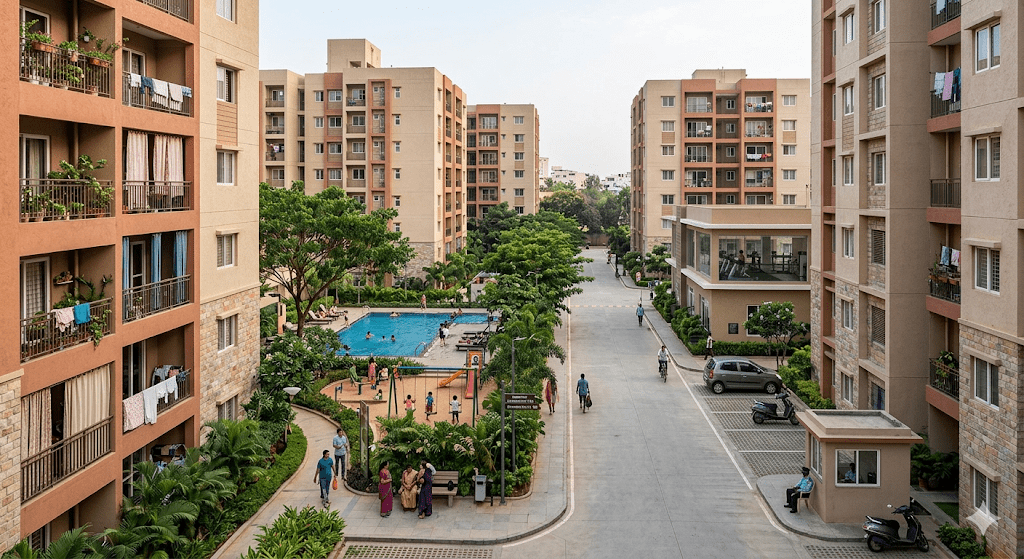
For Gulf-based NRIs specifically, the under-construction vs. ready-to-move decision is not a matter of preference but a risk management question. It is also increasingly the defining factor in how serious NRI real estate buyers from the GCC approach the Sarjapur Road market.
The remote execution problem:
Under-construction projects require active monitoring with site visits, construction progress verification, and quality checks at key stages. A buyer in Dubai cannot do this easily. The developer’s construction updates are not an independent audit. And if possession is delayed by 12–18 months, something that’s not uncommon in Bangalore’s high-activity development corridor — the carrying cost of an untenanted asset adds up materially.
The furnishing problem:
Most under-construction apartments are handed over as warm shells: with flooring, painting, sanitary fittings, and countertops fitted in. However, the rest now becomes a second project for NRI buyers: coordinating interior design, procurement, and installation from abroad. This typically adds ₹8–15 lakh in costs and 3–6 months of coordination before the apartment is tenantable.
The ready-to-move advantage:
A ready-to-move, RERA-cleared apartment allows the buyer to verify what they’re actually getting before any money changes hands beyond booking. OC is obtained. The structure is complete. For furnished or semi-furnished options, rental income begins immediately, eliminating the empty-property holding cost that compounds across delayed under-construction timelines.
The Legal Framework: What Gulf NRIs Need to Know
NRI real estate transactions in India are governed by a clear regulatory framework under FEMA and RBI guidelines. Here is what Gulf NRIs need to know before proceeding.
Eligibility: NRIs, OCIs, and PIOs can purchase residential and commercial property in India freely under FEMA. Agricultural land, farmhouses, and plantations are prohibited.
Fund routing: All payments must flow through NRE, NRO, or FCNR accounts. Direct transfers from overseas accounts to developers are not FEMA-compliant and compromise repatriation rights at exit.
Remote execution: A transaction-specific Power of Attorney, attested at the Indian Embassy or Consulate in the UAE (or relevant GCC country) and adjudicated at the Indian Sub-Registrar’s office, allows complete remote execution.
Repatriation: Sale proceeds from properties purchased with NRE/FCNR funds are fully repatriable. Properties purchased through NRO funds are repatriable up to USD 1 million per financial year after applicable taxes.
Tax: Rental income is subject to Indian income tax with a standard 30% deduction for maintenance. TDS of 31.2% is deducted by tenants on NRI landlord income. LTCG on sale is 12.5% flat for properties held over 24 months. The India-UAE DTAA provides relief against double taxation.
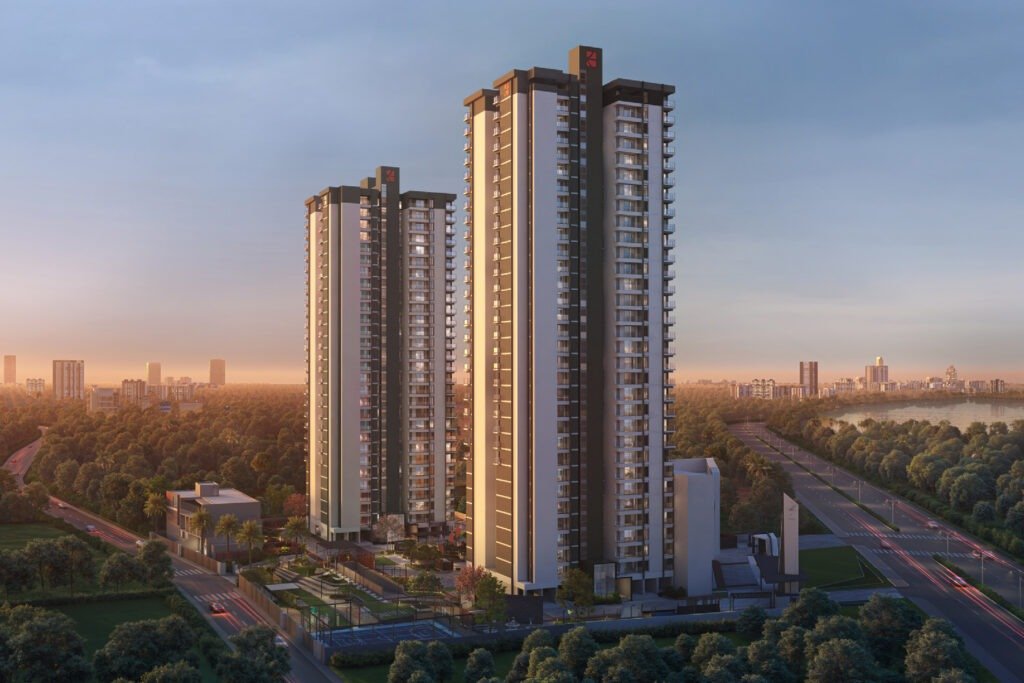
Suyug is fully RERA registered and provides complete legal support for NRI buyers — from POA setup and title verification to banking compliance and post-purchase management. Contact Suyug’s NRI advisory team to explore Saffron, Sarjapur Road.
One Thing Worth Sitting With
The Gulf NRI’s case for Sarjapur Road is not built on sentiment. It is built on a currency advantage that compounds quietly every year, a rental market that is structurally anchored to one of India’s most durable employment ecosystems, and an infrastructure pipeline that hasn’t yet fully delivered the appreciation it will generate.
For NRI investment in India real estate from the Gulf, the combination of luxury apartments in Sarjapur Road with verified RERA compliance, low density, and confirmed infrastructure tailwinds is the clearest expression of that thesis in 2026. The buyers who act on it are entering before the premium is fully priced in.
FAQ’s :
The UAE Dirham is pegged to the US Dollar, while the Indian Rupee depreciates approximately 3–5% annually against the dollar. This means Indian property effectively becomes cheaper in AED terms each year, increasing Gulf NRI purchasing power relative to domestic Indian buyers. A premium Sarjapur Road apartment that appreciated significantly in rupee terms may show a more modest rise in dirham terms, giving Gulf buyers a structural entry advantage that compounds over time.
Yes, via a transaction-specific Power of Attorney attested at the Indian Embassy or Consulate in the UAE (or relevant GCC country) and adjudicated at the Indian Sub-Registrar’s office. The POA holder executes registration on your behalf. Suyug’s NRI advisory team manages the full process remotely: title verification, RERA compliance, banking setup, and post-possession management.
Tenants are required to deduct TDS at 31.2% on rental payments to NRI landlords. A standard 30% deduction is available on gross rent for maintenance and repairs before computing taxable income.
Under-construction projects require active construction monitoring, which is impractical from abroad, and typically require 3–6 months and ₹8–15 lakh in remote interior coordination before the property is tenantable. Ready-to-move assets allow verification before purchase, eliminate delivery risk, provide immediate rental income, and remove the empty-property holding cost that compounds during delayed under-construction timelines.
Properties purchased with NRE or FCNR funds: sale proceeds fully repatriable after applicable Indian taxes. Properties purchased through NRO funds: repatriation capped at USD 1 million per financial year post-tax. Repatriation is processed through your NRE or NRO account via normal banking channels, and no special RBI approval is needed for residential property transactions within these limits.
The corridor combines employment diversity (Wipro’s campus, the ORR tech belt, and Electronic City), creating rental demand independent of any single employer; one of Bangalore’s densest international school ecosystems for returning families; 63% appreciation between 2021 and 2024; and confirmed infrastructure catalysts (Metro Phase 3A, PRR, SWIFT City) that haven’t yet fully priced into mid-corridor entry points. For a Gulf NRI with a 5–7 year horizon, the combination of current yield and forward appreciation makes it Bangalore’s most coherent address for NRI investment in India real estate.