Features That Define Premium Apartments in Bangalore Today
The Bangalore residential market in 2026 has shifted structurally. Properties priced above INR 1 crore now account for 71% of total home sales across the city, up from 59% the previous year per JLL data. Sales of homes below INR 1 crore contracted by 24% in the same period. The buyer already in the premium segment is looking harder at what they are actually getting for the price.
The word premium has been applied so broadly in Bangalore’s developer marketing that it has nearly lost meaning. This guide works through the eight features that distinguish a genuinely premium apartment in Bangalore from a mid-market project with an upgraded bathroom fitting. Each has a structural basis and a financial consequence.
TL;DR
- Premium apartments in Bangalore are defined by low unit density, high carpet efficiency, construction methodology, biophilic design, water security, smart infrastructure, sound control, and security systems and not by the amenity list
- Low unit density under 50 units per acre is the structural prerequisite for everything else: privacy, amenity quality, noise insulation, and resale premium
- MIVAN monolithic construction, no shared walls, and carpet efficiency above 70 percent are the three most verifiable quality indicators
- Sarjapur Road’s mid-segment projects deliver luxury apartments in Bangalore specifications at premium pricing, with 86% capital appreciation between 2020 and 2024
- RERA verification, construction methodology confirmation, and water infrastructure audit are the three non-negotiable checks before booking
Low Unit Density and Spatial Privacy
Every other premium feature depends on this one. A project can offer a 30,000 sq ft clubhouse, imported marble flooring, and a rooftop infinity pool. If it runs 120 units per acre, the clubhouse is crowded, the corridors are noisy, and the parking is contested. Density is the structural variable that determines whether every other feature actually delivers.
Premium projects in Bangalore’s 2026 market target under 50 to 60 units per acre. Genuine luxury sits below 40. The difference manifests in noise insulation, lift wait times, common area maintenance quality, and the demographic profile of the resident community. For investors, lower density creates a more stable tenant pool and generates a consistent resale premium.
High Carpet Area Efficiency
Super built-up area is a developer metric. Carpet area is a living metric. Premium projects deliver carpet efficiencies of 68 to 72% of super built-up area. Projects targeting genuine luxury aim for 72 to 78%. On a 2,000 sq ft super built-up apartment the difference is 80 to 120 sq ft of actual usable space.
The RERA-registered carpet area for any project is verifiable on rera.karnataka.gov.in and should always be the basis for cross-project price comparisons. A project with a lower super built-up price but poor carpet efficiency can cost more in usable space terms than a higher-priced project with better efficiency.
Construction Methodology and Structural Quality
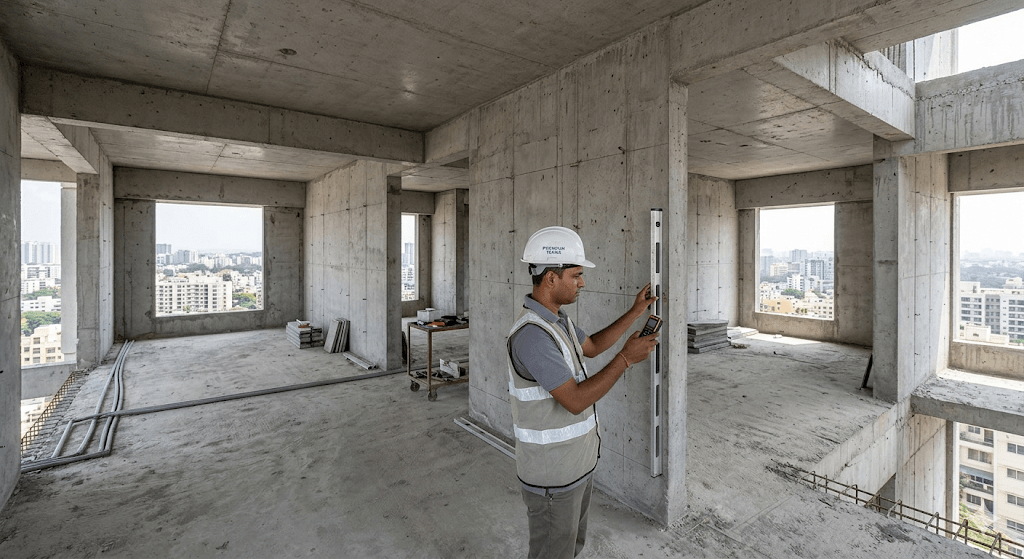
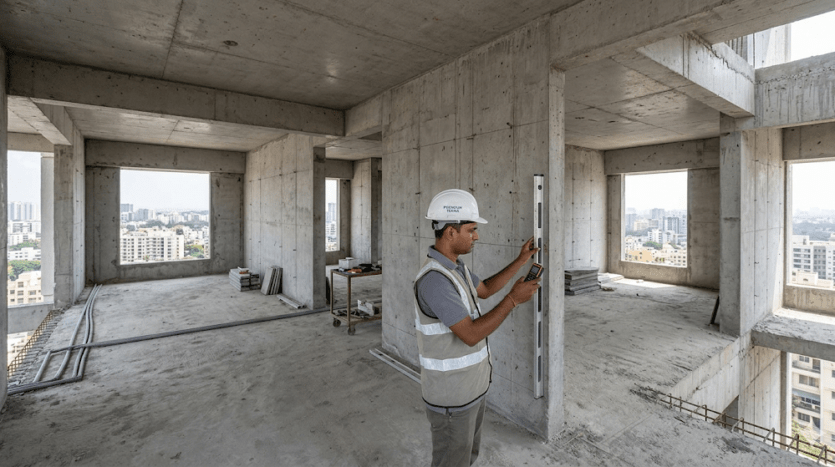
The finish quality applied over a structure matters far less than the structure beneath it. MIVAN aluminium formwork pours walls, slabs, and columns in a single continuous monolithic operation, eliminating the joints and interfaces where conventional brick and mortar creates long-term vulnerabilities: seepage paths, crack propagation zones, and differential settlement points.
The column-free flat-slab variant used in luxury projects adds structural flexibility, allowing interior walls to be repositioned and enabling genuine bare-shell customisation.
No shared walls between adjacent units is the third construction feature worth verifying explicitly. When each apartment is a standalone structural cell, noise transmission between neighbouring units is dramatically reduced and privacy in daily living is materially higher.
Biophilic Design and Micro-Climate Landscaping
Biophilic design in premium apartments in Bangalore is not a landscaping aesthetic. It is a design philosophy that structures the relationship between indoor living and the outdoor environment with functional outcomes: temperature regulation, air quality improvement, and long-term maintenance cost reduction.
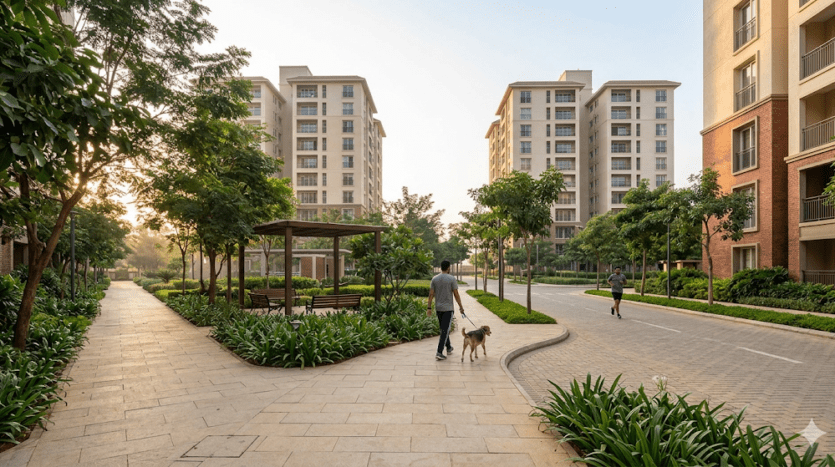
At the project level this means native species landscaping requiring significantly less irrigation, green buffer zones between buildings that reduce ambient surface temperature, and shaded walkways that make common areas genuinely usable across Bangalore’s weather conditions.
At the unit level it means cross-ventilation designed into the floor plan, minimum two balconies per unit, and building orientation that maximises natural light. These specifications are verifiable in the RERA-filed approved building layout rather than taken from marketing materials.
Multi-Generational Layout and WFH Design
The post-pandemic shift toward hybrid work has permanently changed what a premium apartment needs to deliver. A dedicated workspace acoustically separated from living areas, high-bandwidth connectivity infrastructure throughout the unit, and accessibility features for senior family members are now structural requirements rather than optional upgrades.
Layouts that deliver on these needs simultaneously, without compromising any individual space, require planning at the structural design stage. This is the distinguishing marker between a premium apartment in Bangalore designed for 2026 living and one designed for 2010 living with upgraded finishes.
Water Security and Rainwater Management
Water security in Bangalore is a financial variable, not a sustainability talking point. Peripheral sub-zones along Sarjapur Road, Dommasandra, and Attibele remain partially dependent on private water tankers despite Cauvery Stage 5 commissioning because last-mile distribution infrastructure is incomplete.
A premium project should carry a BWSSB feasibility certificate confirming grid connectivity, an operational rainwater harvesting system covering at least 30 percent of catchment area, and an STP capable of recycling at least 60% of wastewater. Each is verifiable independently. Tanker dependency in peripheral sub-zones adds INR 2,500 to 4,000 per month in costs with 8 to 12% annual price inflation.
Smart Home Infrastructure and EV Readiness
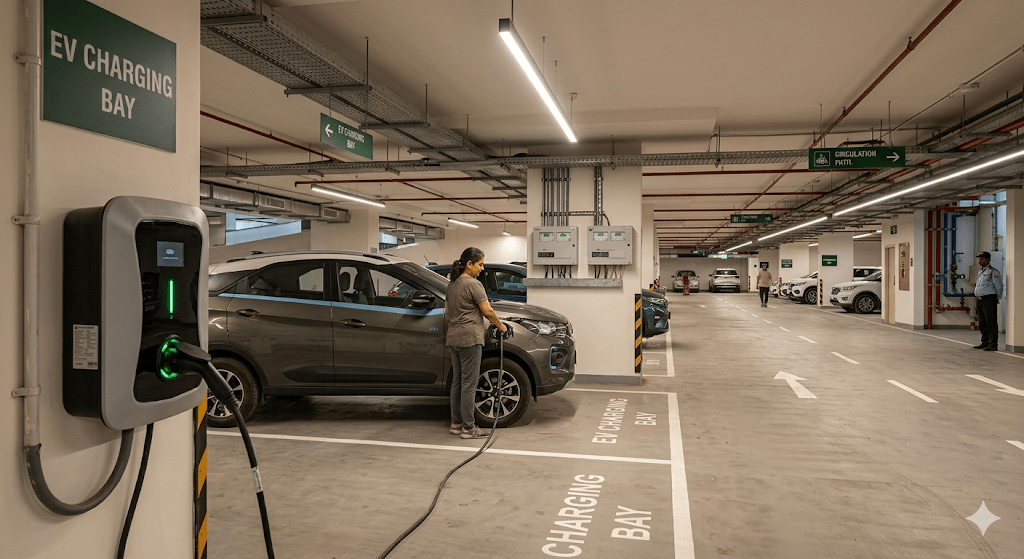
Premium apartments now integrate smart home automation as infrastructure: unified app-based control of lighting, climate, security, and visitor management; smart electricity metering by zone; and solar-ready electrical infrastructure already cabled for future photovoltaic installation.
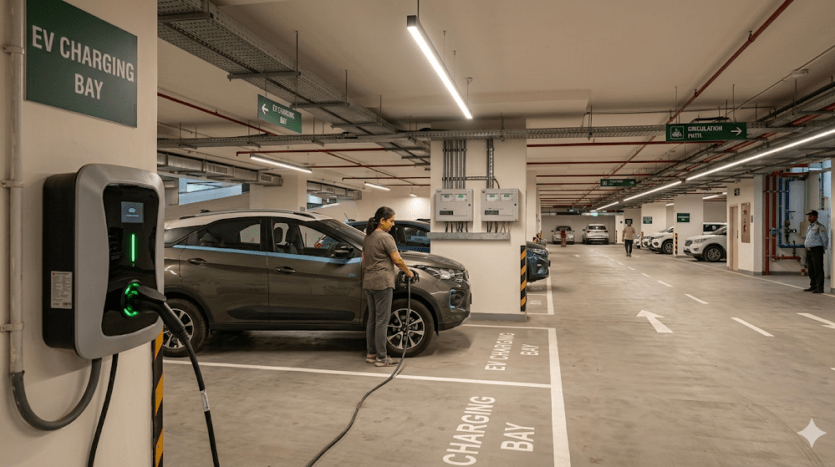
EV charging readiness is the feature most buyers currently underweight. The shift toward electric vehicles among Bangalore’s IT professional demographic is accelerating faster than most residential projects anticipated. A building not pre-wired for EV charging requires significant retrofitting costs and association approval complexity. Verifying dedicated EV charging points per parking bay is a straightforward step with long-term convenience and resale consequences.
Sound Control and Security Systems
Sound control operates at two levels. No shared walls handles horizontal noise transmission between units. The vertical dimension requires acoustic slab insulation between floors, insulated plumbing channels preventing water flow noise through walls, and double-glazed windows reducing external ambient noise.
These specifications appear in the structural drawings and material specification document rather than the marketing brochure. Buyers should request the specification sheet and look for acoustic slab treatment, plumbing insulation method, and window glazing grade explicitly.
Security systems have moved beyond CCTV to biometric and RFID-based access control, digital visitor management with time-limited access codes, AI-assisted perimeter surveillance, and panic response integration with on-site security teams.
What This Means for Sarjapur Road
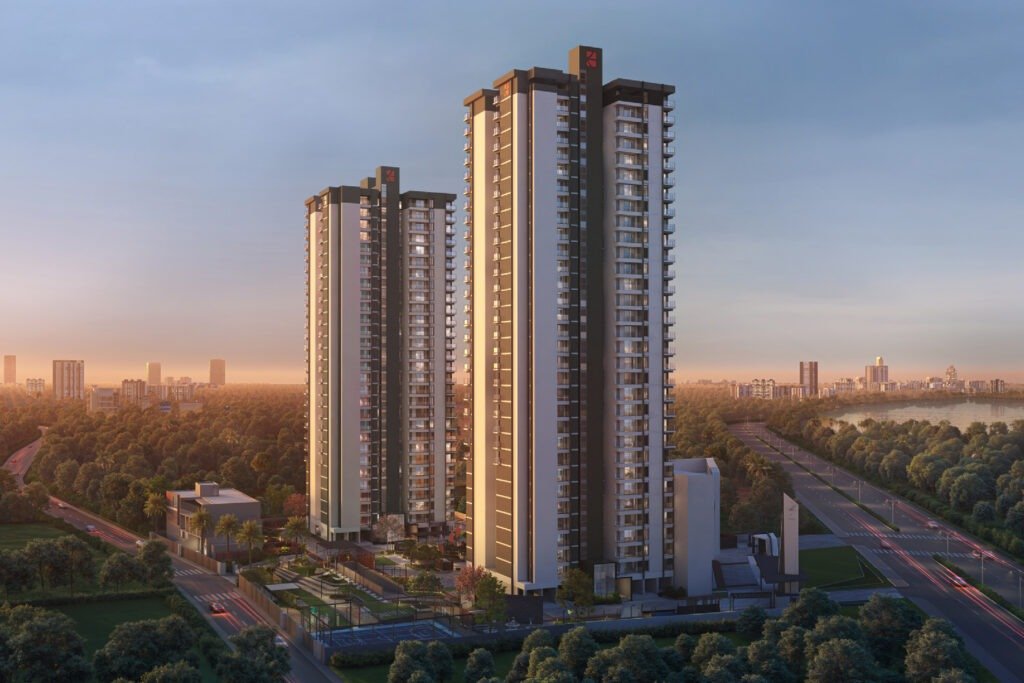
The eight features above converge most coherently in Bangalore’s current market at Sarjapur Road’s mid-corridor entry points. MIVAN-constructed, no-shared-wall, IGBC-certified, sub-70-units-per-acre projects at INR 1.5 to 2.5 crore are delivering specifications that in most other Bangalore corridors would require INR 3 to 5 crore budgets.
Property values along the Sarjapur corridor appreciated 86 percent between 2020 and 2024, rising from approximately INR 5,000 to INR 9,300 per sq ft. Metro Phase 3A, the Peripheral Ring Road, and SWIFT City are confirmed catalysts not yet fully priced into mid-corridor entry points.
Suyug’s projects at Sompura Gate, The1 (235 units, RERA: PRM/KA/RERA/1251/310/PR/051224/007268) and Saffron (110 units, RERA: PRM/KA/RERA/1251/308/PR/140825/008000), deliver IGBC Silver pre-certification, MIVAN construction, no shared walls, tower-level RERA registration, operational rainwater harvesting, solar power integration at Saffron, and EV charging at entry from INR 1.5 crore.
Book a virtual site visit with Suyug’s team to review floor plans, specification sheets, and RERA documentation for The 1 and Saffron at Sompura Gate.
One Thing Worth Sitting With
The features that define a genuinely premium apartment in Bangalore in 2026 are not visible in a brochure render. They are embedded in the construction specification, the RERA-filed floor plan, the density calculation, and the water infrastructure certificate. Buyers who verify these before booking find that the premium they paid was real. Buyers who accept marketing language at face value often discover the gap after possession.
FAQ’s :
Low unit density expressed as units per acre is the foundational metric. It determines whether every other premium feature actually delivers in daily living. Verify this from the RERA-filed site plan rather than the developer’s marketing materials, which typically present density in ways that make it appear lower than it is.
The RERA-registered carpet area for any project is publicly verifiable on rera.karnataka.gov.in. Divide the RERA carpet area by the super built-up area the developer quotes to calculate the efficiency percentage. Premium projects should sit above 68%. Never compare projects using super built-up area alone.
Cauvery Stage 5 has been commissioned but last-mile distribution networks across several peripheral Sarjapur sub-zones remain incomplete. Buyers should request the BWSSB feasibility certificate, verify operational rainwater harvesting, and confirm the STP can recycle at least 60% of wastewater before booking.
Finish quality can be replaced. Construction methodology cannot. MIVAN monolithic construction eliminates the seepage paths and crack propagation zones that conventional brick and mortar creates at joints and interfaces. A MIVAN-built project with standard finishes will outperform a conventionally built project with imported marble over a 15 to 20 year holding period.
Unified app-based control of lighting, climate, and security; smart electricity metering; solar-ready electrical infrastructure already cabled for future PV installation; and dedicated EV charging points per parking bay. EV readiness is the feature most buyers currently underweight and will most regret not verifying.
When each apartment is a standalone structural cell with no wall shared with an adjacent unit, horizontal noise transmission between neighbouring units is dramatically reduced. This is a design decision made at the structural planning stage and cannot be retrofitted after construction, making it one of the most material quality-of-life differences between a premium and a standard apartment.