Apartments in Sarjapur Road: NRI Investment Guide 2026
Apartments in Sarjapur Road: NRI Investment Guide — Pricing, ROI, and What to Expect in 2026
For NRI investors evaluating NRI investment in India real estate from the US, Canada, UAE, or the UK, Sarjapur Road presents a case that is straightforward when the data is laid out clearly and complicated only when it isn’t. The corridor has delivered documented appreciation, structural rental demand, and a pipeline of confirmed infrastructure catalysts. What it requires from a remote investor is clarity on the numbers: what the asset actually costs in your currency, what it yields after the tenant’s TDS deduction, and what the forward appreciation looks like against the infrastructure timeline.
This guide covers all of it: current pricing across configurations and sub-zones, year-on-year appreciation from 2020 to 2026, rental yield with the actual numbers, the tenant profile that drives those yields, the infrastructure that will continue to drive pricing, how the corridor compares to its alternatives for NRI investors specifically, and what distinguishes a project worth buying from one that isn’t.
TL;DR
- Apartments in Sarjapur Road currently range from ₹6,500–₹16,000 per sq ft, depending on sub-zone and configuration — approximately USD 77–190 per sq ft at current exchange rates
- The corridor delivered 63% appreciation between end-2021 and late 2024, from approximately ₹6,050 to ₹9,850 per sq ft, per Anarock data
- Gross rental yields run 3.0–5.5% depending on sub-zone; net yields after TDS and maintenance are typically 2.5–4.5%
- Primary tenant pool is senior IT professionals employed at Wipro, RMZ Ecoworld, Embassy Tech Village, and Electronic City; low vacancy, high occupancy stability
- Metro Phase 3A (Hebbal–Sarjapur, ₹25,999 crore, projected 2031–2033) and the Peripheral Ring Road represent confirmed forward appreciation catalysts
- Luxury apartments in Sarjapur Road in IGBC-certified, low-density projects offer NRI buyers the combination of verified appreciation, professional management infrastructure, and RERA-backed legal security
Why Sarjapur Road Is Bangalore’s NRI Investment Hotspot
Among Bangalore’s established residential corridors, Sarjapur Road has the most coherent investment thesis for NRI buyers in 2026, and it rests on three factors that are independently verifiable rather than developer-claimed.
Employment gravity that doesn’t depend on a single company:
The corridor is anchored by three distinct IT employment zones: Wipro’s corporate campus at Sompura Gate, the ORR tech belt (RMZ Ecoworld, Ecospace, Embassy Tech Village, Cessna Business Park), and Electronic City via Dommasandra. Multi-employer demand means rental occupancy doesn’t fluctuate with a single company’s hiring cycle. For an NRI landlord managing a property remotely, this is the most important structural characteristic of any rental market.
Appreciation that is documented, not projected:
The 63% appreciation between end-2021 and late 2024: from approximately ₹6,050 to ₹9,850 per sq ft per Anarock, is a historical data point, not a forecast. For NRI investors evaluating NRI investment in India real estate against other asset classes, this sits alongside the PFIC-free tax treatment of physical property and the currency hedge provided by a rupee-denominated appreciating asset.
Infrastructure pipeline that hasn’t fully priced in:
Metro Phase 3A, the Peripheral Ring Road Phase 1, and the SWIFT City development are confirmed catalysts whose appreciation impact has historically materialized 18–24 months before commissioning. For buyers entering in 2026, the appreciation from these catalysts is still ahead of the current price.
Current Price Per Sq Ft: 2 BHK, 3 BHK, and 4 BHK Configurations
Pricing on Sarjapur Road is not uniform across the 21-kilometre corridor. Sub-zone, configuration, and project quality each drive meaningful price differences.
Sub-zone price matrix (2026):
| Sub-Zone | Avg. Price (₹/sq ft) | Approx. USD/sq ft | Approx. AED/sq ft | Key Driver |
| Carmelaram–Bellandur | ₹12,000–₹16,000 | USD 141–188 | AED 520–690 | ORR proximity; highest yield |
| Varthur–Sarjapur Main | ₹10,000–₹14,000 | USD 118–165 | AED 432–605 | High density; established schools |
| Kasavanahalli | ₹9,500–₹14,500 | USD 112–171 | AED 411–628 | Hospitals; premium demand |
| Gunjur Corridor | ₹8,850–₹12,500 | USD 104–147 | AED 383–541 | Whitefield spillover demand |
| Sompura Gate | ₹6,500–₹11,000 | USD 77–130 | AED 282–476 | Mid-corridor; longest runway |
| Dommasandra–Attibele | ₹6,500–₹9,500 | USD 77–112 | AED 282–411 | Growth frontier; entry pricing |
Configuration-specific pricing at Sompura Gate (Suyug projects):
- 3 BHK (1,601–1,939 sq ft) at The 1: from ₹1.5 crore
- 4 BHK (3,122–3,573 sq ft) at The 1: from ₹2.5 crore
- 3 BHK (1,896–2,612 sq ft) at Saffron: from ₹1.5 crore
For NRI investors, expressing these prices in USD and AED is more useful than in rupee terms alone. At current rates, a ₹1.5 crore apartment translates to approximately USD 176,000 or AED 647,000: a premium Bangalore address at a fraction of equivalent quality in Mumbai or Delhi-NCR.
Year-on-Year Price Appreciation: 2020–2026
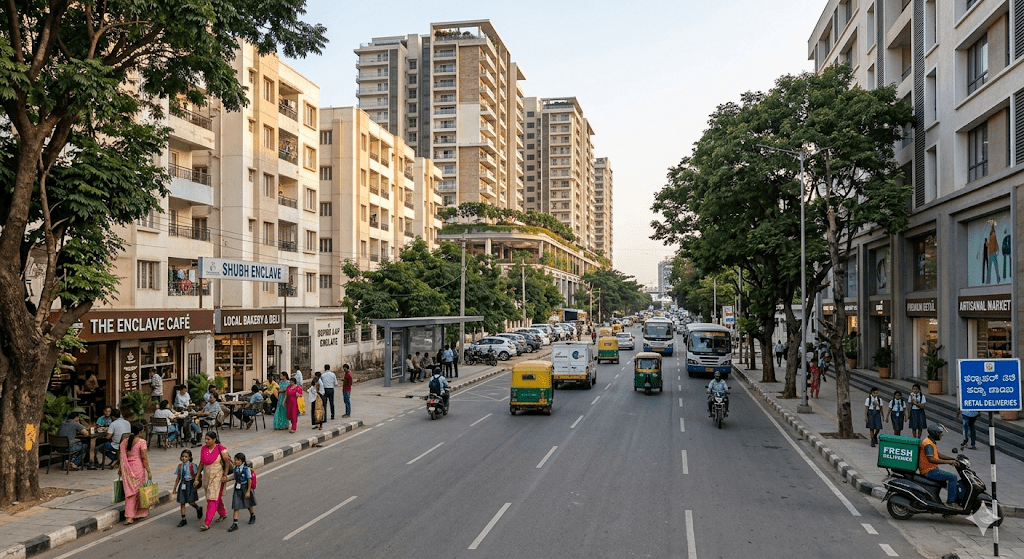
The appreciation story on Sarjapur Road is best understood in context: the corridor was significantly underpriced relative to its employment gravity in 2020, which explains the compression of appreciation into a short window.
Appreciation timeline:
| Year | Avg. Price (₹/sq ft) | YoY Change | Notes |
| 2020 | ₹5,500 | — | Pre-COVID baseline; corridor underpenetrated |
| 2021 | ₹6,050 | +10% | Post-COVID recovery; IT hiring surge begins |
| 2022 | ₹7,200 | +19% | ORR office leasing absorption hits peak |
| 2023 | ₹8,500 | +18% | Premium project launches compress supply |
| 2024 | ₹9,850 | +16% | Infrastructure announcement premium begins |
| 2026 (mid) | ₹10,800–₹12,000 | +10–22% | Metro Phase 3A approval premium building |
The NRI return calculation:
An NRI investor who purchased at ₹5,500 per sq ft in 2020 and holds a 1,601 sq ft apartment at The 1 today holds an asset that has appreciated from approximately ₹88 lakh to approximately ₹1.73–1.92 crore at current corridor pricing — a nominal INR gain of approximately ₹85 lakh–₹1.04 crore. After accounting for 4% annual rupee depreciation against the USD over 6 years (approximately 24% total currency drag), the net USD-denominated gain remains substantially positive.
Rental Yield: Actual Numbers from the Market
Rental yield on Sarjapur Road is often quoted at 6–9% in developer marketing material. The actual gross yield at the market level is more conservative, and the distinction matters significantly for NRI investors who plan to declare rental income on Schedule E (IRS Form 1040) or equivalent CRA filing.
Gross rental yield by sub-zone:
| Sub-Zone | Gross Yield Range | Typical Monthly Rent (3 BHK) | Notes |
| Carmelaram–Bellandur | 4.5–5.5% | ₹55,000–₹80,000 | Highest yield; ORR proximity |
| Kasavanahalli | 3.8–4.5% | ₹45,000–₹65,000 | Strong school and hospital proximity |
| Sompura Gate | 3.0–3.8% | ₹35,000–₹55,000 | Mid-corridor; yield improving with infra |
The net yield reality for NRI landlords:
Gross yield does not reflect what an NRI landlord actually receives. The deductions to account for:
- TDS deducted by tenant: 31.2% on gross rent; recoverable via Indian ITR filing, but creates a cash flow lag
- Professional property management fee: 8–10% of monthly rent
- Society maintenance charges: Typically ₹4–8 per sq ft per month
- Vacancy provision: Conservative underwriting assumes 1–2 months vacancy per year
After these deductions, net yield for an NRI landlord on a Sompura Gate apartment typically runs 2.0–2.8% on gross rent — lower than the headline but still positive cash flow on a leveraged asset with 10–15% annual appreciation potential.
Tenant Profile: Who Rents on Sarjapur Road and Why It Matters
For a remote NRI landlord, the quality and stability of the tenant pool is as important as the yield figure. Sarjapur Road’s tenant base has specific characteristics that reduce management friction compared to other Bangalore corridors.
The primary tenant pool:
- Senior IT professionals (L4–L7 levels) at Wipro, IBM, Accenture, and ORR-based tech parks, typically earning ₹25–80 lakh annually, paying rent on time, and staying 2–4 years per tenancy
- Expatriate professionals and international assignees at Global Capability Centres who prefer premium gated community living with managed facilities
- Double-income tech families who prioritise school proximity (Oakridge, Greenwood High, TISB, Indus International) and hospital access (Narayana Health, Columbia Asia)
Why this matters for NRI landlords specifically:
High-income tech tenants in gated premium communities have lower default rates, lower maintenance damage, longer average tenancy duration, and higher tolerance for annual rent escalation (typically 5–8% per annum). For a property managed remotely through a professional agency, this tenant profile minimises the intervention frequency that would otherwise require the owner’s attention.
Corporate leasing demand:
Several MNCs with significant Sarjapur Road presence maintain bulk corporate lease arrangements for senior employees. Corporate leases typically offer 10–15% higher rent, guaranteed on-time payment, zero vacancy risk during the lease term, and professional handover at exit. Premium IGBC-certified projects in the corridor attract more corporate lease enquiries than standard developments.
Upcoming Infrastructure: PRR, Metro Extension, and SWIFT City
The infrastructure pipeline is the most consequential forward-looking variable for Sarjapur Road appreciation. Three confirmed catalysts are at different stages of execution in 2026.
Metro Phase 3A — Hebbal to Sarjapur (Red Line):
- 37 km, 27 stations,₹25,999 crore approved budget
- Projected operational: 2030–2031
- Historically, Bangalore corridors have delivered 15–25% appreciation in the 18–24 months before a metro line commissions
- Sarjapur Road currently has no metro access; the Phase 3A announcement premium is being built into prices, but the full operational premium is still ahead
Peripheral Ring Road (PRR) Phase 1:
- 73 km outer ring connecting Tumkur Road to Hosur Road via Sarjapur Road
- Tendering began in 2026; construction timeline 3–5 years
- Directly connects Sarjapur Road to the airport corridor and Hebbal, significantly reducing commute friction for the ORR tech belt
KIADB SWIFT City:
- 1,000-acre startup and innovation complex adjacent to Sarjapur Road
- Projected to add approximately 1 lakh direct jobs within the catchment area
- New employment cluster, independent of the existing ORR tech belt, diversifies the rental tenant base further
How Sarjapur Road Compares: Whitefield, Hebbal, and HSR Layout
For NRI investors comparing corridors specifically on investment criteria — yield, appreciation runway, management friction, and legal complexity — the comparison looks different from a lifestyle-only evaluation.
| Investment Criterion | Sarjapur Road | Whitefield | Hebbal | HSR Layout |
| Current avg. price (₹/sq ft) | ₹6,500–₹16,000 | ₹8,500–₹18,000 | ₹9,000–₹16,000 | ₹12,000–₹18,000 |
| Gross rental yield | 3.0–5.5% | 3.5–5.0% | 2.5–4.0% | 3.0–4.5% |
| Appreciation runway (2026) | High — infra not yet priced | Moderate — mature corridor | Moderate — airport premium built in | Low — fully priced |
| Metro access (current) | None (Phase 3A ahead) | Purple Line operational | Nil (upcoming multi-modal transit junction) | Yellow Line (nearest) |
| Employment diversity | High (3 zones) | High (IT corridor) | Moderate (airport + ORR) | Low (HSR-specific) |
| NRI management friction | Low (premium gated stock) | Low to moderate | Low | Moderate |
| Entry price for NRI (3 BHK) | ₹1.5–2.5 crore | ₹1.8–3.5 crore | ₹2.0–3.5 crore | ₹2.5–4.0 crore |
The NRI investment conclusion from this comparison:
Sarjapur Road offers the most attractive combination of entry price, appreciation runway, and employment-backed yield stability among these four corridors for a buyer entering in 2026. Whitefield is more mature and less mispriced. Hebbal carries an airport adjacency premium that limits forward appreciation. HSR Layout is effectively fully priced for the infrastructure it already has.
What NRIs Specifically Look for in Sarjapur Road Projects
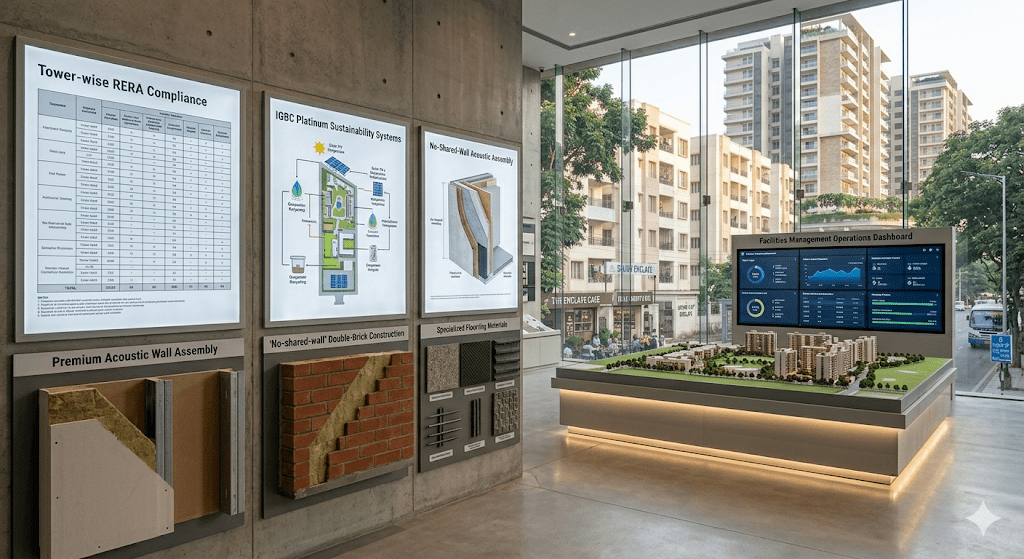
The criteria that drive NRI project selection on Sarjapur Road differ meaningfully from resident buyer criteria. Understanding these differences helps clarify why certain project types outperform on NRI demand.
RERA compliance — tower-wise, not project-level:
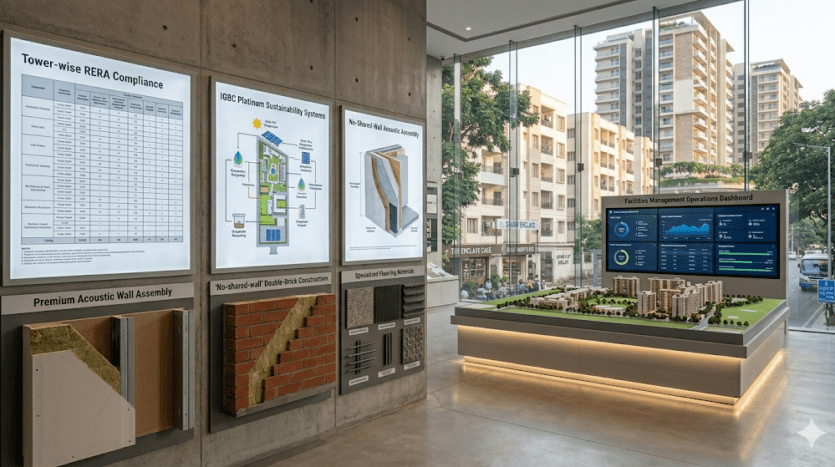
NRI buyers who cannot monitor construction in person place the highest weight on statutory protection. Tower-wise RERA registration, verifiable on K-RERA, is the first filter. Projects where individual towers have their own registration numbers, completion dates, and complaint records provide materially stronger protection than project-level registration alone.
Low density — units per acre matters:
High-density projects (80+ units per acre) create management complexity: crowded common areas, higher maintenance costs, and slower appreciation relative to low-density developments. NRI buyers increasingly filter for projects under 50 units per acre — a threshold that Suyug Saffron (approximately 44 units per acre) particularly meets.
Green certification — IGBC as a proxy for quality:
IGBC Silver pre-certification, which both Suyug projects hold, signals energy-efficient systems, water conservation, and sustainable construction, all of which reduce long-term maintenance costs and improve tenant quality. NRI buyers from the US and Canada, who are accustomed to green building standards, treat IGBC certification as a quality proxy.
No shared walls:
For luxury apartments in Sarjapur Road, the no-shared-walls specification (meaning each apartment shares no structural wall with an adjacent unit) is a premium marker that commands rental premium and resale premium. Both Suyug projects offer this specification.
Professional on-site facilities management:
For remote landlords, the quality of the project’s own facilities management determines how much owner intervention is required. Premium gated communities with dedicated facilities teams, CCTV, 24/7 security, and structured maintenance protocols significantly reduce the ad-hoc intervention burden that lower-quality projects impose on absent owners.
Vastu compliance:
A meaningful proportion of NRI buyers, particularly from Gulf countries and from families with strong cultural ties, prioritise Vastu-compliant apartment orientation as a non-negotiable. Projects that can demonstrate Vastu compliance at the unit level, not just the project level, attract a specific high-intent buyer segment that faces less competition at resale.
Explore Suyug’s apartments in Sarjapur Road: The 1 and Saffron at Sompura Gate, built for NRI buyers who want documented quality, RERA-verified legal security, and returns that hold up in any currency.
One Thing Worth Sitting With
Apartments in Sarjapur Road in 2026 represent a specific combination that is genuinely rare in Indian real estate: a corridor with documented historical appreciation, structural multi-employer rental demand, confirmed forward infrastructure catalysts, and a supply of premium low-density projects that meet international quality standards. For NRI investment in India real estate, the question is not whether Sarjapur Road belongs in the shortlist; it clearly does. The question is which sub-zone and which project within it delivers the yield, appreciation runway, and remote management profile that matches a specific investor’s holding horizon and risk tolerance.
FAQ’s :
Pricing varies significantly by sub-zone: from ₹6,500–₹11,000 per sq ft at mid-corridor entry points like Sompura Gate to ₹12,000–₹16,000 per sq ft at established premium zones like Carmelaram and Bellandur. At current exchange rates, mid-corridor entry translates to approximately USD 77–130 per sq ft or AED 282–476 per sq ft, significantly more accessible than equivalent quality in Mumbai or Delhi-NCR.
Gross yield ranges from 3.0–5.5% depending on sub-zone and project quality. Net yield for NRI landlords after 31.2% tenant TDS, professional management fees (8–10%), maintenance charges, and a conservative vacancy provision typically runs 2.0–2.8%. This is a passive yield on an asset with 10–15% annual appreciation potential in the premium zones, which is a combination that most liquid asset alternatives for NRI investors cannot match.
Sarjapur Road offers a lower average entry price, a stronger appreciation runway (Metro Phase 3A not yet operational vs. Whitefield’s Purple Line already priced in), and comparable employment diversity. Whitefield is a more mature market with compressed appreciation headroom. For buyers with a 5–7 year horizon, Sarjapur Road’s infrastructure pipeline makes it the stronger forward-looking bet; for buyers prioritising immediate yield optimisation, the corridors are broadly comparable.
Three confirmed catalysts: Metro Phase 3A (Hebbal–Sarjapur Red Line, 37 km, ₹25,999 crore approved, projected 2030–2031), Peripheral Ring Road Phase 1 (73 km outer ring, tendering began 2026), and SWIFT City (1,000-acre KIADB startup complex, approximately 1 lakh projected jobs). Historically, Bangalore corridors deliver 15–25% appreciation in the 18–24 months before metro commissioning; that window is still ahead for Sarjapur Road.
The five non-negotiables for serious NRI buyers are: tower-wise RERA registration (verifiable on K-RERA), low project density (under 50–70 units per acre), green certification (IGBC or equivalent), no shared walls, and professional on-site facilities management. Vastu compliance at the unit level is an additional filter for a significant segment of NRI buyers. Projects that meet all five criteria command a consistent premium at both leasing and resale.
For NRI buyers who cannot physically monitor construction progress, ready-to-move assets eliminate delivery risk, allow verification before purchase, and generate immediate rental income. Under-construction projects typically offer 15–20% lower entry prices but require active construction monitoring and remote interior coordination (typically adding ₹8–15 lakh and 3–6 months before the unit is tenantable). The choice depends on the buyer’s risk tolerance and whether an immediate yield or a lower entry price is the priority.