

FEMA Rules for NRI Property Purchase in India: 2026
NRI Real Estate in India: What FEMA Actually Says Before You Buy
Most NRI property guides spend the first half reassuring buyers that the process is straightforward and the second half skimming the legal details that actually determine whether a transaction is compliant. The result is content that builds confidence without building understanding, which leaves buyers exposed at exactly the point where clarity matters most.
This guide takes the opposite approach. It covers what FEMA says, what the RBI permits without prior approval, which properties are absolutely off-limits, how payments must be routed, what repatriation looks like at exit, what RERA verification involves, and what documents you need before signing anything. This is the framework that protects NRI investment in India real estate, and it is worth understanding precisely before any project gets on your shortlist.
TL;DR
- NRIs, OCIs, and PIOs can buy residential and commercial property in India under general RBI permission, and require no prior approval for most transactions
- Agricultural land, farmhouses, and plantation properties are absolutely prohibited under FEMA, regardless of transaction structure
- All payments must flow through NRE, NRO, or FCNR accounts. Payments outside these channels compromise FEMA compliance and repatriation rights
- Repatriation of sale proceeds from NRE/FCNR-funded purchases is fully repatriable; NRO-funded purchases are capped at USD 1 million per financial year
- RERA verification must be done tower-wise, not just project-level: a critical distinction for buyers of multi-phase township projects
- The document checklist covers eight categories; missing any one can delay registration or create post-possession complications
What FEMA Says About NRI Property Purchase
The Foreign Exchange Management Act (FEMA) 1999 is the primary legislation governing cross-border capital flows in India, including the acquisition and disposal of immovable property by non-residents. For NRI property buyers, FEMA operates alongside RBI regulations and the Income Tax Act to define what can be purchased, how it can be financed, and how proceeds can eventually be taken out of India.
The core principle under FEMA:
NRIs are permitted to acquire immovable property in India on a non-repatriation basis, meaning the property can be held and used freely, and on a repatriation basis using NRE or FCNR funds, where sale proceeds can be taken back abroad. The distinction between these two modes of acquisition determines your exit flexibility and is set at the point of purchase, not at the point of sale.
Who FEMA covers:
- NRI (Non-Resident Indian): Indian citizen residing outside India for more than 182 days in a financial year
- OCI (Overseas Citizen of India): Foreign national of Indian origin registered under the OCI scheme — broadly equivalent rights to NRIs for property purchase
- PIO (Person of Indian Origin): The deadline to convert legacy PIO cards to OCI-read cards was on December 31, 2025. Legacy PIO cardholders have to apply afresh to claim property rights.
While foreign nationals of non-Indian origin generally cannot buy property in India, FEMA provides a specific joint-ownership exception for spouses. A foreign spouse of an NRI or OCI can jointly purchase one residential or commercial property without RBI approval, provided that:
- The marriage has been registered.
- The marriage has subsisted for a continuous period of at least two years immediately preceding the purchase.
- The funds are routed through compliant, non-resident banking channels (like NRE/NRO accounts)
Properties NRIs Can Buy
Under current FEMA and RBI guidelines, NRIs have broad freedom to acquire the following:
Residential property:
- Apartments, flats, and independent houses in any residential development
- Plotted residential developments where the layout has municipal approval
- No restriction on the number of residential properties owned
- No restriction on location within India
Commercial property:
- Office spaces, retail units, warehouses, and commercial complexes
- Industrial plots and factory premises, where permitted under local zoning
Key point on number of properties: There is no FEMA-imposed limit on how many properties an NRI can own in India. The repatriation rules, however, cap the number of properties from which proceeds can be repatriated in a single financial year (re: Section 6).
Properties NRIs Cannot Buy
Three categories are absolutely prohibited under FEMA, with no exceptions for NRIs, OCIs, or PIOs:
Agricultural land: Any land classified for agricultural use, including survey numbers carrying an agricultural land use designation, cannot be purchased. This prohibition applies regardless of whether the buyer intends to use it for agriculture. The restriction cannot be circumvented by purchasing through an Indian corporate entity in which the NRI holds shares.
Plantation property: Land used for plantation activities, such as tea, coffee, rubber, and similar, is prohibited.
Farmhouses: Residential structures built on agricultural land (commonly called farmhouses) cannot be purchased by NRIs even if the structure itself appears residential.
The only exception: Agricultural land, plantations, and farmhouses can be inherited by NRIs from resident Indian family members. Inherited property can be held, rented, or eventually sold, but cannot be transferred to another NRI by gift.
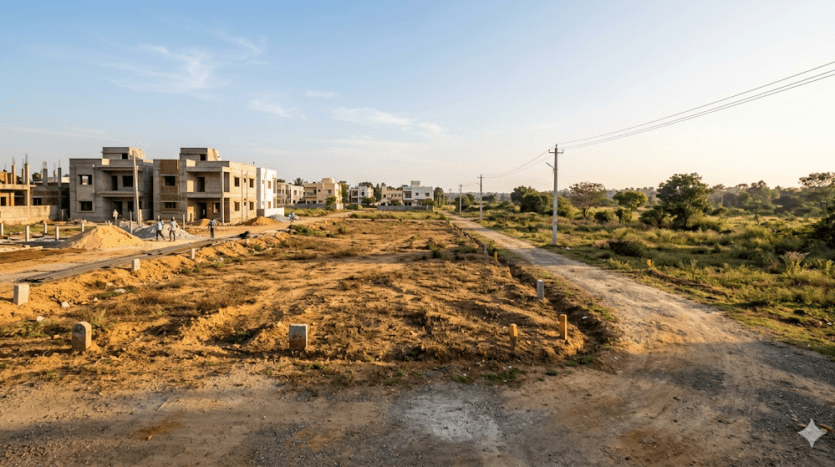
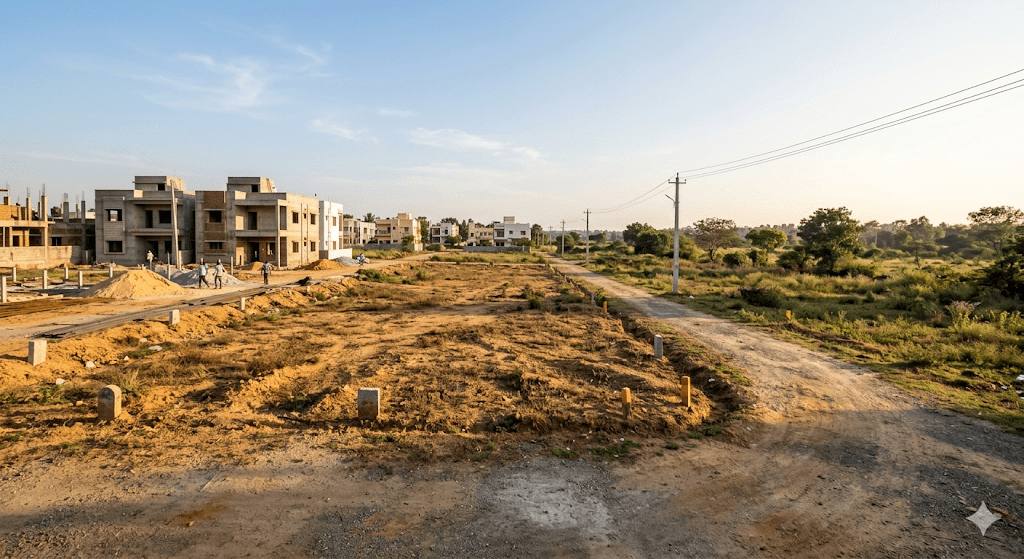
The Sarjapur Road implication: Several sub-zones along Sarjapur Road, particularly the eastern stretch near Dommasandra and Attibele, include land that was until recently classified as agricultural. Buyers must verify the DC Conversion Certificate (agricultural-to-residential conversion order) for their plot’s specific survey number before booking any project in these areas.
RBI’s General Permission: No Prior Approval Needed
One of the most common misconceptions among NRI real estate buyers is that purchasing property in India requires explicit RBI approval. For most residential and commercial transactions, this is not the case.
General permission covers:
Under the Foreign Exchange Management (Acquisition and Transfer of Immovable Property in India) Regulations, NRIs have automatic general permission to acquire residential and commercial property in India, provided the payment is made through approved banking channels (NRE, NRO, or FCNR accounts).
Specific RBI approval is required for:
- Purchase of agricultural land, plantations, or farmhouses (prohibited categories)
- Acquisition by foreign nationals of non-Indian origin
- Certain commercial acquisitions above specified thresholds
For standard residential apartment purchases in RERA-registered projects by NRIs, OCIs, or PIOs, which cover the overwhelming majority of transactions on Sarjapur Road, no prior RBI approval is needed.
Mode of Payment Rules

Payment compliance is where many NRI transactions create problems, not at the point of purchase, but at the point of exit, when repatriation rights are challenged because funds were not routed correctly.
Permitted payment channels:
- NRE (Non-Resident External) account: Remitted foreign earnings; fully repatriable; the preferred source for purchases where the buyer intends to repatriate proceeds
- NRO (Non-Resident Ordinary) account: Indian income (rent, dividends, domestic earnings); repatriation capped at USD 1 million per year post-tax
- FCNR (Foreign Currency Non-Resident) account: Foreign currency deposits; fully repatriable; useful for buyers who want to stage capital without premature INR conversion
- Foreign inward remittance: Direct wire transfer from an overseas bank account to an Indian bank account is permitted as a funding source
What is not permitted:
- Cash payments of any kind
- Payments from accounts held by third parties in India (even family members) without proper documentation
- Direct transfer from an overseas account to a developer’s account, bypassing the NRE/NRO structure
Maintaining clear documentation of the fund source, such as bank statements, remittance records, and NRE account transaction history, is essential for demonstrating FEMA-compliant payment at the time of sale and repatriation.
Repatriation Limits
Repatriation refers to the transfer of sale proceeds from India back to your country of residence. The rules differ based on how the original purchase was funded.
NRE or FCNR-funded purchase:
- Sale proceeds are fully and freely repatriable with no annual cap
- Applies to the amount originally remitted plus any capital gain, after paying applicable Indian taxes
- No limit on the number of properties owned, but free repatriation is restricted to two residential properties per financial year
NRO-funded purchase:
- Repatriation capped at USD 1 million per financial year, across all sources
- Requires a Chartered Accountant’s certificate (Form 15CA/15CB or equivalent under current rules) confirming taxes have been paid
The two-property rule: The Reserve Bank of India (RBI) limits the automatic, cap-free repatriation of property sale proceeds to a maximum of two residential properties per financial year. This restriction applies strictly to properties originally acquired via foreign forex inflows (NRE/FCNR accounts).
If you sell a third residential property within the same year, or wish to repatriate any extra real estate assets outside this scope, you must obtain prior explicit approval from the RBI through your Authorized Dealer bank. Conversely, commercial properties and inherited real estate are entirely exempt from this numerical property cap.
Practical implication: If you intend to repatriate proceeds at exit, fund the purchase through NRE or FCNR accounts and maintain documentation from day one. Repatriation rights are effectively set at the point of purchase, not negotiable retrospectively.
RERA — What NRIs Must Check Before Buying
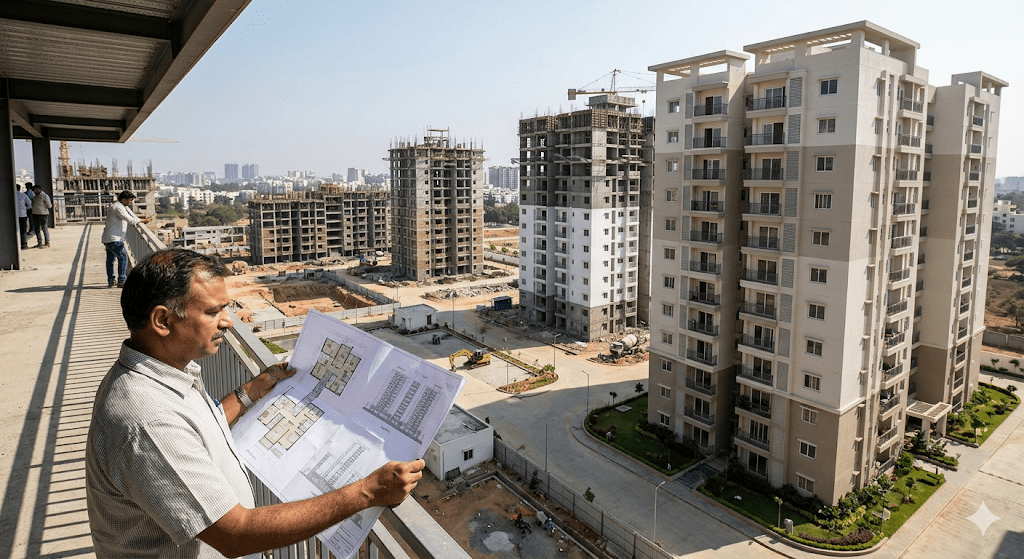
For NRI buyers who cannot physically monitor construction progress, RERA is the most important statutory protection available. It is also one of the most consistently under-utilised by buyers who accept a developer’s verbal RERA assurance without independent verification.
Tower-wise vs. project-level registration: This is the most consequential distinction for buyers in large township projects. A project-level RERA registration covers the overall development but may not cover individual towers or later phases separately. Buyers in an unregistered tower have materially weaker statutory protection. Always verify that your specific tower has its own RERA registration number on the state portal.
What to check on K-RERA (rera.karnataka.gov.in):
- Registered completion date: confirm it has not already lapsed
- Approved building plan: confirm floor count and configurations match what the developer is selling
- Buyer complaints section: unresolved complaints from existing unit holders about the same developer are a meaningful signal
- RERA carpet area for your unit type: must match what is quoted in the sale agreement
For NRI buyers: RERA provides equal statutory protections to NRI and resident Indian buyers. In the event of a delay in possession, the developer is liable for interest payments at the applicable rate, and this is enforceable through the state RERA authority, regardless of where the buyer resides.
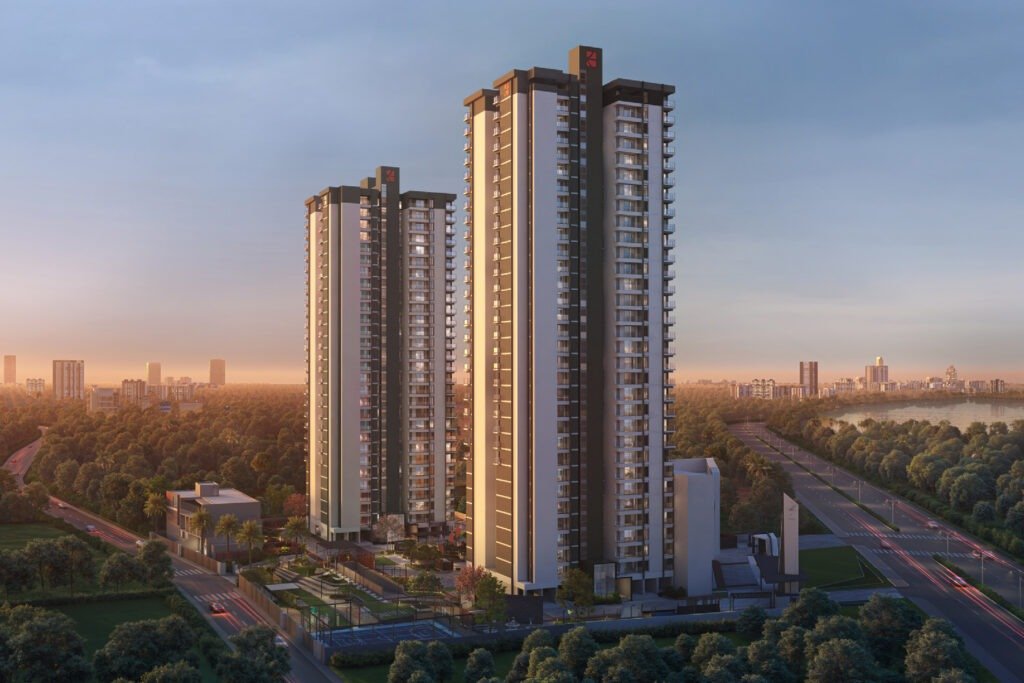
Suyug The 1 and Saffron are both RERA approved: The1 at PRM/KA/RERA/1251/310/PR/051224/007268 and Saffron at PRM/KA/RERA/1251/308/PR/140825/008000. Both can be independently verified on the K-RERA portal.
Required Documents: The NRI Buying Checklist

Documents the buyer must provide:
- Valid Indian passport (or OCI card for foreign nationals of Indian origin)
- PAN card: mandatory for property transactions in India; apply online through the Income Tax Department portal if you don’t have one
- Overseas address proof (utility bill, overseas driving licence, or bank statement)
- NRE/NRO account details and remittance documentation
- Power of Attorney that’s embassy-attested, and transaction-specific (if not present in India for registration)
Documents to obtain and verify from the developer:
- RERA registration certificate (tower-wise): verify independently on K-RERA
- Sanctioned building plan: confirm no deviations from what is being built
- DC Conversion Certificate: if the land was previously agricultural
- Mother Deed: establishes the unbroken ownership chain from the original title to the current developer
- Encumbrance Certificate: confirm no active mortgages or liens; obtain independently via Kaveri Online Services
- A-Khata certificate: confirms property is within BBMP/BDA jurisdiction and fully regularised
- OC (Occupancy Certificate): for ready-to-move units; verify with the issuing authority
Document checklist summary:
| Document | Source | Purpose |
| Passport / OCI card | Buyer | Identity and NRI status |
| PAN card | Buyer | Mandatory for transactions |
| Overseas address proof | Buyer | KYC compliance |
| NRE/NRO remittance records | Buyer | FEMA payment compliance |
| Embassy-attested POA | Buyer (if remote) | Remote registration |
| RERA certificate (tower-wise) | Developer / K-RERA portal | Legal protection |
| Sanctioned building plan | Developer | Deviation check |
| DC Conversion Certificate | Developer | Land use verification |
| Mother Deed | Developer / Lawyer | Title chain |
| Encumbrance Certificate | Kaveri Online Services | Lien/mortgage check |
| A-Khata | BBMP / BDA | Regularisation status |
| OC | Issuing authority | Habitability clearance |
Suyug is fully RERA-registered and provides complete legal support for NRI buyers — from title verification and POA setup to banking compliance and post-purchase management. Contact Suyug’s NRI advisory team to explore The 1 and Saffron on Sarjapur Road.
One Thing Worth Sitting With
The legal framework for NRI real estate purchase in India is well-established and protective, provided buyers use it properly. The risks that materialise post-purchase almost always trace back to shortcuts at the due diligence stage: a project-level RERA check instead of a tower-wise one, a notarised POA instead of a registered one, or payments routed outside NRE/NRO channels. None of these shortcuts is necessary. The framework exists to protect you.The question is whether you use it.
FAQ’s :
No, for residential and commercial property purchases, NRIs have general RBI permission under FEMA regulations, provided payments are made through approved channels (NRE, NRO, or FCNR accounts). Specific RBI approval is required only for prohibited categories (agricultural land, plantations, farmhouses) or transactions by foreign nationals of non-Indian origin.
Yes, NRO account funds can be used to purchase property. However, repatriation of sale proceeds from NRO-funded purchases is capped at USD 1 million per financial year post-tax, compared to fully repatriable proceeds from NRE or FCNR-funded purchases. If you intend to take money out of India when you eventually sell, NRE or FCNR funding is the cleaner route.
A project-level RERA number covers the overall development but may not protect buyers in individual towers or later phases that have separate or no registration. Tower-wise RERA registration means your specific tower has its own registration number, completion date, and approved plan on the K-RERA portal, giving you direct statutory recourse if the developer delays or deviates from the approved plan. Always verify tower-wise on rera.karnataka.gov.in.
A DC Conversion Certificate (District Collector conversion order) confirms that land previously classified as agricultural has been legally converted to residential use. Several sub-zones on Sarjapur Road’s eastern stretch include converted agricultural land. Without a valid conversion certificate covering the full survey number of your plot, the property’s legal status is uncertain, and home loan eligibility can be affected.
Payments made outside approved FEMA channels, directly from an overseas account to a developer, or from a resident Indian family member’s account without documentation, create compliance gaps that can prevent repatriation of sale proceeds at exit. The issue doesn’t surface at purchase; it surfaces when you try to take out money from India years later. Maintain clear NRE remittance documentation from the first payment.
The core documents are: a valid passport or OCI card, a PAN card, overseas address proof, NRE/NRO remittance records, and an Embassy-attested transaction-specific POA adjudicated at the Sub-Registrar’s office in India. The developer must provide: tower-wise RERA certificate, sanctioned building plan, DC Conversion Certificate (if applicable), Mother Deed, and Encumbrance Certificate. For ready-to-move units, confirm OC has been obtained before accepting possession.