3 BHK Apartments in Sarjapur Road: How to Tell If the Space Is Actually Worth What You’re Paying
Most buyers decide on a 3 BHK before they decide on a project. The configuration makes sense — family size, hybrid work, elderly parents, a study room that’s actually a study room — and so the search begins. What’s harder to evaluate is whether the 3 BHK you’re looking at delivers the space it promises, or whether a significant portion of what you’re paying for is corridor, structural wall, and an unusable balcony.
3 BHK apartments in Sarjapur Road span a wide range of sizes — from 1,387 sq ft super built-up at the entry end to 2,612 sq ft and above in premium launches. The difference in usable space between a well-designed 1,601 sq ft 3 BHK and a poorly designed 1,900 sq ft one can be surprisingly small once loading factors, internal corridors, and layout inefficiencies are accounted for. At ₹9,200 per sq ft, that difference is worth ₹27.6 lakh.
This guide is for buyers who have already decided on the corridor and the configuration. It covers how to read a floor plan, what carpet area efficiency actually means, which layout features determine whether a 3 BHK apartment in Bangalore functions for the way your household actually lives, and how to compare projects on spatial value rather than headline size.
TL;DR
- Super built-up area is a marketing number; carpet area is what you live in — always evaluate price per sq ft against carpet area, not super built-up area.
- Loading factors on 3 BHK apartments in Sarjapur Road typically run 25–35%; a 1,900 sq ft super built-up unit may deliver only 1,235–1,425 sq ft of usable carpet
- Layout design determines functional space more than total area — a well-designed 1,601 sq ft 3 BHK can outperform a poorly designed 1,900 sq ft one in daily liveability
- The four layout features that matter most: no shared walls, a dedicated WFH zone, a transition foyer between living and sleeping areas, and a minimum 5-foot balcony depth
- Vastu compliance isn’t just a personal preference — it affects your resale buyer pool and should be verified on the floor plan before booking
- Apartments in Sarjapur Road with IGBC certification and no shared-wall design deliver measurably better acoustic privacy — a daily quality-of-life variable that no amenity list compensates for
The Carpet Area Problem: What You’re Actually Buying
The single most important number in any 3 BHK apartment in Sarjapur Road evaluation is not the super built-up area on the brochure. It’s the carpet area — the usable floor space within your walls, excluding common corridors, lobbies, and structural elements.
How loading factors work in practice:
Super built-up area includes your unit plus a proportional share of common areas — lifts, staircases, lobby, service areas. The loading factor is the percentage difference between the super built-up and carpet area. On Sarjapur Road, loading factors for high-rise 3 BHK projects typically run 25–35%.
What this means for active launches:
- A 1,601 sq ft super built-up 3 BHK with a 28% loading factor delivers approximately 1,153 sq ft of carpet area
- A 1,900 sq ft super built-up 3 BHK with a 32% loading factor delivers approximately 1,292 sq ft of carpet area
- A 2,088 sq ft super built-up 3 BHK with a 25% loading factor delivers approximately 1,566 sq ft of carpet area
The third unit delivers 413 sq ft more usable space than the first — but if the first is priced at ₹9,200 per sq ft and the third at ₹12,500 per sq ft, the effective cost per sq ft of carpet area is roughly equivalent. Loading factor efficiency is the hidden variable that makes some projects genuinely better value than their headline price suggests.
How to get the real number:
Under RERA, developers are legally required to provide carpet area for each unit type separately from the super built-up area. Request the RERA carpet area certificate before evaluating any floor plan. Then calculate:
- Loading factor = (Super built-up – Carpet area) ÷ Super built-up × 100
- Price per sq ft of carpet area = Total price ÷ Carpet area in sq ft
Any loading factor above 35% warrants scrutiny. Below 25% is efficient for a high-rise project and represents genuine value.
How to Read a 3 BHK Floor Plan Before You Visit
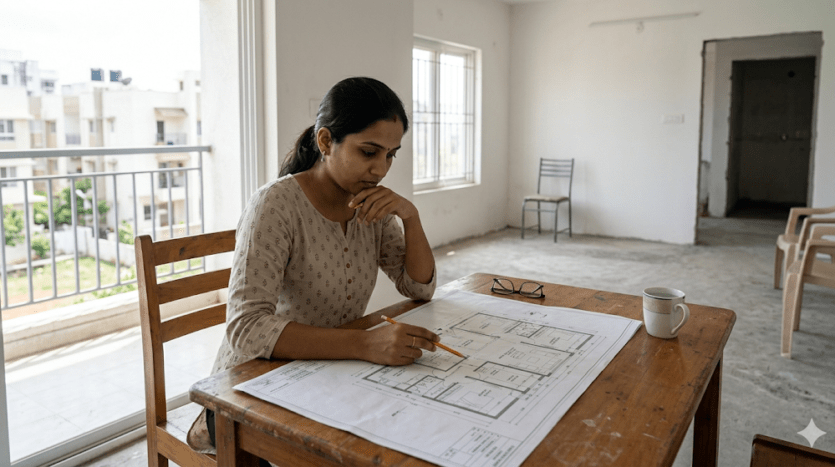
A floor plan tells you more about a 3 BHK apartment than a site visit to a dressed sample flat. Here’s what to look for before you set foot on the property.
The entrance and foyer:
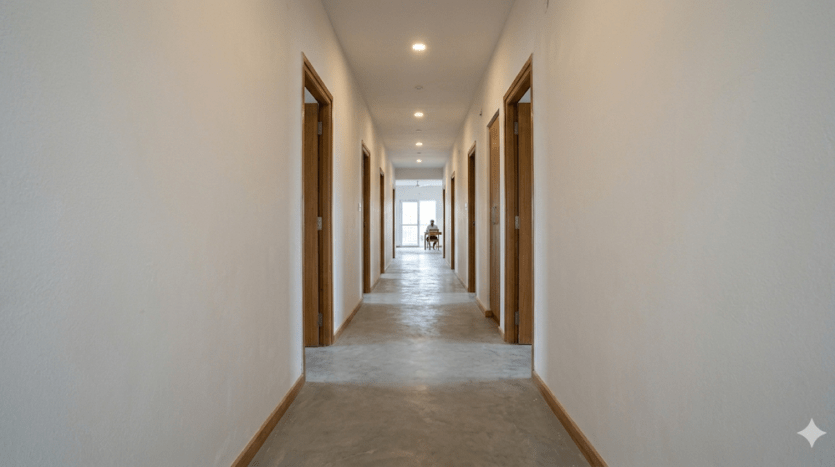
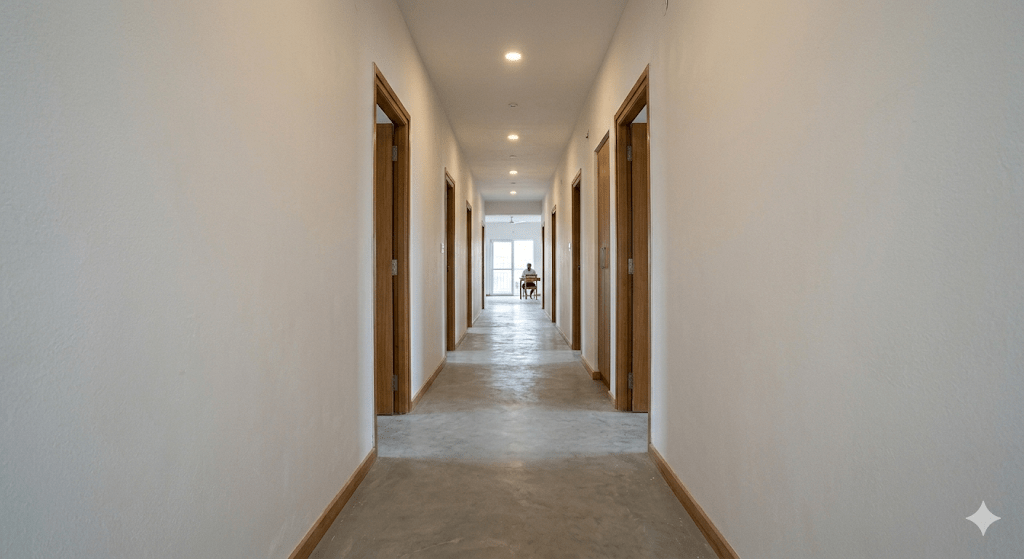
Measure the distance from the main door to the living room. Anything above 10 feet of corridor before you reach the living space is dead space — paid for at the same rate as your bedroom. A compact foyer that opens directly into the living area, with bedrooms accessible via short lateral passages, is the efficient alternative.
The bedroom placement:
- Master bedroom should not be accessible directly from the main living area — the door should open into a private foyer or short corridor that creates visual separation when guests are present
- Secondary bedrooms should not share a wall with the living room of an adjacent unit — a privacy and noise transfer issue in dense towers
- For multigenerational families, a ground-floor-accessible bedroom or a unit where one bedroom is separated from the others by the living space is functionally important for elderly parents
The living and dining zone:
- Check whether the living room has a direct exterior wall with a window — a living room surrounded by bedrooms on all sides with no exterior exposure is the “dark core” problem and affects light quality all day
- Living and dining areas combined should offer enough linear space for a sofa arrangement and a dining table without forcing a choice between the two
- The transition between living and dining should be natural — units where the dining area is a narrow extension of the kitchen rather than a defined zone, compress daily life more than the floor plan suggests
The kitchen:
- Minimum 8-foot width for a functional parallel counter arrangement
- Kitchen work triangle (sink, stove, refrigerator) perimeter should be under 6.5 metres — anything larger means excessive walking during meal preparation
- A kitchen window is not a luxury; it determines ventilation quality and reduces daily exhaust fan dependency
The Four Layout Features That Determine Daily Liveability
Beyond the room-by-room breakdown, four specific features separate 3 BHK apartments in Sarjapur Road that work well in daily life from those that strain under actual occupation.
1. No shared walls:
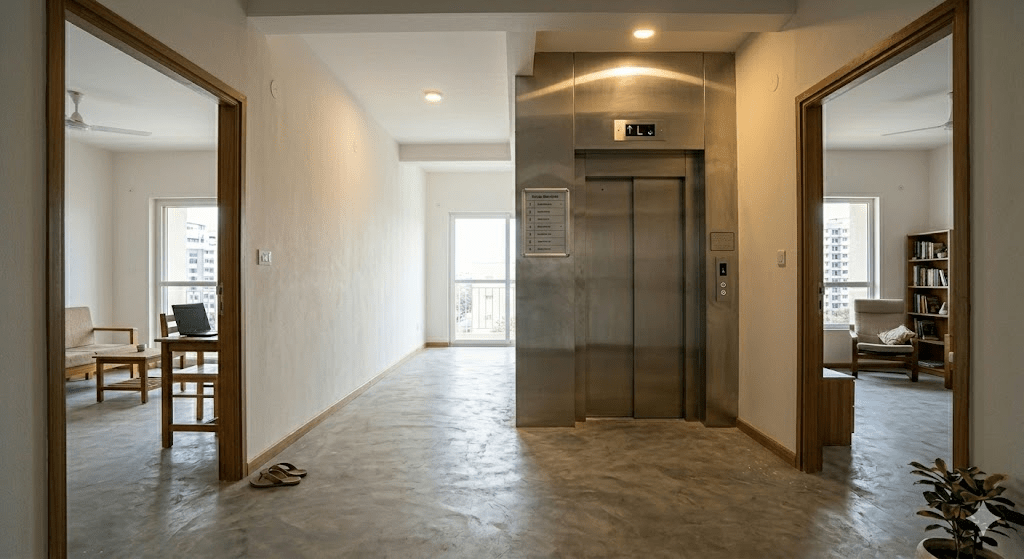
A shared wall between your unit and an adjacent unit is the most consistent source of post-possession regret in high-density towers. It affects acoustic privacy in every room, every hour of the day. In projects with no shared walls — where each unit is structurally separated from its neighbours — this problem disappears entirely. On Sarjapur Road, this design choice is available in specific projects and represents a genuine differentiator worth verifying explicitly on the floor plan.
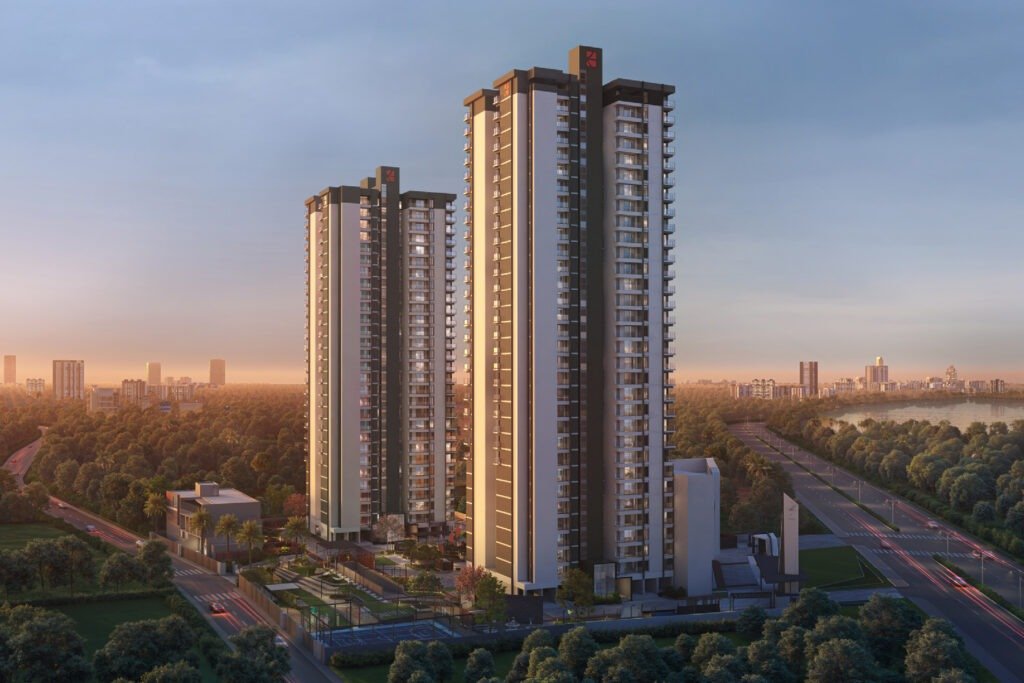
Suyug The 1 and Suyug Saffron both use no-shared-wall design across their 3 BHK configurations — at 1,601–1,939 sq ft and 1,896–2,612 sq ft respectively. This is worth mentioning not as a promotional point but as a benchmark: when evaluating any other project on the corridor, ask specifically whether the floor plan shows a shared structural wall with an adjacent unit.
2. Dedicated WFH zone:
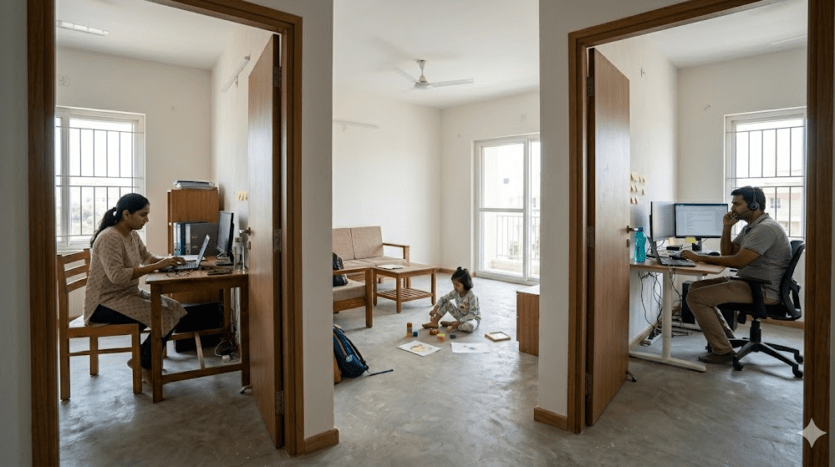
A 3 BHK that treats the third bedroom as a default study solves the WFH problem only if the study is acoustically separated from the rest of the unit. A bedroom with a thin internal wall adjacent to the living room doesn’t function well as a video-call workspace. What to look for:
- The third bedroom or study is positioned away from the living room and kitchen — ideally at the end of a short passage
- Ceiling height of at least 2.75 metres in the study — lower ceilings compress the sense of space in a room where someone will spend 6–8 hours daily
- A window in the study — natural light and ventilation in a workspace affects productivity and well-being more than any desk setup
3. Transition foyer between living and sleeping areas:
The gap between the living zone and the bedroom corridor is the spatial feature that determines privacy when guests are present. An L-shaped entry into the bedroom zone, or a short dedicated passage, prevents direct sightlines from the living room into bedroom doors. Without it, a family of four with regular guests effectively has no private space when entertaining.
4. Balcony depth of minimum 5 feet:
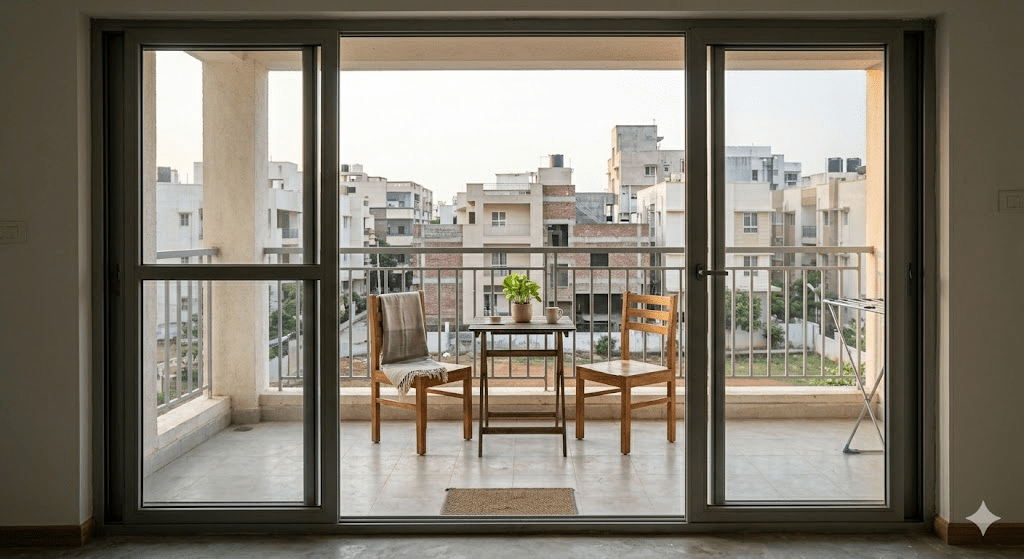
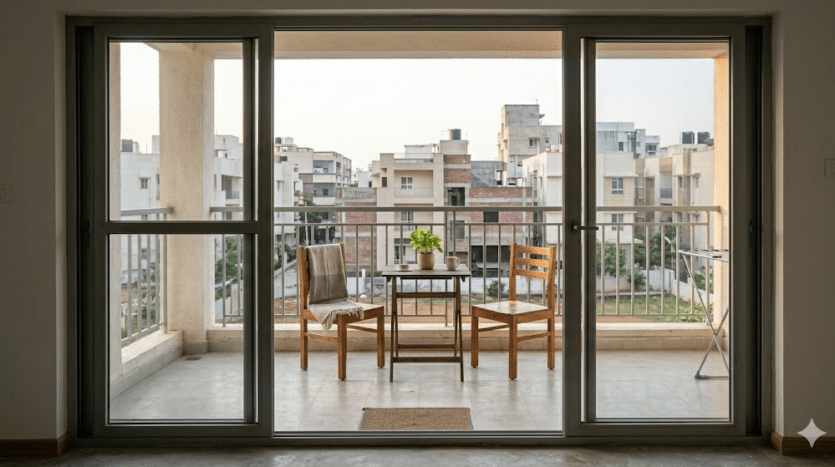
Bengaluru’s climate makes the balcony one of the most genuinely usable spaces in a home for approximately nine months of the year. A balcony with less than 4-foot depth is a standing ledge — the door opens onto it, but nothing functional fits. At 5–7 feet, a balcony becomes a morning coffee zone, a secondary workspace, or an evening reading space. At 7+ feet, it functions as a genuine outdoor room.
Verify balcony depth on the floor plan, not in the sample flat, where staging makes every space look larger than it is.
The WFH Equation: Does This 3 BHK Actually Work for Two People Working From Home
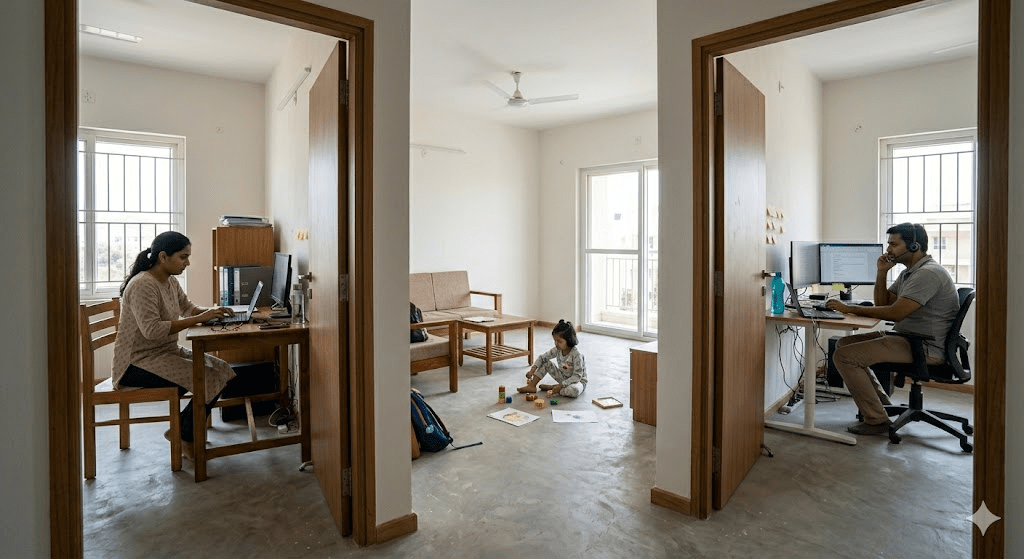
Return-to-office mandates in 2025 and 2026 have been partial and inconsistent across Bengaluru’s IT sector. The hybrid working reality — three days at home, two in the office — means a 3 BHK apartment in Bangalore needs to function as a two-person workspace without the home feeling like an office.
The two-person WFH stress test:
Walk through the floor plan with this scenario: two adults on simultaneous video calls, one child at home, and a guest bedroom in use. The questions to answer:
- Can both adults work in separate rooms with doors that close — and are those rooms acoustically separated enough that call audio doesn’t bleed between them?
- Is the kitchen positioned so that cooking sounds and smells don’t infiltrate both workspaces simultaneously?
- Is there a common area — living room or dining zone — where the child can be occupied without disrupting either workspace?
- Does the unit have a natural hierarchy of private and shared space, or does it feel like all rooms open onto each other?
What size ranges on Sarjapur Road actually deliver for WFH:
A 1,601 sq ft super built-up 3 BHK with a 28% loading factor delivers approximately 1,153 sq ft of carpet. Distributed across three bedrooms, a living-dining zone, kitchen, and balcony, the average bedroom in this configuration runs approximately 130–150 sq ft — functional as a WFH space if the layout is efficient, tight if it isn’t.
A 1,939 sq ft super built-up 3 BHK with a 25% loading factor delivers approximately 1,454 sq ft of carpet. The additional 300 sq ft of carpet area meaningfully changes the WFH equation — bedrooms are larger, the living zone has more separation from the workspace corridor, and the balcony can absorb overflow.
At Suyug Saffron’s 1,896–2,612 sq ft range, the upper configurations deliver carpet areas that allow genuine spatial separation between work and living zones — relevant for households where both adults work from home regularly and need the home to function as two independent offices without constant negotiation over space.
Vastu and Resale: The Floor Plan Variables That Affect Liquidity
Vastu compliance functions less as a spiritual consideration in Bengaluru’s resale market and more as a buyer pool filter. A 3 BHK apartment with a South-West entrance or a North-East kitchen excludes a meaningful proportion of traditional buyers from the resale conversation, which translates directly into longer time-to-sell and lower negotiating leverage.
The specific placements that matter for resale:
- Entrance direction: North, North-East, or East are preferred; South-West is the most commonly flagged concern in resale conversations
- Kitchen placement: South-East is preferred; North-East is the most frequently cited concern
- Master bedroom: South-West is traditionally preferred for the master bedroom — the opposite of what many buyers assume
- Toilets: Not in North-East or South-West — both are consistently flagged in buyer due diligence
How to verify on a floor plan:
Ask the developer for a compass-oriented floor plan — one that shows the unit’s orientation relative to North. Many sample flat visits omit this, and buyers assume orientation from the direction the balcony faces. Verify independently, particularly for units on different sides of a tower where orientation varies by floor position.
The resale implication:
On Sarjapur Road, where inventory is growing rapidly, and resale timelines are extending, a non-Vastu-compliant unit narrows the buyer pool at exactly the moment when a wider pool matters most. The 10–15% discount that Vastu-non-compliant units typically require to move is not a small consideration on a ₹1.5 crore asset.
The Questions to Ask on Every Site Visit
Most buyers spend site visits evaluating finishes, views, and amenities. The questions that actually protect your investment are different.
On the floor plan and spatial design:
- What is the RERA-registered carpet area for this specific unit type — not the super built-up area?
- What is the loading factor, and how does it compare to RERA-mandated disclosure?
- Does this unit have shared structural walls with adjacent units — and can I see which walls those are on the floor plan?
- What is the depth of the balcony in feet, measured from the door to the outer railing?
- What direction does the main entrance face, and can I see a compass-oriented floor plan?
On construction and acoustic quality:
- What is the thickness of the concrete slab between floors — 125mm minimum for meaningful sound insulation?
- Is the waterproofing in wet areas internal or surface-applied — and what is the warranty on it?
- Are the internal walls solid brick/block or lightweight partition — and does this apply to bedroom walls specifically?
On layout functionality:
- Can I visit the actual floor where my unit will be during construction — not just the sample flat?
- Is the study or third bedroom acoustically separated from the living room, and is there a door that closes fully?
- Where does the kitchen exhaust route — into the external wall or into a shared shaft?
Evaluating 3 BHK apartments in Sarjapur Road and want to understand how a specific floor plan compares in terms of spatial efficiency? Suyug’s team walks buyers through exactly this — carpet area, layout design, WFH functionality, and what the floor plan doesn’t show you. Reach out for a straightforward conversation.
One Thing Worth Sitting With
The 3 BHK apartment in Bangalore you buy will be the space your family negotiates every morning for the next decade. The amenities will be used occasionally. The floor plan will be used constantly. Spending an extra hour evaluating carpet area efficiency, balcony depth, and acoustic separation before you fall in love with a project is the highest-return due diligence available — and it costs nothing except attention.
FAQ’s
For a family of four with one dedicated workspace, target at least 1,200 sq ft of carpet area as a functional minimum. At 1,400+ sq ft, the space begins to allow genuine separation between work and living zones. Most super built-up figures on Sarjapur Road carry loading factors of 25–35%, so a 1,900 sq ft super built-up unit may deliver only 1,235–1,425 sq ft of usable carpet — always request the RERA carpet area certificate before evaluating any floor plan.
Subtract the carpet area from the super built-up area, divide by the super built-up area, and multiply by 100. For example, a 1,800 sq ft super built-up unit with 1,260 sq ft of carpet area has a loading factor of 30%. Anything above 35% warrants scrutiny; below 25% is efficient for a high-rise project. Always use the RERA-registered carpet area, not a figure the developer provides verbally.
Prioritise acoustic separation of the third bedroom or study from the living room, ceiling height of at least 2.75 metres in the workspace, a natural window in the study, and a layout where two adults can work simultaneously without audio bleed between rooms. No-shared-wall design eliminates the adjacent-unit noise problem entirely and is available in specific projects on Sarjapur Road — verify this explicitly on the floor plan.
Yes, materially. Non-compliant configurations — South-West entrance, North-East kitchen, toilets in North-East or South-West — narrow the resale buyer pool by excluding traditional buyers regardless of the selling buyer’s personal beliefs. On Sarjapur Road, where inventory is growing, and resale timelines are extending, a narrower buyer pool translates to longer time-to-sell and typically a 10–15% price concession to move the unit. Verify orientation on a compass-oriented floor plan before booking.
Suyug The 1 offers 3 BHK configurations in the 1,601–1,939 sq ft super built-up range, starting at approximately ₹1.5 crore — suited to tech professionals and nuclear families of three to four who want a manageable footprint with premium design. Suyug Saffron offers larger 3 BHK and 4 BHK configurations in the 1,896–2,612 sq ft range, starting at approximately ₹1.5 crore — suited to multigenerational families or households where two people work from home simultaneously and need genuine spatial separation. Both are IGBC Silver pre-certified with no shared walls at Sompura Gate, Sarjapur Road.
Balconies under 4 feet deep are functionally decorative — a door opens onto them, but no furniture fits. At 5–7 feet, a balcony becomes a genuinely usable outdoor zone — morning coffee, secondary workspace, or reading space — which in Bengaluru’s climate is available for nine months of the year. Verify balcony depth on the floor plan in feet, not by visual impression in the sample flat, where staging consistently makes spaces appear larger than they are.