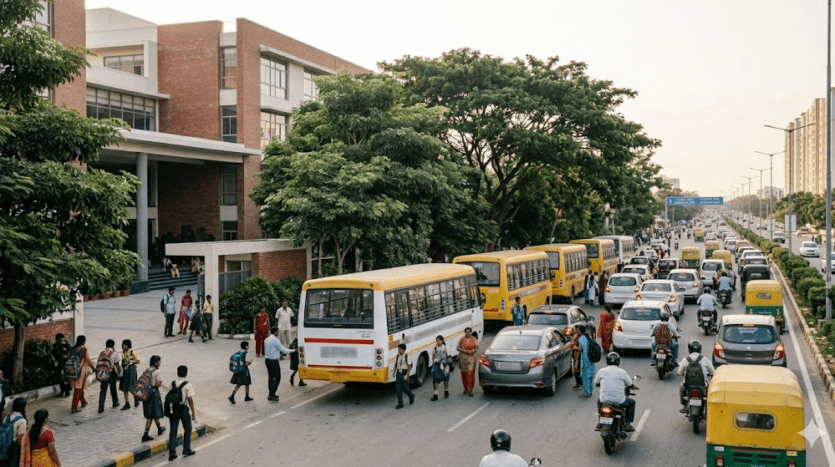
Flats in Sarjapur Road: What Every Buyer Should Know Before Shortlisting a Project
Most people arrive at Sarjapur Road as their preferred location for a home having already made a partial decision. They’ve heard the name enough times: from a colleague, a broker, a news article about Bengaluru’s fastest-appreciating corridors, that the location feels familiar before they’ve spent a single hour on it. Then they start researching properly, and the familiarity dissolves into a set of genuine questions: Which part of the corridor? Which configuration? Which price band? Which developer?
This guide is for that moment. It’s written for buyers who are evaluating flats in Sarjapur Road as a location before they’ve committed to a project, a configuration, or even a budget range. It covers the corridor’s transformation, its micro-zone breakdown, price reality, social infrastructure, commute truth, and the questions that matter before any shortlist gets made.
If you’ve already decided on Sarjapur Road and are comparing specific projects, this isn’t your starting point. But if you’re still working out whether the location makes sense for your situation, this is exactly where to begin.
TL;DR
- Sarjapur Road spans 21 kilometres and contains several distinct micro-zones, each with different price points, buyer profiles, and growth trajectories
- Flats in Sarjapur Road range from ₹55 lakh in developing pockets to ₹5 crore+ in premium high-rise projects
- The corridor’s strongest advantages are its position at the nexus of three major IT employment zones, a dense school belt, and a maturing social ecosystem
- Its most honest limitations are peak-hour traffic, uneven water supply across sub-zones, and infrastructure that is still years from completion in several areas
- Apartments in Sarjapur Road have appreciated 185.7% over ten years; the next appreciation cycle is infrastructure-driven and sub-location dependent
- Understanding the corridor’s micro-zones before shortlisting a project is the single most important step a buyer can take
The Sarjapur Road Story: How a Peripheral Route Became a Primary Corridor
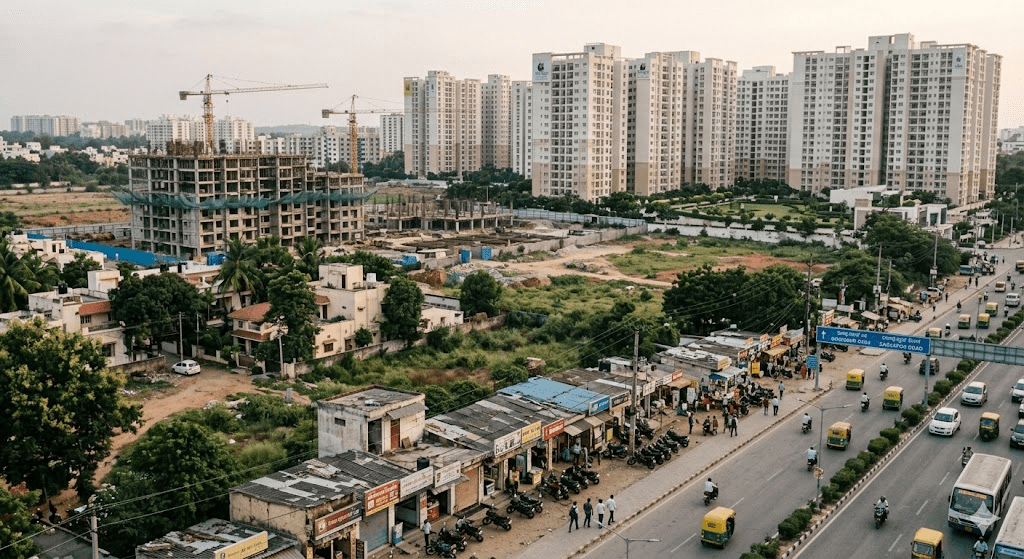
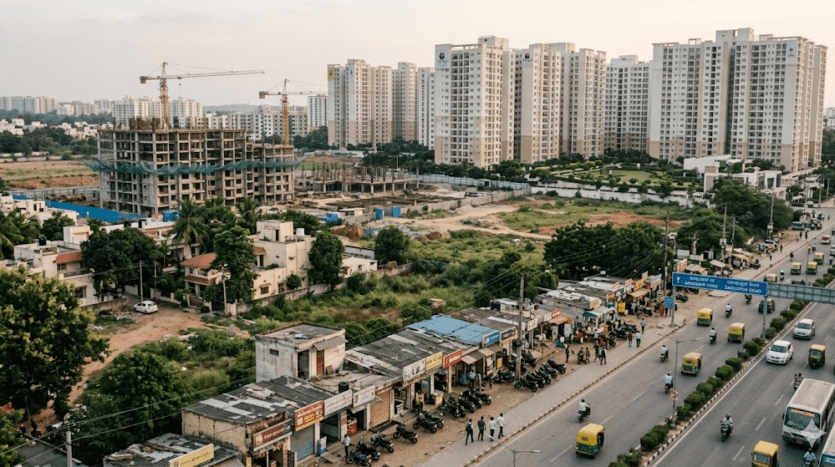
Fifteen years ago, Sarjapur Road was described, not uncharitably, as the wild west of Bengaluru real estate. It was a loamy clay agricultural stretch with sparse development, open fields, and the kind of promise that sounds convincing on paper but takes decades to materialise. The infrastructure was thin, the social ecosystem was nascent, and buyers who entered early were making a genuine speculative bet.
That bet has paid off in a way that few Bengaluru micro-markets can match. The catalyst wasn’t a single event but a convergence:
- The saturation of established IT hubs — Koramangala, HSR Layout, Indiranagar — pushed demand outward as prices there hit ceilings that most professionals couldn’t clear
- The Outer Ring Road created a physical arc of employment density that Sarjapur Road sits at the centre of, connecting Whitefield to the east, Electronic City to the south, and Koramangala to the north
- Tier-1 developers — Prestige, Sobha, Brigade, Godrej — entered the corridor, which signalled to the market that the speculative phase was over and the establishment phase had begun
By 2026, Sarjapur Road is not an emerging market. It is an established premium corridor with documented appreciation, a maturing social ecosystem, and a second wave of infrastructure investment underway. The buyers arriving now are not early adopters; they are informed professionals making a considered decision about one of Bengaluru’s most competitive residential locations.
What hasn’t changed is the complexity. Flats in Sarjapur Road span a 21-kilometre stretch with genuinely different sub-markets at different points. Understanding that geography is the foundation of any sound purchase decision.
The 21-Kilometre Breakdown: Understanding the Micro-Zones
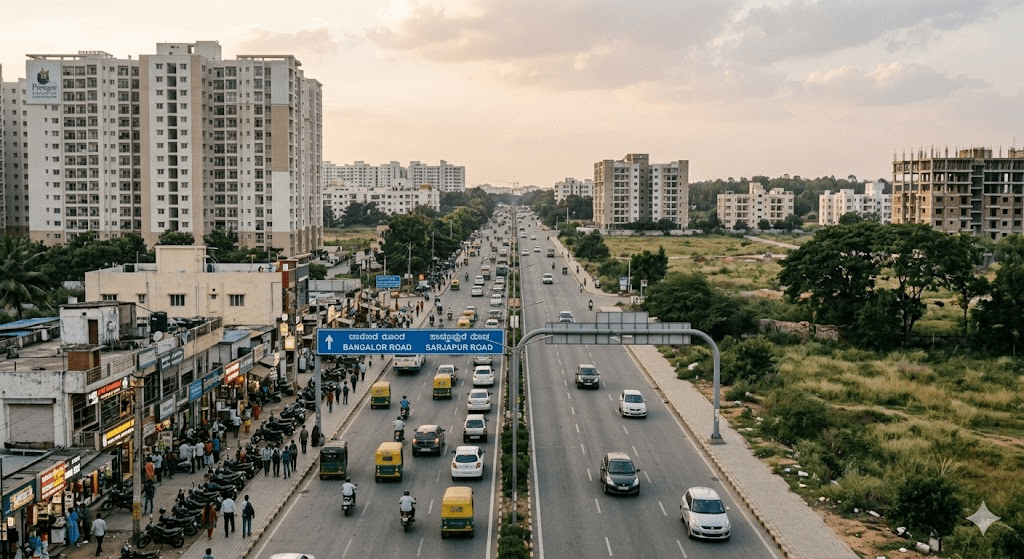
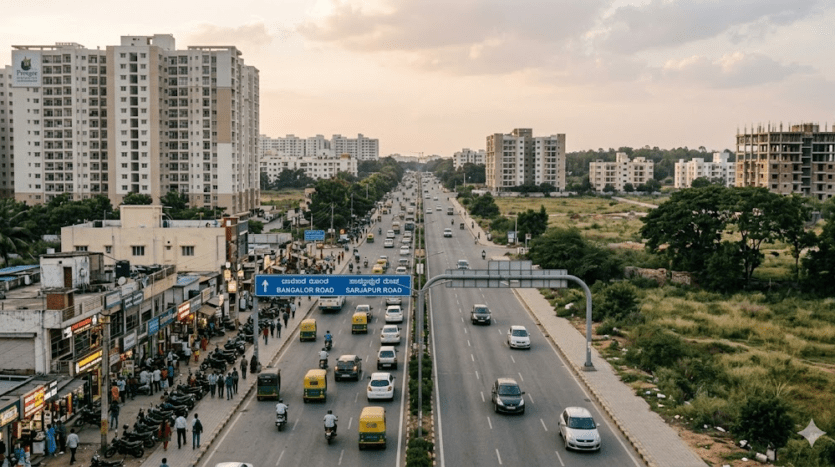
The single most important thing a buyer can understand about Sarjapur Road is that it is not one market. The corridor runs from the ORR junction near Iblur in the west to Sarjapur Town in the east, and the price, lifestyle, and growth profile shifts meaningfully across that stretch.
Zone 1 — The Mature Western Cluster: Bellandur, Kaikondrahalli, Iblur
This is the most established end of the corridor. Proximity to the ORR means the highest employment node density, the strongest rental demand, and the most liquid resale market. It also means the highest prices:
- Flats for sale in Sarjapur Road at this end run ₹12,000–₹19,000 per sq ft for premium projects
- Rental yields are strong at 4–5.5%, driven by demand from RMZ Ecoworld, Ecospace, and the broader ORR tech belt
- Social infrastructure is the most mature — retail, dining, healthcare, and schools are all well-established
- The trade-off is that appreciation headroom is more compressed than further along the corridor, and traffic at the Iblur and Silk Board junctions remains the corridor’s most persistent pain point
Zone 2 — The Growth Middle: Kasavanahalli, Gunjur, Mullur, Carmelaram
This is where the corridor’s growth story is most active in 2026. Prices are lower than the western cluster but rising faster:
- Apartments in Sarjapur Road in this zone run ₹8,500–₹13,000 per sq ft
- Kasavanahalli is established and premium — strong school proximity, mature neighbourhood feel
- Gunjur and Mullur are rapidly developing, with high rental demand from mid-level IT professionals and strong launch activity from Grade-A developers
- Carmelaram is gaining attention specifically because of confirmed Metro Phase 3A station proximity — prices here are pricing in some of that future infrastructure premium but haven’t fully caught up
Zone 3 — The Emerging Eastern Corridor: Dommasandra, Kodathi, Sarjapur Town, Sompura Gate
This is the early-investor end of the corridor. Entry prices are the most accessible, appreciation headroom is the highest, and the liveability infrastructure is still developing:
- Flats in Sarjapur Road at this end run ₹5,500–₹9,000 per sq ft
- Kodathi is gaining attention as a township development zone — integrated projects with internal social ecosystems that reduce dependence on the surrounding area
- Dommasandra and Sarjapur Town are PRR impact zones — the Peripheral Ring Road’s completion is expected to deliver 20–25% long-term appreciation in this stretch
- The honest limitation is that buyers need a 5–7 year horizon and tolerance for current infrastructure gaps to make this zone work
What Flats in Sarjapur Road Actually Cost in 2026
Price is the first question every buyer asks and the one that requires the most context to answer honestly.
The headline numbers:
- Average price across the corridor: approximately ₹11,000–₹12,000 per sq ft
- Premium Grade-A projects: ₹14,500–₹19,450 per sq ft
- Entry-level developing pockets: ₹5,500–₹7,500 per sq ft
- Ten-year absolute appreciation: 185.7% (from ~₹4,200 per sq ft in 2016)
Configuration price ranges (2026 actuals):
| Configuration | Entry Range | Mid-Premium Range | Luxury Range |
| 2 BHK | ₹55L–₹85L | ₹90L–₹1.3 Cr | ₹1.4 Cr+ |
| 3 BHK | ₹1.1 Cr–₹1.5 Cr | ₹1.5 Cr–₹2.5 Cr | ₹2.5 Cr–₹3.5 Cr |
| 4 BHK | ₹1.7 Cr–₹2.5 Cr | ₹2.5 Cr–₹4 Cr | ₹4 Cr–₹8 Cr+ |
What the base price doesn’t include: Add 15–20% to any quoted base price for the true all-in cost. Stamp duty (5–6%), registration (1%), GST on under-construction units (5%), sinking fund, advance maintenance, and parking together add ₹15–₹30 lakh on a ₹1.5 crore purchase. Budget for this before, not after, you fall in love with a project.
The appreciation context: The easy phase of appreciation — where the entire corridor rerated uniformly — is largely behind buyers entering now. Future appreciation will be sub-location specific, infrastructure-driven, and project-quality dependent. Buyers entering at ₹10,000–₹12,000 per sq ft are paying for established status; the growth runway from here is real but requires a longer holding horizon than the buyers who entered five years ago needed.
The Employment Gravity: Why IT Professionals Keep Choosing This Corridor
Sarjapur Road’s position in Bengaluru’s employment geography is genuinely unusual. Most residential corridors are adjacent to one major employment cluster. Sarjapur Road sits at the intersection of three:
- The ORR tech belt — RMZ Ecoworld, Ecospace, Bagmane Tech Park, and a concentration of MNC campuses within 5–10 km of the western end
- Whitefield — accessible via the ORR and increasingly via the metro; home to ITPL, the International Tech Park, and dozens of mid-size tech company offices
- Electronic City — Infosys, Wipro’s main campus, and a dense concentration of IT-ITES employers accessible in 30–45 minutes via Dommasandra on most mornings
Wipro’s corporate campus sits directly on Sarjapur Road at Sompura Gate, making it the only corridor in Bengaluru where a major Tier-1 IT employer is literally on the main road. RGA Tech Park adds another significant employment node within the corridor itself.
This employment density creates a structural rental demand that is unlikely to soften regardless of broader market cycles. As long as Bengaluru’s IT sector employs at current levels — and the 647-acre industrial park development near Sarjapur suggests continued expansion — the corridor’s residential demand has a dependable economic foundation.
Social Infrastructure: Schools, Hospitals, and Daily Life
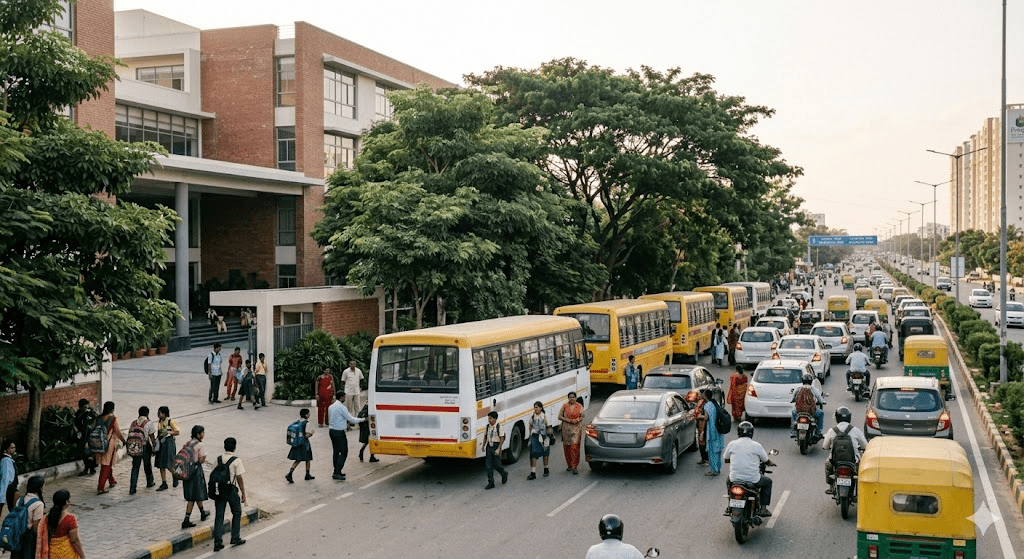
One of the most consistent reasons buyers choose flats in Sarjapur Road over comparable options in other corridors is the quality and density of social infrastructure. It’s worth being specific about what that means in practice.
The school ecosystem:
- Oakridge International (IB/IGCSE): ~4.77 km from the corridor core; fees ₹4.25L–₹8.25L per year
- Indus International (IB): ~2.87 km; one of Bengaluru’s most sought-after IB campuses
- Greenwood High (ICSE/IB): on the corridor itself; strong mid-tier fee structure
- The International School Bangalore (TISB): premium IB curriculum; approximately 8 km from Carmelaram
- National Public School East (CBSE): on the corridor; fees ₹1.80L–₹2.80L per year
- Inventure Academy: progressive curriculum; consistently well-regarded by resident families
For a family evaluating apartments in Sarjapur Road with school-going children, this concentration covers every major curriculum — IB, IGCSE, ICSE, CBSE, and Cambridge — across a wide fee range. The school belt is not just a lifestyle amenity; it’s a durable demand anchor that makes the corridor’s residential values structurally resilient.
Healthcare:
Manipal Hospital, Sakra World Hospital, Motherhood Hospital, and Columbia Asia are all within reasonable distance of the corridor. For joint families with elderly members, or buyers planning to stay for 10+ years, this healthcare density is a meaningful quality-of-life variable.
Daily life infrastructure:
The corridor has matured to a point where most daily needs — grocery, pharmacy, fitness, dining — are available without leaving the general area. D-Mart, Decathlon, and Market Square anchor the retail ecosystem. The density of cafes, restaurants, and co-working spaces has grown significantly in the last three years, making the corridor feel self-sufficient in a way that newer peripheral suburbs don’t.
The Commute Reality: Peak Hours, Routes, and What’s Improving
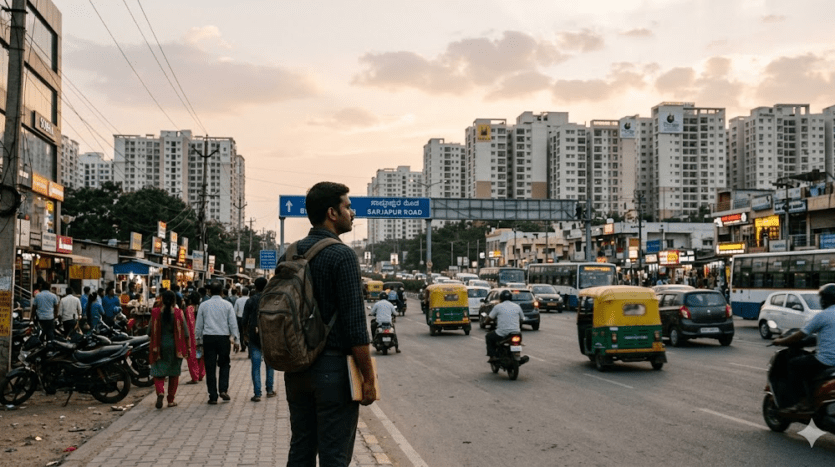
Traffic is the most consistent concern raised by residents and prospective buyers on Sarjapur Road, and it deserves an honest treatment rather than a brochure-level reassurance.
The current reality:
- The Iblur and Silk Board junctions are the corridor’s most persistent bottlenecks — peak hour queues here can add 30–45 minutes to any journey heading north or west
- Travel to Whitefield via the ORR runs 70–90 minutes in peak hours; 25–35 minutes off-peak
- Travel to Electronic City via Dommasandra runs 30–45 minutes on most mornings — one of the better commutes from the corridor
- Travel to Koramangala or HSR Layout via Carmelaram runs 45–60 minutes in morning traffic
What’s actually improving and when:
- Sarjapur main road widening (6-lane): active; grade separators and flyovers at key junctions including Wipro are reducing bottlenecks; expected to show meaningful improvement within 2–3 years
- Peripheral Ring Road (PRR/BBC): Phase 1 tendering began in 2026; when operational, it will connect Sarjapur Road to Tumakuru Road and airport access, cutting inter-zone travel times by up to 50%
- Metro Phase 2A (Blue Line): Silk Board to KR Puram; expected operational by late 2026; the Iblur station will directly benefit the western end of the corridor
- Metro Phase 3A (Hebbal–Sarjapur Red Line): 28 stations, 36.5 km; construction slated 2029–2031; full operational window around 2033
For buyers whose office is within the corridor — Wipro HQ, RGA Tech Park — the commute question is already resolved. For buyers commuting to Whitefield five days a week, the honest answer is: plan for 90 minutes today, with meaningful improvement expected by 2027–2028.
Water, Flooding, and the Questions Buyers Don’t Ask Early Enough
These are the two infrastructure variables that buyers most consistently underestimate before purchase and most consistently cite after possession. Addressing them honestly is more useful than glossing over them.
Water supply:
Large portions of Sarjapur Road — particularly the eastern and mid-corridor zones — lack direct BWSSB (Cauvery) piped connections. Residents in these areas depend on borewells, many of which are depleting, and private water tankers. Tanker costs in 2024 ran ₹4,000–₹8,000 per household per month in affected areas.
What to ask before booking any flat:
- Does the project have a sanctioned BWSSB connection, or does it depend on borewells and tankers?
- What is the rainwater harvesting storage capacity per unit?
- Does the STP output cover toilet flushing and landscaping needs?
- What is the actual maintenance charge in the developer’s completed projects — including water procurement costs?
Projects with IGBC certification, functioning rainwater harvesting systems, and advanced STP technology are meaningfully better positioned for Bengaluru’s worsening water stress. This is not a minor amenity consideration; it is a monthly cost and quality-of-life variable that affects the lived experience of the home far more than most launch-day features.
Flood risk:
The 2022 and 2025 Bengaluru floods changed the buyer checklist permanently. Parts of Sarjapur Road — particularly low-lying areas near Bellandur Lake and Varthur Lake — are genuinely at risk during high-intensity monsoon events.
What to verify:
- Plinth elevation relative to surrounding road level — 600mm above road level is the minimum safe threshold
- Whether the project has a dedicated stormwater drainage plan
- Cross-check the specific survey number against BBMP’s storm water drain maps
- Elevated terrain and smart drainage integration are the two most reliable flood risk mitigants
The Infrastructure Pipeline: What’s Confirmed and What’s Not
Sarjapur Road’s investment case rests heavily on infrastructure that is in various stages of planning and execution. Being clear about what’s confirmed versus what’s speculative is essential for setting the right expectations.
Confirmed and underway:
- Sarjapur main road widening and junction improvement works — active construction, visible progress
- Metro Phase 2A (Silk Board–KR Puram Blue Line) — late 2026 operational target; Iblur station confirmed
- STRR (Satellite Town Ring Road) — operational in phases from 2027; diverts freight traffic from the corridor
In planning with confirmed funding:
- BBC/PRR Phase 1 — tendering began 2026; significant inter-zone connectivity improvement upon completion
- Metro Phase 3A (Hebbal–Sarjapur Red Line) — feasibility complete; construction 2029–2031; operational ~2033
The investor’s read on timing:
Infrastructure appreciation in Bengaluru historically activates 18–24 months before commissioning, not at announcement. Buyers entering now for Metro Phase 3A are roughly 6–7 years ahead of that window — which is appropriate for a long-horizon investment thesis but requires patience and interim yield to sustain.
Who Sarjapur Road Is — and Isn’t — Right For
Flats in Sarjapur Road make the most sense for:
- IT professionals working within the corridor or in the ORR tech belt, for whom commute reduction is a daily quality-of-life gain
- Families with school-going children who want access to Bengaluru’s densest school ecosystem without compromising on residential quality
- Investors with a 5–7 year horizon who want a corridor with documented appreciation, strong rental demand, and meaningful infrastructure tailwinds
- NRI buyers seeking a managed asset in a market with strong tenant demand and improving legal transparency
The corridor requires honest reconsideration for:
- Buyers whose primary office is in North Bengaluru or the airport zone — the commute from Sarjapur Road to these destinations remains difficult and infrastructure improvement timelines don’t help in the near term
- Buyers with a 2–3 year holding horizon — transaction costs, current appreciation compression at the premium end, and infrastructure that hasn’t yet delivered make short-term flipping a weak thesis here
- Buyers who haven’t resolved their water supply question for their specific sub-location — entering a project with unresolved water infrastructure is a known post-possession risk that no amenity list compensates for
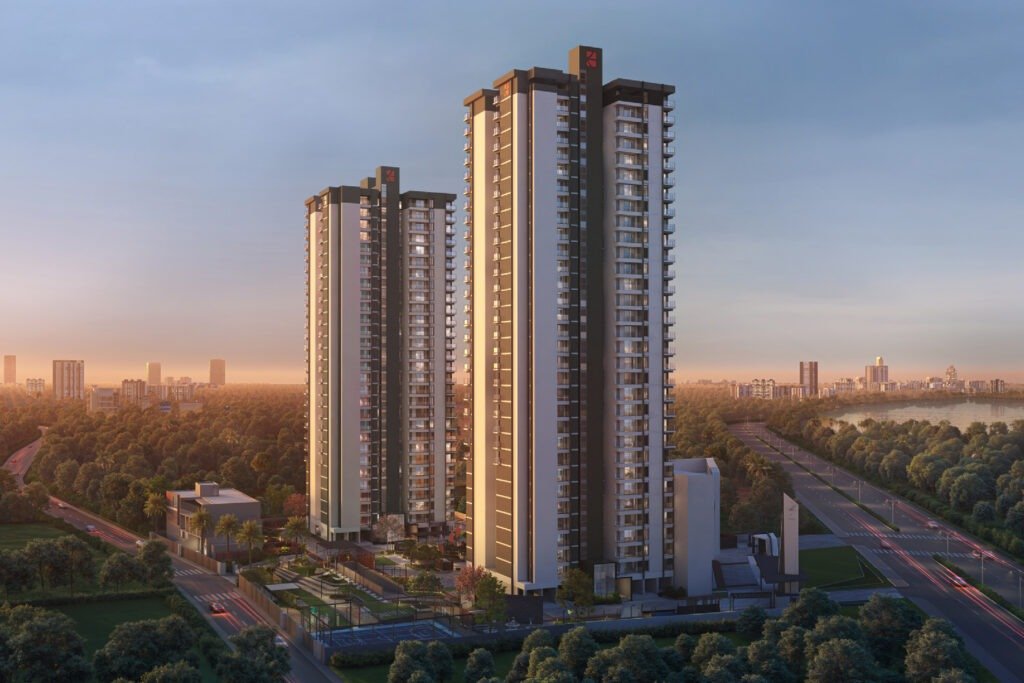
Suyug’s projects on Sarjapur Road — designed with IGBC certification, rainwater harvesting, no shared walls, and deliberate proximity to the corridor’s employment and school anchors — represent a particular approach to what long-term usability means in this market. For buyers working through the locality evaluation, they offer a useful reference point for what responsible development in this corridor looks like.
Working through your evaluation of flats in Sarjapur Road and want a clearer picture of how a specific sub-location or project fits your situation? Suyug’s team works through these questions with buyers regularly — reach out for a straightforward conversation.
One Thing Worth Sitting With
Sarjapur Road rewards buyers who understand what they’re buying into before they fall in love with a floor plan. The corridor’s strengths are real and documented. So are its limitations. The buyers who make the best decisions here are the ones who’ve spent time on the locality before they spend time on the project — because no amount of amenities compensates for a sub-location that doesn’t fit your life.
FAQ’s
The corridor average sits at approximately ₹11,000–₹12,000 per sq ft, but this masks significant sub-zone variation. The western end near Bellandur and Kaikondrahalli runs ₹12,000–₹19,000 per sq ft in premium projects. The mid-corridor around Gunjur and Carmelaram runs ₹8,500–₹13,000 per sq ft. The eastern end near Dommasandra and Sarjapur Town runs ₹5,500–₹9,000 per sq ft. Sub-location is the primary price driver, not the corridor average.
For buyers with a 5–7 year horizon, yes — the combination of strong rental demand, confirmed infrastructure tailwinds, and a maturing social ecosystem makes flats for sale in Sarjapur Road a coherent long-term investment. The strongest near-term appreciation case is in the mid-corridor (Carmelaram, Gunjur) where prices haven’t fully priced in metro proximity. The eastern end (Dommasandra, Kodathi) offers the highest headroom but requires patience with current liveability gaps.
Kasavanahalli and the mid-corridor zone offer the strongest combination of school proximity, mature neighbourhood infrastructure, and residential quality for families. The school belt — Oakridge, Indus, Greenwood High, NPS East, TISB — is concentrated in and around this zone. For families planning a 10–15 year stay, living within 15 minutes of this ecosystem is a durable quality-of-life and resale value advantage.
It varies significantly by sub-location and project. The western end has better BWSSB connectivity; the mid and eastern corridor zones are more dependent on borewells and tankers. Before booking any flat, confirm the project’s BWSSB connection status, rainwater harvesting capacity, and STP output. Projects with IGBC certification and functioning water recycling infrastructure are materially better positioned. Tanker costs in unresolved projects run ₹4,000–₹8,000 per month — a real and ongoing post-possession expense.
Metro Phase 3A — the Hebbal–Sarjapur Red Line — has feasibility clearance and construction is scheduled for 2029–2031, with an operational window around 2033. Historically, Bengaluru micro-markets see 15–20% appreciation in the 18–24 months before a metro line commissions. Projects within 1–1.5 km walkable distance of confirmed stations (Iblur, Agara, Carmelaram) are best positioned to capture that premium.
Verify RERA registration tower-wise on the K-RERA portal, confirm A-Khata status (B-Khata carries conversion risk and complicates home loans), check the Mother Deed and Conversion Certificate if the land was previously agricultural, and request the RERA carpet area certificate separately from the super built-up area figure. For ready-to-move units, confirm the OC (Occupancy Certificate) has been obtained. Speaking to residents in the developer’s completed projects is the most reliable due diligence step available.