


NRI Real Estate Investment in India: A Complete 2026 Guide
For most Non-Resident Indians, the decision to invest in Indian real estate is rarely purely financial. It’s the apartment that stays ready for visits home. The asset that anchors the next generation to a city where their parents built careers. The wealth that doesn’t disappear in currency fluctuations because it exists in the country where the family’s future remains.
That emotional logic now has strong financial backing. NRI investment in Indian real estate has shifted from a sentimental gesture to a strategic portfolio decision, driven by favourable exchange rates, a maturing regulatory environment, and a luxury residential market that has delivered consistent double-digit appreciation in India’s primary IT corridors. The 2026-27 Union Budget has further simplified cross-border transactions, removing friction that once made remote purchases feel complicated.
This guide covers everything a global Indian needs to evaluate, execute, and benefit from NRI real estate investment in India: the legal framework, tax structure, banking channels, process roadmap, and where the strongest opportunities sit in 2026.
TL;DR
- NRIs, OCIs, and PIOs can buy residential and commercial property in India freely under FEMA; agricultural land, farmhouses, and plantations remain prohibited
- Funds must flow through NRE, NRO, or FCNR accounts, each with different repatriation rules and best-use cases
- The 2026-27 Union Budget removed the TAN requirement for NRI property transactions; PAN-based TDS is now sufficient.
- Long-term capital gains (assets held 24+ months) are taxed at a flat 12.5% without indexation for properties purchased on or after July 23, 2024.
- Bangalore leads NRI property investment nationally in 2026, driven by IT employment density, GCC expansion, and a maturing school ecosystem
- Sarjapur Road averages ₹10,200 to ₹11,750 per sq ft with rental yields of 3.5 – 5.5%.
- A transaction-specific Power of Attorney (POA) attested by the local Indian Embassy allows remote management of affairs without a visit to India
Why NRIs Invest in Indian Real Estate

The motivations behind NRI real estate investment have evolved significantly over the last decade. What was once primarily a sentimental decision, such as keeping a home in India for visits, maintaining family roots, has become a multi-layered financial strategy.
The financial drivers:
- Exchange rate leverage: NRIs earning in USD, AED, or GBP effectively access Indian real estate at a structural discount. As the rupee has weakened against major global currencies, the purchasing power of overseas earnings in India has grown, making premium assets more accessible in relative terms than they appear in INR terms alone.
- Capital appreciation: Luxury residential properties priced above ₹1.5 crore captured 53% of new launches across India in Q1 2026, per Anarock data. In Bengaluru’s primary IT corridors, annual appreciation has consistently run 10–12%, with select micro-markets delivering higher returns over 3-year windows.
- Rental yield: Premium apartments in high-demand corridors like Sarjapur Road have an annual yield of 3.5–5.5%. It is above the national average and backed by a structural tenent pool of IT professionals whose employment is tied to the corridor.
The emotional and generational drivers:
- Maintaining a physical anchor in India for potential future relocation is a consideration that has grown more relevant as work-from-anywhere policies have matured
- Transferring rupee-denominated wealth to the next generation without complex cross-border inheritance structures
- Securing access to India’s school ecosystem is particularly relevant for NRI families considering a return during their children’s formative years
These motivations compound. A real estate NRI purchase that delivers 4% yield, 10% appreciation, and family utility across visits is a different calculation from a purely financial investment. For most global Indian buyers, that combination is what makes the asset class irreplaceable in a diversified portfolio.
Types of Properties NRIs Can Buy Under FEMA
The Foreign Exchange Management Act (FEMA) governs what NRIs, OCIs (Overseas Citizens of India), and PIOs (Persons of Indian Origin) can and cannot purchase in India. The rules are straightforward but worth understanding precisely before committing capital.
Permitted property types:
- Residential apartments, villas, and plotted developments
- Commercial offices, retail spaces, and warehouses
- No limit on the number of properties an NRI can own in India
Absolutely prohibited property types:
- Agricultural land
- Plantation property
- Farmhouses
The agricultural land prohibition is absolute and cannot be circumvented by purchasing through an Indian corporate entity in which the NRI holds shares. The only exception is inheritance. Agricultural land inherited from a resident Indian family member can be legally retained.
For OCIs and PIOs:
The same rules apply as for NRIs under the current RBI guidelines. OCIs do not require RBI approval for residential or commercial property purchases.
Legal Framework: RBI, FEMA, and RERA

Three regulatory bodies govern NRI real estate transactions in India. Understanding the role of each prevents compliance gaps that create post-purchase complications.
FEMA (Foreign Exchange Management Act): Governs the flow of funds from abroad into Indian property transactions. All payments must originate from NRE, NRO, or FCNR accounts. Cash transactions and overseas direct transfers to a seller’s account are not permitted. FEMA also governs the repatriation of sale proceeds back abroad.
RBI (Reserve Bank of India): Provides the general permission framework under which NRIs can purchase property without seeking individual approval. As long as the transaction follows FEMA-compliant fund flow and the property type is permitted, no separate RBI approval is required for most residential purchases.
RERA (Real Estate Regulatory Authority): The most important protection for remote buyers. Every under-construction project must be registered with the state RERA authority. For NRI property investment in Bangalore, verify on rera.karnataka.gov.in:
- Tower-wise registration number (not just project-level)
- Registered completion date and whether it has lapsed
- Any unresolved buyer complaints against the developer
- Whether the RERA-registered carpet area matches what the developer has quoted
RERA provides statutory recourse if a developer delays possession or deviates from approved plans. These protections matter, especially for buyers who cannot monitor construction in person.
Tax Implications: TDS, DTAA, and Rental Income
Tax is where NRI real estate transactions get highly complex, and where the 2026-27 Union Budget has introduced meaningful simplifications.
TDS on property purchase:
When an NRI sells property to a resident Indian buyer, the buyer must deduct TDS from the sale consideration. The 2026-27 Union Budget removed the requirement for buyers to obtain a Tax Deduction and Collection Account Number (TAN) — PAN-based TDS is now sufficient, significantly reducing administrative friction.
Capital gains tax:
| Holding Period | Tax Treatment | Rate |
| Under 24 months | Short-Term Capital Gains (STCG) | Per income tax slab |
| 24 months and above | Long-Term Capital Gains (LTCG) | 12.5% flat, no indexation (for assets purchased on/after July 23, 2024) |
Rental income: Rental income earned by NRIs on Indian property is taxable in India at their applicable slab rate. A standard 30% deduction is permitted for maintenance and repairs, and municipal taxes paid are also deductible:
Taxable Rental Income = Gross Annual Rent − Municipal Taxes − 30% Standard Deduction
A tenant paying rent to an NRI landlord must deduct TDS at 31.2% before remitting payment.
DTAA (Double Taxation Avoidance Agreement): India has DTAA treaties with over 90 countries, including the UAE, US, UK, Canada, and Singapore. NRIs can claim credit for taxes paid in India against their tax liability in their country of residence, preventing the same income from being taxed twice. The specific treaty terms vary by country; confirm applicable DTAA provisions with a tax advisor before filing.
The Step-by-Step Buying Process for Remote Buyers
NRI real estate transactions can be completed entirely remotely without a visit to India. Here is the standard execution sequence:
Step 1: RERA research and shortlisting
Verify shortlisted projects on the relevant state RERA portal. Confirm tower-wise registration, completion timeline, and developer complaint history before engaging with a sales team.
Step 2: Power of Attorney (POA)
Execute a transaction-specific POA limited to the specific property and transaction, not a general POA. Have it attested at the Indian Embassy or Consulate in your country of residence, then adjudicated at the relevant Sub-Registrar’s office in India. A specific POA prevents unauthorised use by the appointed representative.
Step 3: Banking setup
Ensure NRE, NRO, or FCNR accounts are active with an Indian bank. Booking amounts and subsequent payments must flow through these accounts to maintain FEMA compliance.
Step 4: Booking and agreement
Pay the booking amount via wire transfer from your NRE/NRO account. Review the Sale Agreement carefully. Confirm that the RERA-registered carpet area, possession date, and penalty clauses match what was communicated verbally.
Step 5: Home loan (if applicable)
Indian banks and NBFCs offer home loans to NRIs with LTV ratios of 75–90%, and loan tenures of 20-30 years. EMI payments must be made from NRE or NRO accounts.
Step 6: Registration
The registered POA holder executes the sale deed at the Sub-Registrar’s office on your behalf. Pay stamp duty (5% in Karnataka) and registration fee (2% in Karnataka) from your Indian bank account.
Step 7: Post-possession
A professional property management agency can handle the rental management. Rental income flows into your NRO account; repatriation of up to USD 1 million per financial year is permitted from NRO after applicable taxes.
Top Locations for NRI Investment in 2026
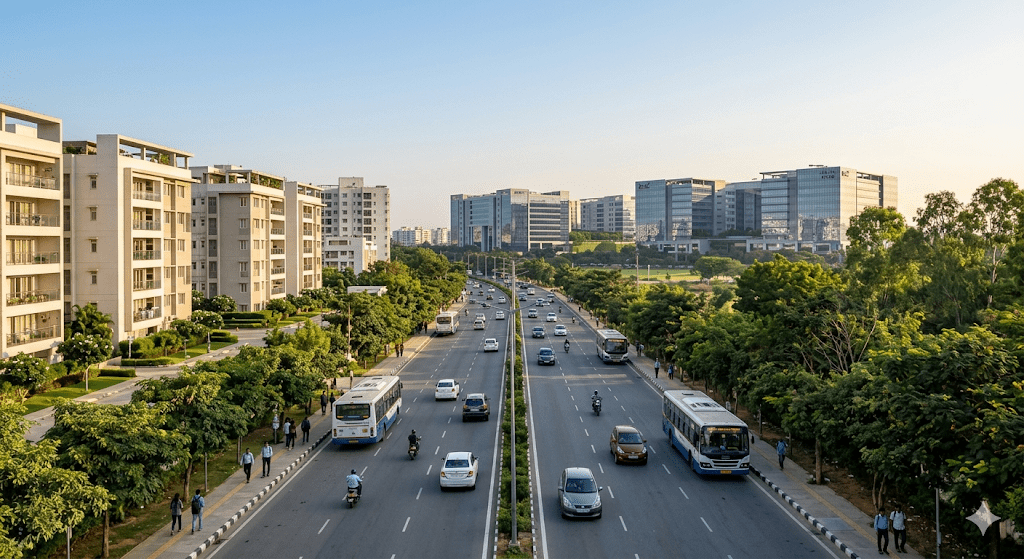
Bengaluru leads NRI property investment nationally in 2026. The city accounts for a dominant share of GCC (Global Capability Centre) leasing activity due to the employment engine that drives residential rental demand and, by extension, capital appreciation in its primary corridors.
Within Bengaluru, Sarjapur Road is the premier micro-market for NRI investment:
- Average apartment pricing: ₹10,200 to ₹11,750 per sq ft.
- Rental yield: 3.5–5.5% annually.
- Employment anchor: Wipro’s corporate campus directly on the corridor; RMZ Ecoworld, Ecospace, and the ORR tech belt within commuting range
- School ecosystem: Oakridge International, Indus International, Greenwood High, TISB, NPS East, covering IB, IGCSE, ICSE, and CBSE curricula
- Infrastructure catalyst: Metro Phase 3A (Hebbal–Sarjapur Red Line), to be operational by 2031–2033, with an anticipated 15–25% appreciation in the 18–24 months before commissioning.
For NRI families considering a future return to India, the combination of employment proximity, school access, and infrastructure trajectory makes Sarjapur Road the most coherent single-location investment in Bengaluru’s residential market.
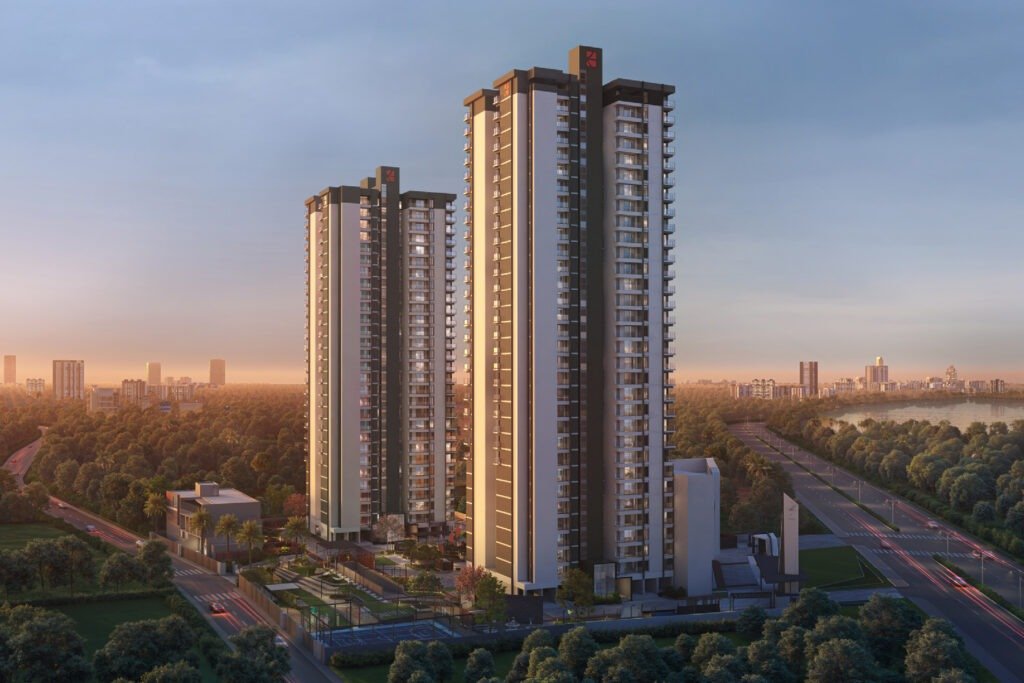
Suyug’s projects on Sarjapur Road, both IGBC Silver pre-certified and RERA-approved, with no shared walls and verified sustainable infrastructure, are specifically designed for buyers who need the asset to work reliably without active management. For NRI investors evaluating the corridor, they represent a useful benchmark for what low-friction, long-term real estate looks like in this market.
Common Mistakes NRIs Make — and How to Avoid Them
Executing a general POA instead of a transaction-specific one
A general POA grants the appointed person broad authority over your assets. If misused, it is difficult to reverse. Always limit the POA to the specific property and transaction, with a defined scope of authority.
Paying outside FEMA-compliant banking channels
Any payment that doesn’t originate from an NRE, NRO, or FCNR account creates a compliance gap that can complicate the repatriation of sale proceeds later. Never pay directly from an overseas account to a developer or seller.
Not verifying RERA registration tower-wise
A project-level RERA registration does not protect buyers in a specific tower or phase that has its own registration status. Verify tower-wise on the state RERA portal before signing anything.
Ignoring TDS obligations
When selling property in India, buyers are required to deduct TDS from the entire sale consideration paid to an NRI. Failure to do so creates liability for both buyer and seller. Ensure the transaction includes proper TDS deduction and filing, even with the simplified PAN-based system.
Buying in a sub-zone with unresolved water infrastructure
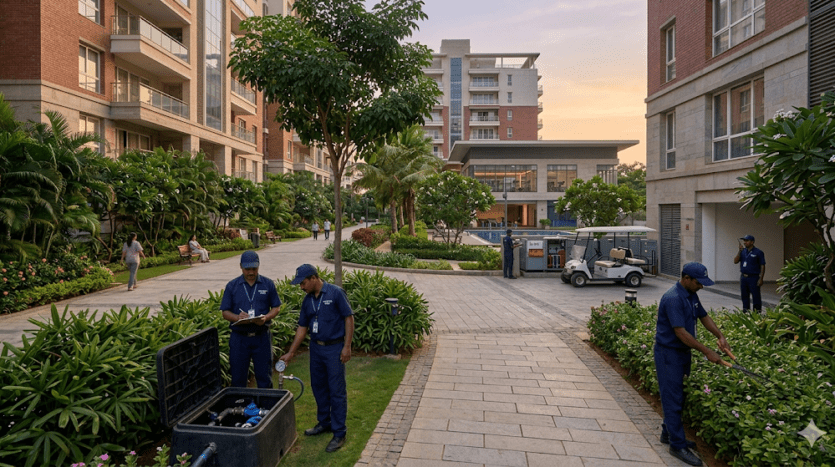
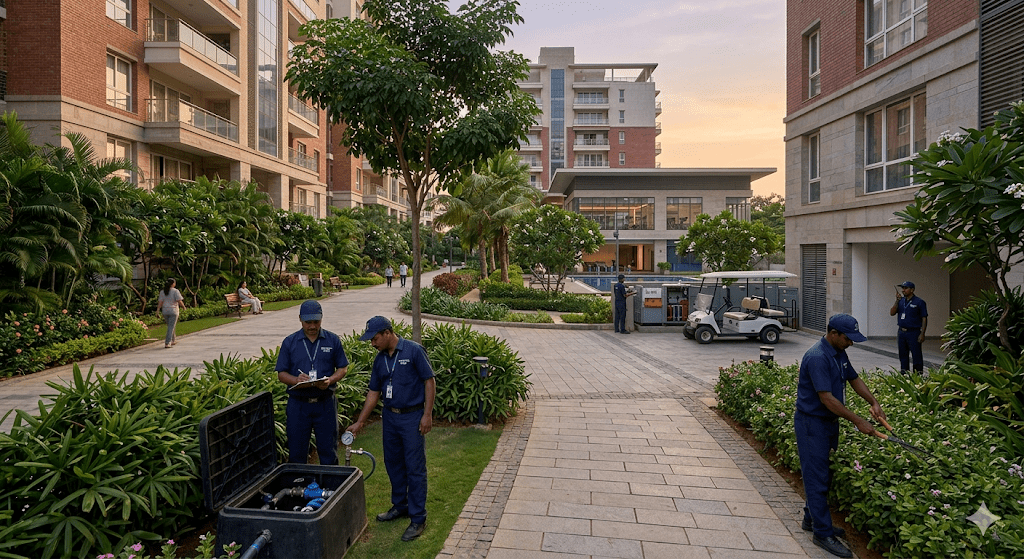
Remote buyers often discover water supply issues only after possession. Projects dependent on borewells and private tankers carry ongoing monthly costs of ₹5,000–₹8,000 and supply uncertainty. Verify the BWSSB connection status or the RWH infrastructure before booking.
Not factoring in the all-in cost
Base price is not the purchase price. Add stamp duty, registration fee, GST (5% on under-construction), corpus fund, advance maintenance, and parking to arrive at the true acquisition cost, typically adding 15–18% to the base price.
Suyug’s premium apartments on Sarjapur Road are trusted by NRI investors across the UAE, US, and UK — RERA-approved, IGBC-certified, and built for buyers who need an asset that works reliably from a distance. Connect with Suyug’s NRI Investment Desk for a detailed consultation on legal process, project specifications, and investment returns.
One Thing Worth Sitting With
The best NRI real estate investment is not the one with the highest projected return on a developer’s spreadsheet. It’s the one where the legal title is clean, the project is RERA-compliant, the water infrastructure is resolved, and the location has fundamentals, including employment, schools, and connectivity, that sustain value across a decade. Those variables take an hour to verify and help justify a decision that shapes the next generation.
FAQ’s :
No, the prohibition under FEMA is absolute and applies to all NRIs, OCIs, and PIOs regardless of how the purchase is structured. Agricultural land, plantations, and farmhouses cannot be purchased. The only exception is inheritance: agricultural land inherited from a resident Indian family member can be legally retained.
The 2026-27 Union Budget removed the TAN requirement for NRI property transactions. PAN-based TDS is now sufficient both for buyers deducting tax and NRIs filing returns. This significantly reduces administrative complexity for remote buyers.
If the property was purchased using NRE or FCNR funds, the full sale proceeds (after applicable taxes) are freely repatriable with no annual cap. If purchased through NRO funds or local Indian income, repatriation is capped at USD 1 million per financial year after paying applicable taxes.
A transaction-specific POA, that is, a PoA limited to a single property and a defined set of actions, is safe and widely used for NRI property transactions. A general POA, which grants broad authority over your assets, carries a significantly higher risk of misuse. Have the POA attested at your nearest Indian Embassy or Consulate, then adjudicated at the relevant Sub-Registrar’s office in India before it is used.
For properties held over 24 months (purchased on or after July 23, 2024), Long-Term Capital Gains are taxed at a flat 12.5% without indexation. For properties held under 24 months, Short-Term Capital Gains are taxed at the NRI’s applicable income tax slab rate. DTAA relief may be available depending on your country of residence, do confirm with a qualified tax advisor.
Core documents include:
– a valid passport and visa/OCI card,
– a PAN card (mandatory for the transaction),
– NRE/NRO bank account details,
– transaction-specific POA (Embassy attested and locally adjudicated), and
– proof of overseas address.
For due diligence:
– the project’s RERA registration certificate,
– the Mother Deed establishing a 30-year clear title,
– the Encumbrance Certificate,
– the DC Conversion Order confirming non-agricultural land status, and
– the sanctioned building plan from the relevant municipal authority.