
Apartment Price in Bangalore: 2026 Trends and Insights
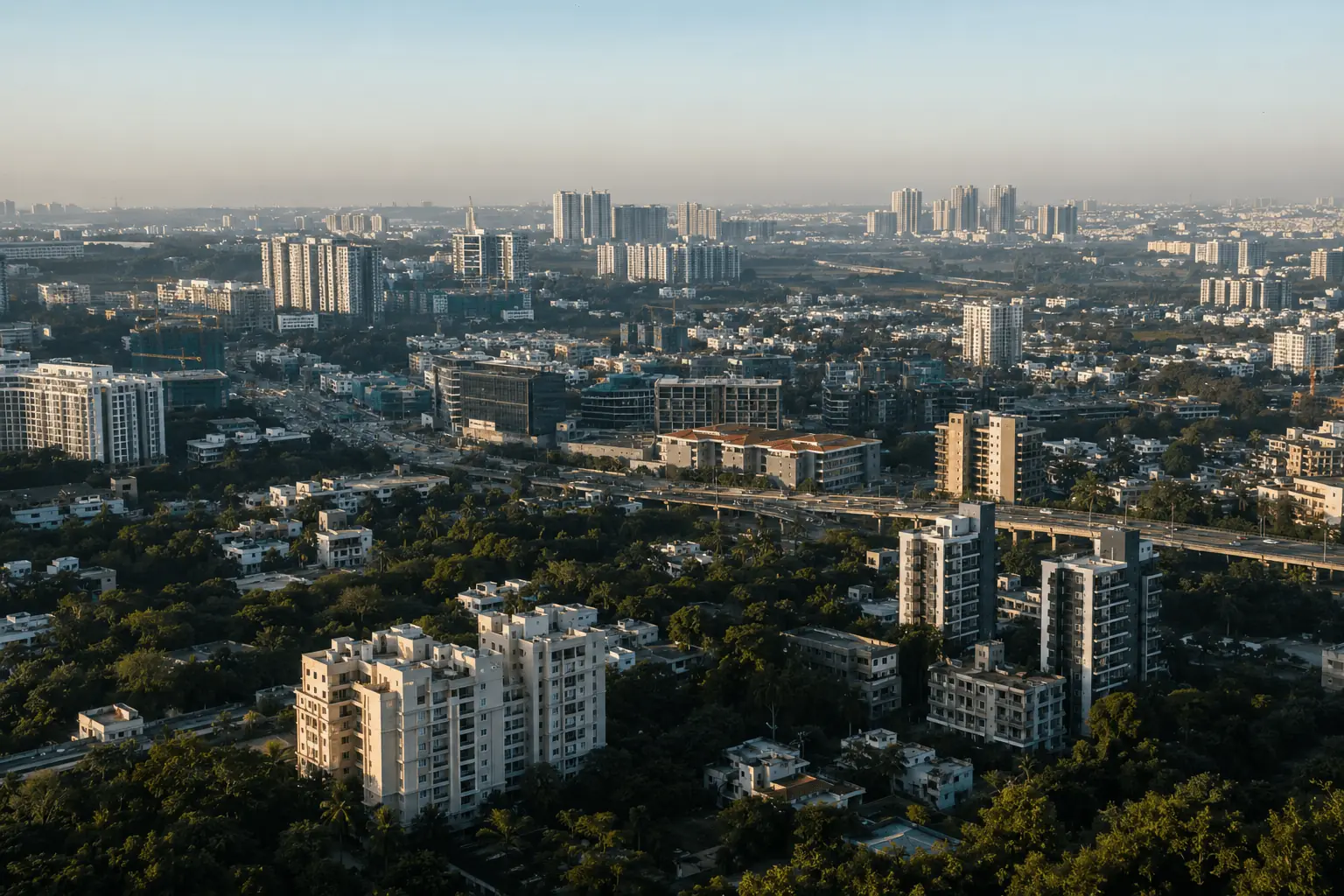
SUYUG Infra
Long guide · 4,075 words · 19 min read · 5 questions answered
In this article · 8 sections
A quoted price on a Bangalore apartment is not one number. It is the sum of what the land under it cost, what the specification costs to build, what the approvals are worth, and what the developer thinks the corridor supports. This guide is about that sum — how to read a quote you have been given, and how to test it — rather than about where prices are going, which is not something we forecast.
Apartment prices in Bangalore vary widely between the peripheral developing zones and the established corridors. This guide does not print the rates at either end, and it is worth saying why: they move by quarter, a page cannot chase them, and a stale number read as current is worse than no number. The gap itself is the durable fact, and it is far from arbitrary — it tracks proximity to employment, infrastructure delivery, construction quality, and developer credibility. Understanding what produces the gap is what lets you tell a defensible quote from an inflated one.
This guide works through the forces that set Bangalore’s apartment quotes in 2026, sets out where each zone and corridor sits relative to the others and why, shows how to model the yield on a Sarjapur Road unit from inputs you can verify yourself, and gives homebuyers and investors a practical framework for making the decision.
TL;DR
- Apartment prices in Bangalore vary widely across zones and corridors; this guide explains what drives the variation rather than printing rates that date within a quarter
- Anarock’s Q1 2026 data has the segment it classifies as high-end and above taking more than half of Bangalore’s record quarterly launches — that is where the supply is being built
- Sarjapur Road is the corridor where the catalysts are furthest from delivered; its mid-corridor stretch is the part with the least infrastructure actually in place
- The commercial-residential multiplier is Bangalore’s defining demand driver: office pre-leasing in a corridor converts into housing demand in the same corridor, because the people signing those leases have to live within commuting distance of them
- Metro Phase 3A (the Hebbal–Sarjapur corridor), the Peripheral Ring Road, and SWIFT City are the three infrastructure catalysts on the record for Sarjapur and South Bangalore — each approved to a different degree, none delivered
- Rental yield on residential property in Bangalore is thin on its own, and we publish no figure for it; build it from your own six inputs, and keep it separate from anything you have been told about future value
The State of Bangalore Real Estate in 2026
Bangalore’s residential market has structurally transformed over the past decade. What was once a largely mid-segment, end-user market has reorganised around premium supply, institutional-grade demand, and yield-conscious investment. The speculative fringe that characterised early Sarjapur or North Bangalore launches has been replaced by fundamentals-driven buying from corporate professionals, NRI portfolio builders, and upgrading families.
Where the supply is being built is a matter of record rather than opinion. Anarock’s Q1 2026 data shows Bangalore posting record residential launches of 24,400 units, the highest quarterly figure in the city’s history, with more than half of that in the segment Anarock classifies as high-end and above. Whatever else is arguable about this market, the mix of what developers are choosing to build is not.
That mix reflects the income profile of Bangalore’s buyer base and a construction cost reality: at current land and input costs, affordable supply is structurally difficult to deliver in the established corridors, so it is largely not being launched there.
For a buyer, the practical consequence is narrow and worth stating plainly. In a quarter with launches at that volume, you are choosing between many comparable projects rather than one — which means you can insist on documents, walk a second site, and take a quote away to test it, without the pressure a thin market creates. That is the whole of the advantage, and it is a negotiating advantage rather than a market call.
What we will not tell you is where prices go next. Nobody publishing a page like this one knows, and the ones who claim to are describing an assumption.
What Is Driving Apartment Prices in Bangalore
Three forces are structurally driving apartment prices in Bangalore across all corridors. Understanding them explains why some sub-markets are consistently outperforming others.
The commercial-residential multiplier
Bangalore’s residential demand is structurally linked to office absorption. Commercial pre-leasing in a corridor converts into housing demand in the same corridor within a year or two, because the people filling those desks have to live within commuting distance of them. We do not publish a conversion ratio for it — the ones in circulation are estimates, not measurements — but the direction is not in dispute, and it is why office leasing announcements are worth more attention than launch-day price lists. Sarjapur Road, which commands direct access to Infosys, Wipro, and the emerging biotech cluster around Carmelaram, has benefited from this multiplier continuously since 2018. This is an operational demand from employees who need to live near where they work.
Infrastructure delivery and the pre-priced gap
Connectivity is the variable a developer prices against, because it determines who can realistically live in a corridor and commute out of it. That much is mechanism, and it is uncontroversial. What it is worth, and when, is a forecast — so what this guide gives you instead is the status of each catalyst, which is public. Metro Phase 3A — the Hebbal–Sarjapur corridor — the Peripheral Ring Road (PRR), and SWIFT City are each at a different stage of approval and construction for Sarjapur and South Bangalore, and the section below sets out which stage each has reached. Treat the timeline as the risk, not the catalyst.
Construction cost inflation
Input costs — steel, cement, skilled labour, and increasingly MIVAN aluminium formwork equipment — have risen materially since 2022. Developers are not absorbing this. It is flowing through to launch prices. This is why a later phase of the same project, on the same land, with the same specification, is often quoted differently from the phase before it: not speculative repricing, but the underlying construction cost having moved. When you are comparing a new phase against an earlier one, that is the first explanation to rule out before reading anything into the difference — and a developer who cannot account for it in input terms is telling you something else.
Zonal Price Breakdown: Apartments in Bangalore
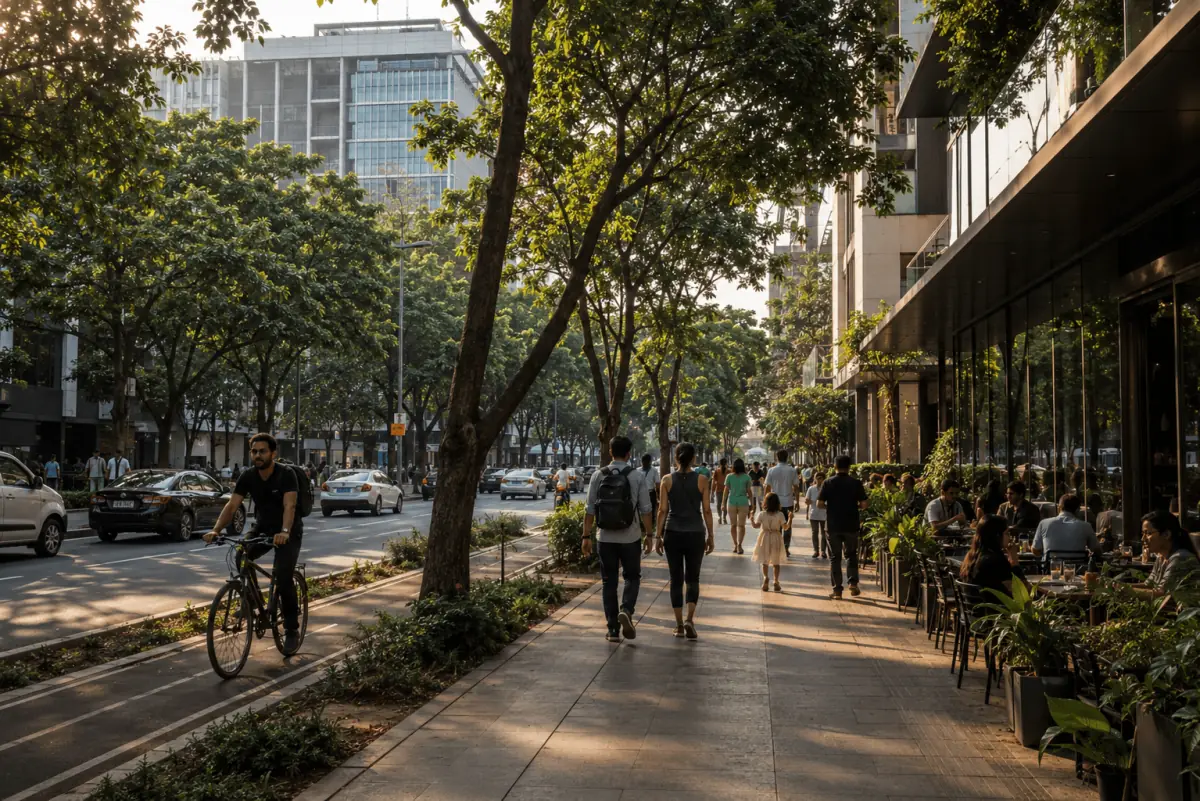
The table below is deliberately not a rate card. It sets out where each zone sits relative to the others and what is driving that position — the part that stays true between quarters. For the current rate in any of these zones, ask the developer in writing and check it against registered sale considerations on Kaveri Online Services.
| Zone | Sub-Markets | Position on price | What drives it | Rental Demand |
|---|---|---|---|---|
| East Bangalore | Whitefield, Varthur, Hoodi, ITPL | Upper-mid; mature | Tech park adjacency plus an operational metro — the connectivity here is delivered, not pending | Very high; immediate tech park adjacency |
| North Bangalore | Hebbal, Devanahalli, Bagalur, Kogilu | Lower-mid | Airport corridor and industrial expansion; long duration, contingent on ring-road delivery | Moderate; airport corridor, long commute to south tech hubs |
| South Bangalore | JP Nagar, Bannerghatta, Kanakapura | Mid | Pink Line metro corridor; residential rather than employment-anchored | Moderate-high; improving with Pink Line metro |
| West Bangalore | Rajajinagar, Yeshwanthpur, Tumkur Rd | Lowest of the six | End-user demand with limited corporate leasing; least exposed to IT cycles in both directions | Lower; predominantly end-user, less corporate rental |
| Sarjapur Road | ORR to Sompura Gate, Attibele | Mid, widening sharply along its own length | Multi-directional employment access; infrastructure still ahead of it rather than behind it | High; multi-directional tech corridor |
| Outer Ring Road Belt | Marathahalli, HSR, Bellandur | Highest of the six | Deep corporate demand against constrained land; a mature market where the infrastructure is built rather than sanctioned | Very high; peak corporate demand, mature market |
East Bangalore
This is the zone where the least is still pending. Whitefield, ITPL, and Varthur have an operational metro, occupied tech parks and a settled rental market, which means what you are buying here is largely what is already there. The entry case is the rent a specific unit can actually command — a number you can test against live listings for the same configuration nearby — rather than anything contingent on a future approval.
North Bangalore
This is the zone where the most is still pending. Devanahalli and the airport corridor rest on the Peripheral Ring Road completing and on continued KIADB industrial expansion — the first is tendering, the second is a programme rather than a delivered fact. The commute to the south and east tech hubs is the constraint corporate tenants cite, and until the ring road exists it stays the constraint. Drive it at your own commuting hour before you accept anyone’s account of it, including ours.
South Bangalore
This is the metro-linked opportunity. JP Nagar, Bannerghatta Road, and Kanakapura Road all sit within the Pink Line metro corridor. We do not publish a figure for what a station is worth — the estimates in circulation vary widely and none of them is a measurement of this corridor. The mechanism is the point: a station widens the pool of people who can live in a zone and commute out of it, and prices follow the pool. What is checkable here is the alignment itself, on BMRCL’s own site, and the fact that this corridor is residential rather than employment-anchored — so its demand comes from people commuting out of it. The timeline, not the catalyst, is the risk.
Sarjapur Road is covered in its own section below.
Deep Dive: How a Quote Is Built on Sarjapur Road
Sarjapur Road is the corridor this guide takes apart in detail, because it is the one where the fewest of the variables are settled. It is multi-directional, providing access to Infosys, Electronic City, Wipro, and Koramangala without requiring commuters to enter the city — that is geography, and you can drive it. Almost everything else about the corridor is at a stage rather than at a conclusion, and the sections below say which stage.
How the corridor is structured, from the ORR outward:
| Sub-Location | Development Stage | Position on price | What is settled, and what is not |
|---|---|---|---|
| ORR to Carmelaram (Core) | Ready-to-move | Highest on the corridor | Homes complete and let; you can inspect the unit and the OC. Little here waits on a pending approval |
| Carmelaram to Sompura Gate (Mid) | Under construction | Below the core | RERA registration and milestones are checkable; delivery is not done. Construction risk sits with the developer’s record |
| Sompura Gate to Sarjapur Town (Upper Mid) | Under construction / new launch | Below the mid stretch | Rests on a metro approved to a stage and not built. The timeline is BMRCL’s, not yours |
| Sarjapur Town to Attibele (Outer) | Pre-launch / plotted | Lowest on the corridor | No employment anchor of its own yet; title and approval quality on the specific parcel is the whole of the diligence |
What actually happened along the corridor. The sequence that reshaped the Sarjapur Road core is worth understanding because it is the sequence the mid-corridor may or may not repeat: a thin starting base, then employment arriving on the same road, then connectivity announced but not built. Each of those three is checkable against something. The base is checkable against registered sale considerations for the survey number on Kaveri Online Services. The employment is checkable against occupancy at the campuses on the corridor. The connectivity is checkable against the alignment BMRCL publishes. What is not checkable is a percentage someone quotes you for the corridor as a whole, which is why this guide does not print one.
The core is built out; the mid-corridor around Sompura Gate is not. Phase 3A metro connectivity, PRR completion and SWIFT City development all sit ahead of that stretch rather than behind it — each approved to a different degree, none delivered, and each carrying its own slippage risk. What that ought to be worth to you is a judgement you make, not a figure we supply.
How to model the yield yourself, on any unit on this corridor:
Do not accept a yield figure from anyone, including us. Build it from six inputs you can each verify, in this order:
- Purchase price — the quoted rate on your specific unit, in writing, times the saleable area on the agreement.
- Acquisition costs on top — registration and stamp duty at the rates the Karnataka Department of Stamps and Registration publishes on the day you register, plus documentation. Get the figure from the department’s own calculator rather than from a sales sheet.
- Achievable monthly rent — not the developer’s projection. Take live listings for the same configuration in completed projects within a kilometre, and discount them, because listings are asks.
- Annual holding cost — society maintenance at the rate per sq ft the project will actually charge, property tax, a vacancy allowance of at least one month, and repairs.
- Net yield — (2) and (4) subtracted, divided by total acquisition cost. On residential property in Bangalore this number is usually low enough to surprise people, and that is the honest starting point.
- Appreciation — leave it out of the yield calculation entirely and treat it as a separate, uncertain line. Anyone who blends an assumed appreciation rate into a yield figure has produced a number that says more about the assumption than the asset.
The yield alone looks modest, and it should. That is the honest floor of the argument for Sarjapur Road, and the rest of the argument is not a number: it is a corridor with real occupational demand, several employers rather than one, and infrastructure that has been sanctioned rather than merely talked about. Whether that is enough is your call. Anyone who converts it into a return figure for you has stopped describing the corridor and started describing their assumptions.
What the Infrastructure Around Sarjapur Road Actually Is
Infrastructure is the variable buyers are told most about and can verify most easily, because each of these projects is executed by a named body that publishes its own status. What follows is what each one is, who is building it, and how far it has got. What none of it comes with is a figure for what it does to a home, and you should be wary of any page that supplies one.
Metro Phase 3A — the Hebbal–Sarjapur corridor
Phase 3A is the Hebbal–Sarjapur corridor — reported in the press as the Red Line, though BMRCL has announced no colour for it — and it is worth separating from the two lines it gets confused with, because they are different projects at different stages: the Yellow Line (RV Road to Bommasandra) serves Electronic City and Bommasandra, and the Pink Line (Kalena Agrahara to Nagawara) serves the Hulimavu, JP Nagar and Bannerghatta corridors. Neither of those is Phase 3A, and neither runs to Sarjapur Road. We publish no figure for what that is worth per square foot, and we would not trust one: the estimates in circulation are modelled, not measured, and none of them was measured on this corridor.
Current status: Phase 3A has received State Cabinet approval and is awaiting Union Cabinet approval. Nothing is under construction on this alignment yet. Treat any operational date you are quoted, including the 2030-to-2033 window in circulation, as an estimate rather than a commitment, and check the current position and station list on BMRCL’s own site rather than in a brochure.
The Bengaluru Business Corridor (BBC)
The Bengaluru Business Corridor, formerly the Peripheral Ring Road, will create a 73-km orbital connection around Bangalore, linking Tumkur Road in the northwest to Hosur Road in the southeast, directly passing through the Sarjapur and Attibele belt. If it is built as aligned, it would give the corridor a road link to North and West Bangalore that does not exist today, which is the mechanism people are describing when they talk about a wider tenant pool. Phase 1 tendering began in 2026; nothing is open to traffic, and the corridor has slipped before. Treat the timeline, not the catalyst, as the risk, and take the current status from the BDA rather than from a sales sheet.
SWIFT City. The proposed SWIFT (Start-up, Warehousing, Innovation, Finance, and Technology) City on the Sarjapur-Attibele belt is a state government-backed employment anchor. We publish no job-creation figure for it, because none of the numbers in circulation is KIADB’s own — its status is at kiadb.in, and that is where to read it. Current status: land acquisition in progress, which is a long way from occupied desks. The reason it matters at all to the outer Sarjapur belt is structural rather than numerical: that stretch has no employment anchor of its own today, and SWIFT City is the only one proposed for it.
Buying Strategy for Domestic and NRI Investors
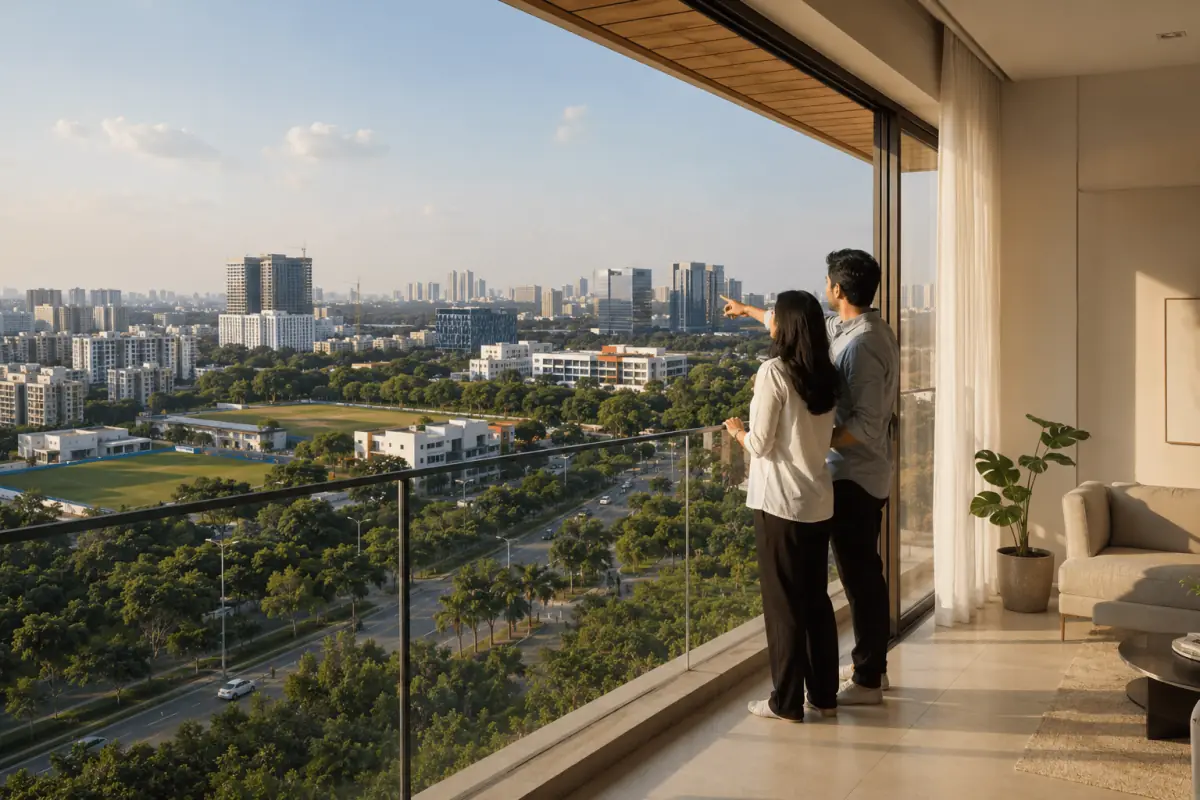
Understanding apartment prices in Bangalore is only half the decision. The other half is knowing which type of buyer you are and what that means for which zone, configuration, and stage you should be targeting.
For the upgrading family
Your priority is liveability, school access, and manageable EMIs. The ORR-to-Carmelaram belt on Sarjapur Road gives you proximity to Harvest International, Euro Kids, and a cluster of secondary schools, combined with ready-to-move inventory that eliminates construction risk. Budget for registration and stamp duty on top of the base price, at whatever the Karnataka Department of Stamps and Registration has notified on your registration date — the department publishes the current rates and a calculator on kaverionline.karnataka.gov.in, and those rates change by notification, so take them from there rather than from a sales sheet or from this page.
For the domestic investor
Leverage is your tool, and it cuts both ways. Deploying equity against a larger asset in the mid-Sarjapur corridor puts the whole asset’s movement onto a fraction of your capital — which magnifies a gain and equally magnifies a flat decade. Run it on your own numbers, using the six inputs above and the rate your lender actually offers you, before treating leverage as an argument. The recurring risk is vacancy, and the tenants who reduce it are the ones who can reach their desk on foot — so walk the route yourself, at your tenant’s hour, before you accept anybody’s account of it. Prioritise the location over the amenity stack.
For the NRI buyer
The regulatory pathway is clear. An NRI can purchase a single residential property in India without RBI approval under FEMA guidelines. Funds can be routed through an NRE or NRO account. Rental income is repatriable, subject to applicable TDS deductions. Capital gains on sale are repatriable, subject to FEMA conditions and applicable tax treatment.
The practical challenge is property management. Agencies charge either a percentage of the annual rent or a flat retainer of around a month’s rent, and the scale varies by agency — ask for the fee schedule in writing, and put it into the holding-cost line of the yield calculation above rather than treating it as a rounding error. What it buys you is the removal of operational complexity from another time zone, which for most NRI owners is the point.
Due diligence before any purchase — the four non-negotiables:
- RERA verification: Check project registration, promoter history, and construction milestone compliance on rera.karnataka.gov.in
- Khata classification: Confirm A-Khata status. B-Khata land creates complications in future resale, home loan disbursement, and Khata transfer
- UDS in sale agreement: The Undivided Share of Land allocated to your unit must be specified explicitly. Do not sign a sale agreement that leaves this vague
- Occupancy Certificate: For ready-to-move properties, confirm OC has been issued by BBMP or BDA before paying the final tranche
Suyug’s projects at Sompura Gate — The 1 (235 units, RERA: PRM/KA/RERA/1251/310/PR/051224/007268) and Saffron (110 units, RERA: PRM/KA/RERA/1251/308/PR/140825/008000) — are MIVAN-constructed residences with no shared walls, rainwater harvesting, solar integration at Saffron, and EV charging, in the mid-Sarjapur corridor. On green building the two are not in the same position and we do not merge them: THE1 holds IGBC pre-certification — a design-stage assessment by the Indian Green Building Council, ahead of the final certificate awarded on completion. Saffron is designed to align with IGBC guidelines and has not been assessed by IGBC.
Speak with Suyug’s advisory team to review RERA documentation, floor plans, and pricing for The 1 and Saffron at Sompura Gate.
How to Read Any Price Quote Before You Sign
Whatever the number quoted, the figure on a broker's sheet or a builder's brochure is rarely the number that ends up on the agreement for sale. A useful discipline, on any project and any corridor, is to ask what that headline rate is actually applied to, and what it excludes.
- Which area is the rate quoted against? A per-square-foot rate against super built-up area and the same rate against carpet area describe very different homes. RERA requires the agreement for sale to state carpet area explicitly — ask for that figure before comparing rates across projects, not after.
- What sits outside the base rate? Car parking, club membership, a corner or floor-rise premium, statutory charges (stamp duty, registration, GST), and a maintenance deposit are commonly quoted separately from the base rate. A like-for-like comparison across two projects only works when every buyer adds these back in on both sides.
- Is the quote for a specific unit or a project average? Rates vary by floor, facing and tower within the same project. A quote given over a phone call, before a specific unit number is discussed, is an opening figure — not a commitment.
- What does the payment plan actually require, and when? A construction-linked plan and a down-payment plan can carry different effective costs once financing is factored in. Ask for the payment schedule in writing before treating any headline rate as comparable across projects.
None of this replaces professional advice on a specific transaction. It is simply the set of questions that turns a marketing number into a comparable one.
One Thing Worth Sitting With
The buyers who make sound decisions on apartments for sale in Bangalore in 2026 are the ones who separate location from project, the rent a unit earns from the story attached to it, and what is delivered from what is merely sanctioned. On Sarjapur Road’s mid-corridor that distinction does most of the work, because so much of what is described to you there is still an approval rather than a road. Ask which it is, every time, and ask who has to sign the next stage. That question has an answer on the public record. The one about what it will all be worth does not.
Frequently asked questions
Bangalore does not have a single average, and we do not publish a rate card. Rates move by quarter and by micro-market, so any figure printed here would be stale before most people saw it. The order is consistent even when the numbers move: the Outer Ring Road belt and the central premium pockets sit at the top, established east and Sarjapur Road corridors sit in the middle, and the peripheral belts sit below both. For the current number on a specific project, ask the developer in writing and cross-check it against the sale consideration on registered transactions in the same survey number through the Karnataka Department of Stamps and Registration’s Kaveri Online Services portal.
We do not publish appreciation percentages, because the honest ones are hard to verify and the convenient ones are marketing. What is checkable is the mechanism: the corridors that reprice hardest are the ones that started from a low base and then received employment and connectivity at the same time — which is why the east and Sarjapur Road corridors have moved more than the mature central pockets. To test any corridor claim yourself, pull registered sale considerations for the same survey numbers across two dates on Kaveri Online Services. That is a transaction record rather than an estimate.
On the framework rather than on a forecast, because we publish no forecast. The variables that are actually checkable are the depth of the employment base near the corridor, whether that base rests on one employer or several, how much land is left in the pocket, the project’s RERA registration and construction milestones on rera.karnataka.gov.in, the Khata classification and the Undivided Share written into your sale agreement. Where the infrastructure catalysts are concerned — metro, the Peripheral Ring Road — what you can verify is their stage of approval and who sanctioned them, not what they will do to a price. Anyone telling you a corridor’s value is not yet priced in is describing an opinion, not a measurement.
A station changes what a location is worth by changing who can live there and commute from it, and that shows up in prices after the line is operational rather than when it is announced. We do not publish a percentage for it. What matters for a buying decision is the status and the alignment, both of which are public: Metro Phase 3A (the Hebbal–Sarjapur corridor) is awaiting Union Cabinet approval; Phase 2A/2B (Yellow and Pink Lines) is approved and in execution. Check the station list and alignment on Bangalore Metro Rail Corporation Limited’s own site rather than a brochure line reading “metro nearby”, and treat the timeline as the risk it is.
An NRI can purchase a residential property in India without RBI approval under FEMA guidelines. Purchase funds must be routed through an NRE or NRO account. Rental income is repatriable net of applicable TDS. Capital gains on eventual sale are repatriable subject to FEMA conditions, and applicable tax treatment. Engaging a FEMA-literate CA before purchase is advisable for NRIs.
Was this useful?
Comments
Was this useful?
Schedule a site visit
Leave your details and the team will call back to fix a convenient date.