
Bengaluru’s Longest Metro Line via Sarjapur

SUYUG Infra
Short briefing · 1,274 words · 6 min read
Bengaluru’s Longest Proposed Metro Line via Sarjapur: What Is on the Record, What Stage It Has Reached, and Where The1 and Saffron Sit on the Corridor

Bengaluru is entering a new phase of infrastructure-driven real estate growth. The proposed expansion of Namma Metro — including a corridor connecting Kalena Agrahara to Kadugodi via Sarjapur — signals a major shift in how the city will expand. The feasibility study puts the main line at 68 km and adds a 5 km spur to the proposed international cricket stadium in Anekal taluk, 73 km of route in total, around fifty stations, fully elevated. The 73 is the total and already contains the spur; the version in circulation that adds five kilometres to it is counting the same track twice. And a feasibility study is the stage this has reached — the study is complete, no detailed project report has been prepared, and neither the state nor the Union government has sanctioned it.
For property buyers and investors, the useful question is not what this will do to prices — nobody can tell you that, and we will not — but what stage the proposal has actually reached, and what a built line would change for the people living on the corridor.
What the Sarjapur Metro Corridor Would Actually Change
1. Strategic Connectivity Upgrade
The planned metro line is expected to pass through:
- Bannerghatta Road
- Jigani Industrial Area
- Attibele
- Sarjapur Road (core growth zone)
- Dommasandra
- Varthur
- Whitefield (IT hub connectivity)
These are high-demand zones currently constrained by road traffic. Two of them are the two arms of the same corridor, and they are not interchangeable: what gets built on Sarjapur Road and what gets built on the Sarjapur–Attibele arm differ, even where the district and the regulator do not.
A metro line here changes the commute, and it widens the pool of people who can live on this corridor and work elsewhere in the city. Those are the two things it does. What they are worth is not something we put a number on.
2. What a Metro Proposal Is, and Is Not
A proposed line is not a built line, and the gap between the two is where most of the risk sits. Before weighing any of this, separate the three things people routinely blend together:
- The alignment — which stretch the line is drawn along. Published by BMRCL, and subject to change until it isn’t.
- The station locations — which decide whether a specific project is genuinely walkable to a platform or merely in the same postcode. Also BMRCL’s to publish.
- The stage of approval — DPR, state approval, Union Cabinet approval, tendering, construction. Each is a separate hurdle, and a line can sit at one of them for years.
How to check each of the three:
- Ask which station is being claimed, by name, and find it on BMRCL’s published alignment
- Ask what stage of approval the line has actually cleared, and who has to sign the next one
- Walk the distance from the site to the station location yourself, before accepting anyone’s description of it
None of those three questions has a marketing answer. They all have documented ones.
What Changes at Each Stage, and What Does Not
Short-Term (0–2 Years)
- Increased buyer interest and enquiry volume
- A developer-led marketing push, in which “metro nearby” starts appearing on hoardings
- Nothing built, and no change to what any agreement for sale actually binds
Mid-Term (2–5 Years)
- Alignment, station locations and construction dates either firm up or slip — both happen, and the second is not rare
- Land use around confirmed station locations begins to change, which is visible on the ground
- The commute itself is still unchanged until a line opens
Long-Term (5+ Years)
- If commissioned, the corridor gains a transport option it does not have today
- The pool of people who can live here and work across the city widens
The Question Most Buyers Skip
Most buyers ask when the metro will open. The more useful question is a different one:
Would I still want this home if the line never came?
If the answer is yes, the metro is upside you have not paid for. If the answer is no, you are buying an approval rather than a home — and approvals are not what an agreement for sale binds.
Where THE1 and Saffron sit on this corridor
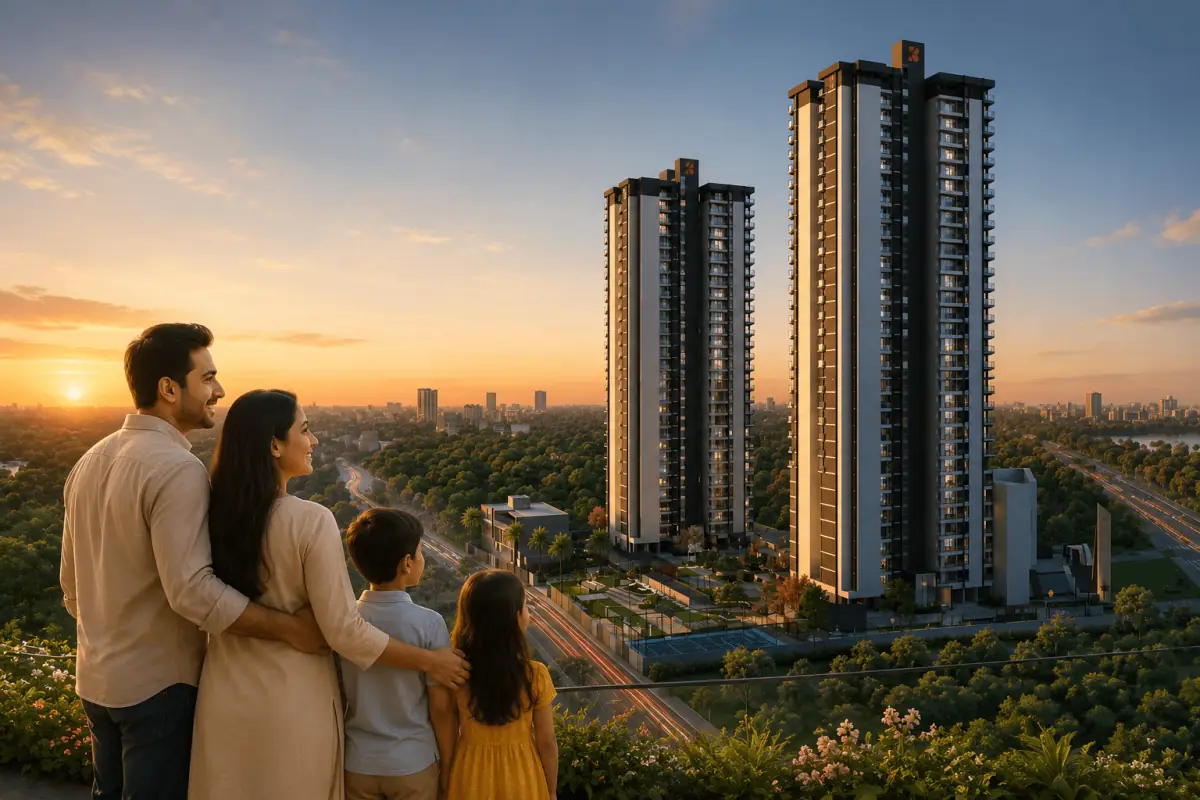
Both are apartment projects at Sompura Gate on Sarjapur Road, in Bengaluru Urban district, registered with K-RERA. Neither is a plotted development, and nothing on this corridor is DTCP-approved — DTCP is a Tamil Nadu authority, and this is Karnataka. Our only plotted project, The Big Banyan, is across the state line in Krishnagiri district and is registered with TNRERA.
- THE1 — 235 residences in two towers on 3.5 acres. 3 BHK homes of 1,601–1,939 sq ft and 4 BHK penthouses of 3,122–3,573 sq ft. K-RERA PRM/KA/RERA/1251/310/PR/051224/007268.
- Saffron — 110 residences on 2.5 acres, in 3 and 4 BHK configurations.
What a confirmed metro alignment changes for an apartment buyer is narrower than the general case above, and worth stating plainly: it changes the commute, and it changes the pool of people who will want the home later. It does not change the carpet area, the specification or the registration — those are what the agreement for sale binds, and they are the same the day before an alignment is announced as the day after.
We publish no appreciation figure, no rental yield and no forecast for either project. The alignment, the station locations and the construction dates are BMRCL's to announce, and bmrc.co.in is the source of record for all three. Anyone quoting you a return that a metro line will deliver is quoting themselves.
Critical Buyer Insight
Q: What will the metro line do to property prices?
Answer: We do not know, and neither does anyone else quoting you a figure. What is knowable is the alignment, the station locations and the stage of approval — all three published by BMRCL — and what a built line changes in practice, which is the commute and the size of the pool of people who would want the home later.
Q: How should I weigh Sarjapur Road in 2026?
Answer: On what you can verify. The employment access is multi-directional rather than tied to a single campus, and you can drive it. The schools, hospitals and workplaces are named individually elsewhere on this blog, and you can visit them. The metro is proposed, not built. Weigh those separately, and treat the third as a timeline risk rather than a feature.
Q: Does proximity to a metro station change what a home is worth?
Answer: It changes the commute, and it widens the pool of people who will want the home later — both are real. What we will not do is put a number on it. Any figure for how much a station is worth is a forecast, and a forecast about infrastructure that is not built yet is a forecast twice over. Check the alignment and the station locations against BMRCL before you weigh it at all.
Q: Is it better to buy before the metro is finished?
Answer: That depends on facts about you, not about the metro — when you need the home, what the loan costs you in the meantime, and whether you would still want it if the line slipped. Everyone selling you "early entry" is describing an upside without pricing the delay risk beside it. The registration, the agreement for sale and the specification are what bind, and they do not improve because a station opens nearby.
Was this useful?
Comments
Was this useful?
Schedule a site visit
Leave your details and the team will call back to fix a convenient date.