
The Real Case for Buying a 3 BHK Apartment in Sarjapur Road in 2026
SUYUG Infra
Long guide · 3,621 words · 16 min read · 6 questions answered
In this article · 9 sections
There’s a particular moment in every serious homebuyer’s journey when the shortlist stops changing. You’ve visited enough projects, read enough brochures, and talked to enough brokers to know where you’re actually going to land. For a growing number of buyers in Bengaluru, that moment keeps pointing to the same corridor: Sarjapur Road.
This isn’t about hype. Sarjapur Road has been “the next big thing” for so long that the phrase started to feel hollow. But something has shifted in the last 24 months. The corridor isn’t speculative anymore. It’s expensive, it’s crowded, and depending on the time of day, it’s frustrating to drive through. And yet, the 3 BHK segment here is consistently oversubscribed at launch. That contradiction deserves an honest explanation, not a glossy one.
This guide is written for buyers who are somewhere between seriously interested and genuinely confused. It covers prices, infrastructure, the school ecosystem, commute reality, and the investment case. Where the picture is positive, we’ll tell you why. Where it gets complicated, we’ll tell you that too.
TL;DR
- Sarjapur Road is no longer one price band — what a project costs per sq ft depends far more on its micro-zone and tier than on the corridor name it advertises
- The 3 BHK configuration has become a functional requirement for hybrid-working professionals, not just a lifestyle upgrade
- Metro Phase 3A (the Hebbal–Sarjapur corridor) is real but distant; completion is projected for 2033
- The school belt — Oakridge, Indus, Greenwood High, NPS East — is one of the strongest demand anchors in the city
- Peak-hour commutes to Whitefield and Koramangala are materially longer than the same drive off-peak; test your own route on a working morning rather than planning around a brochure estimate
- Rents for 3 BHKs vary widely by sub-location; establish the figure yourself from what the neighbouring towers are actually let at, rather than from any published range
- Projects built with real sustainability credentials — a documented IGBC status, no shared walls, smart drainage — hold their value better in resale
Why the 3 BHK Has Become the Default Configuration
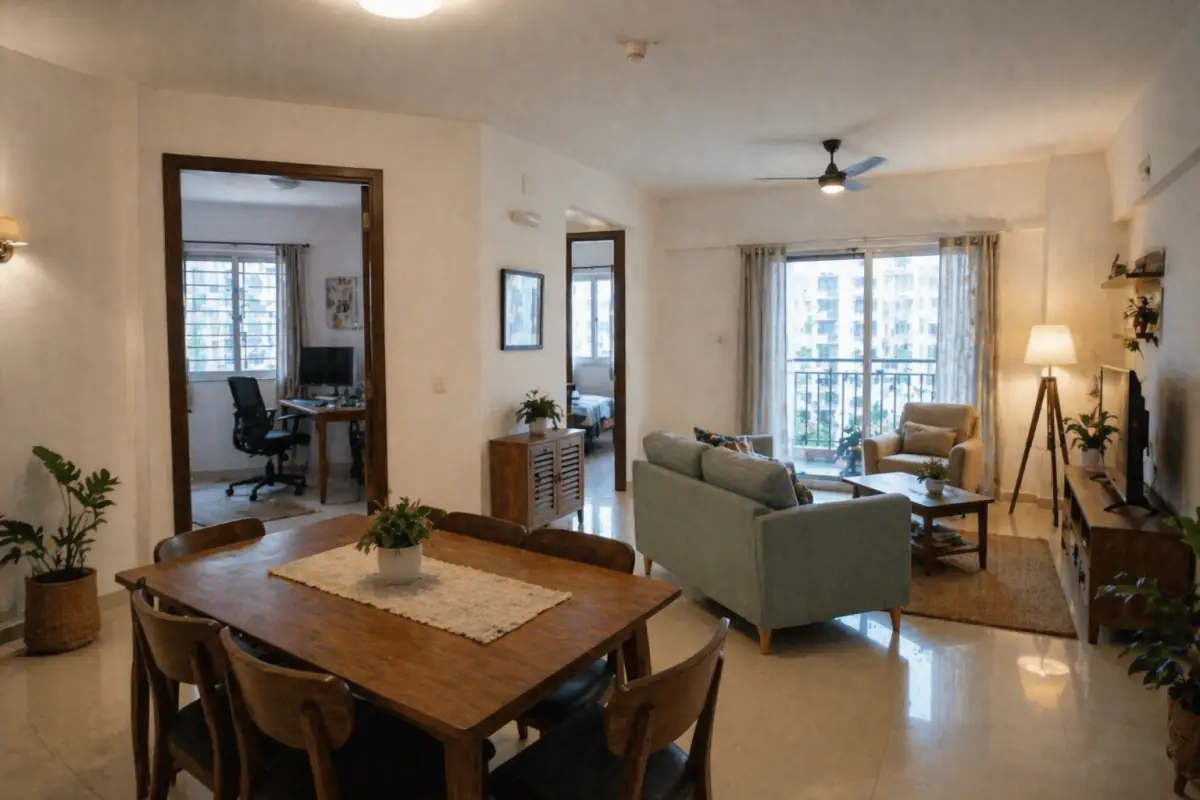
A few years ago, a 3 BHK in Sarjapur Road was a decision you made when your family grew or your income crossed a certain threshold. Today, it’s increasingly the first serious purchase, not the second.
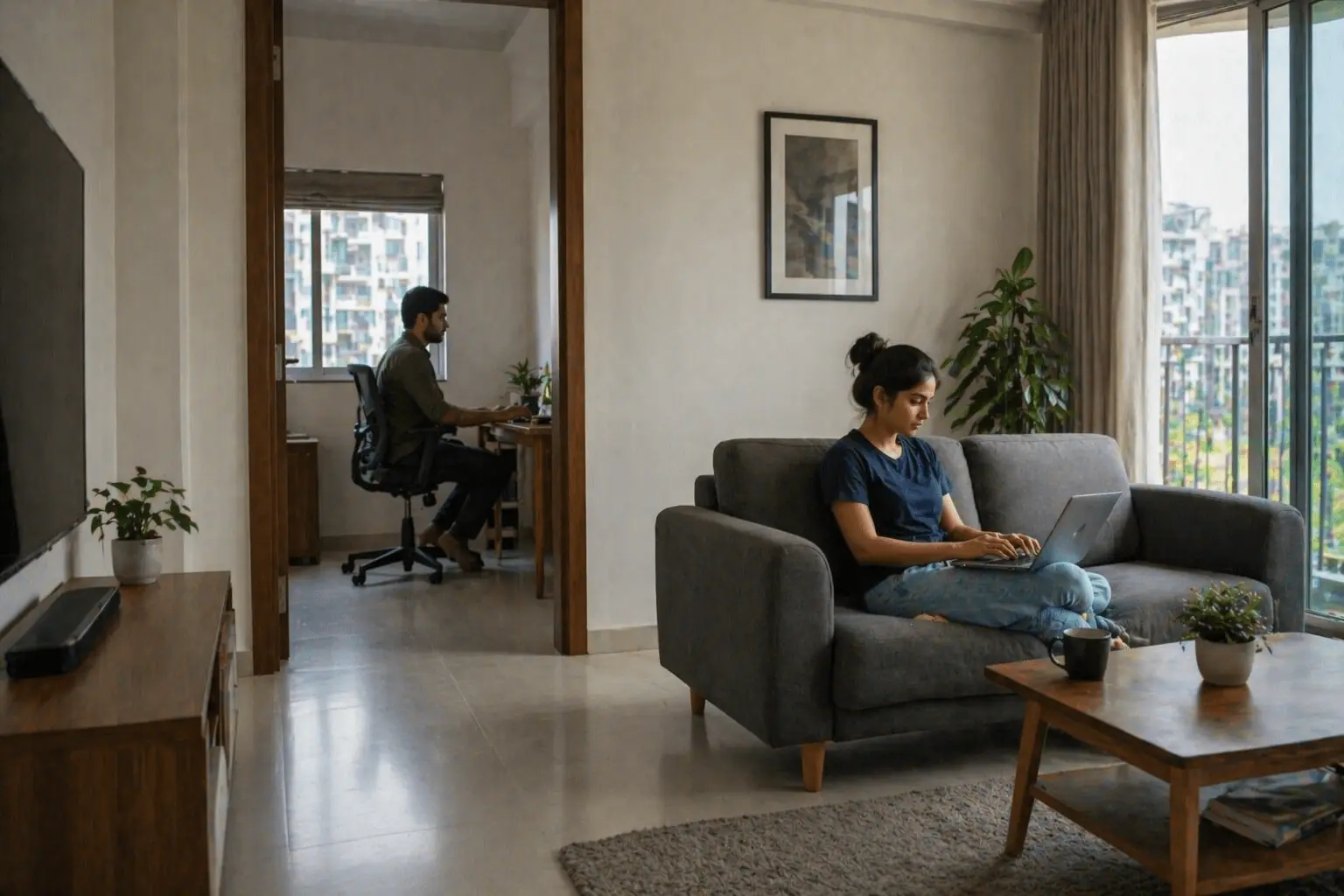
The shift is rooted in how work has changed. Hybrid schedules are now the norm across most of the IT companies clustered in this corridor — Wipro, Accenture, Microsoft, Infosys. When three days a week are spent at home, the architecture of the home stops being incidental. The third bedroom stops being hypothetical and starts being functional: a dedicated workspace that doesn’t bleed into where your family eats or sleeps.
What buyers are actually evaluating now:
- Whether the layout allows two people to work simultaneously without interfering with each other’s calls
- Whether the balcony or verandah creates enough separation from the living area to feel like a different environment
- Whether the building is dense enough that you can hear neighbours through shared walls — a growing concern in high-rise developments
- Whether the carpet area actually matches what the brochure calls “usable space”
The 1,450 to 2,000 sq ft range that defines most 3 BHKs in this corridor is not accidental. It’s the minimum footprint for a household of four that includes one or two work-from-home professionals without the home feeling compressed. Projects that have prioritised no-shared-wall design and cross-ventilation — features that sound like architecture jargon until you’ve lived in a flat that doesn’t have them — are seeing noticeably stronger demand at both the buying and rental stages.
For families with children, the calculus adds another layer. The third room becomes a child’s bedroom, the home office shifts to the dining area or a corner of the master bedroom, and that compromise is what drives buyers back to the 3 BHK even when the budget strains. The functional logic is clear, and it isn’t going away.
What Prices Actually Look Like in 2026
Sarjapur Road is no longer a single price band. The variance across the 21-kilometre corridor is driven less by the label on a project and more by the specific micro-zone it sits in.
The broad price picture:
- The gap between the cheapest and the dearest per-sq-ft rate on the corridor is wide enough that a corridor average is close to meaningless for any individual purchase
- What separates the tiers is sub-zone maturity, land cost and specification — not the marketing label
- The comparison that actually informs a decision is the rate a specific project is quoting today against the rate it launched at, which a developer can show you and an average cannot
What this means for a 3 BHK buyer:
- The lower end of the range sits in the least built-out sub-zones — Sompura and Dommasandra — where more of what you are buying is still a plan than a delivered building
- The middle band is where most serious transactions on this corridor happen: social infrastructure already running, projects at or close to completion, resales you can inspect
- The top of the range is township-scale, with larger floor plates and a deeper amenity programme; ask what that adds to the monthly maintenance, which is charged per unit of area and therefore scales with the size of the home
| Locality | Where entry prices sit | Where it is in the cycle | What holds the rent up |
|---|---|---|---|
| Sarjapur Road | Wide internal spread — three markets under one name | Mid-cycle; road and metro work sanctioned, not built | Wipro on the corridor, ORR belt and Electronic City in reach |
| Whitefield | Narrow band, above Sarjapur Road’s middle | Mature; metro delivered and in the price | ITPL and a dense mid-size tech cluster |
| HSR Layout | Highest of the four by a wide margin | Fully priced; supply-constrained | Startup density and central location |
| Electronic City | Lowest of the four | Mature; Yellow Line already operational | Infosys and Wipro campuses — deep, but concentrated |
HSR Layout is the most supply-constrained of the four and the hardest to enter. Whitefield already has its metro delivered, which means that part of its story sits behind it rather than ahead of it. Electronic City has a deep employment base but a concentrated one. Sarjapur Road sits at a different point in the same cycle: the road and rail work here is sanctioned rather than built, and that is the whole of the difference. Whether that reads as opportunity or as risk depends on how long you can wait — and we are not going to tell you which way it resolves.
The Infrastructure Timeline: What’s Confirmed, What’s Not
Infrastructure is where buyer optimism and market reality diverge most sharply on Sarjapur Road. Here’s a clear-eyed breakdown.
Metro Phase 3A — The Hebbal–Sarjapur Corridor
What’s proposed:
- 36.59 km line with 28 stations
- Key interchanges at Iblur (Blue Line), Agara (Blue Line), Dairy Circle (Pink Line), KR Circle (Purple Line)
- Project cost: there is no sanctioned figure to quote. The Union government has not approved the DPR, and the state’s own estimate has already been revised downward once after the Centre asked for the cost to be rationalised. BMRCL publishes the figure that is current; a number that has moved twice does not belong on this page
Current status (as of early 2026):
- Geotechnical investigations active for Sarjapur–Carmelaram stretch
- Central government has raised technical concerns about the double-decker viaduct design — specifically whether parallel road and metro infrastructure may push commuters back to private vehicles
- Projected completion: 2033
What this means for you:
- End-users expecting to commute by metro by 2028 should recalibrate
- Investors with a 5–7 year horizon are better positioned; the re-rating around a metro line historically happens in the months before it commissions, not after it opens
Peripheral Ring Road (PRR) and STRR
These are the more realistic near-term infrastructure wins:
- The 116-km PRR links Tumakuru Road to Hosur Road, bypassing the city core entirely
- The 288-km STRR diverts heavy freight away from Sarjapur Road, reducing the “dust bowl” effect residents have long complained about
- Combined effect: both are designed to move through-traffic and freight off the corridor itself, which is the mechanism by which local movement improves. How much, and by when, is a question for the implementing agencies rather than for a property page
The Sarjapur main road widening is also in progress. It has worsened congestion while the work is live; what the corridor feels like once it is finished is something you can only judge after it is finished. Ask the implementing authority for the current stage of work rather than taking a completion estimate from a sales desk.
The School Belt: Why Families Keep Choosing Sarjapur Road
For buyers with children — or buyers planning for them — Sarjapur Road’s concentration of schools is one of the most underrated factors in the purchase decision.
The school ecosystem at a glance:
- Oakridge International (IB/IGCSE) — take current fees and the admissions cycle from the school directly
- Indus International (IB) — a long-established IB campus on this side of the city
- Greenwood High (ICSE/IB) — on the corridor itself; take current fees from the school directly
- National Public School East (CBSE) — on the corridor
- Champion International (Cambridge) — take current fees from the school directly
The spread matters. This isn’t an ecosystem serving only high-income families; it runs from CBSE day schools to full IB campuses, which is part of why the demand anchor here is durable. Fee structures change every year and each school publishes its own, so take them from the school rather than from a property page.
Why this matters to a buyer beyond the obvious:
- School proximity drives a stable secondary demand for rental — families relocating for an admission want to be within a short school run, and that demand renews with each admissions cycle rather than with a launch
- The high-income demographic that these schools attract has downstream effects on the quality of retail, dining, and social infrastructure in the area
- In resale, properties inside the school belt hold their buyer pool better than comparable flats further out on the same road, because that demand is anchored to admissions rather than to a launch cycle
Beyond schools, the corridor includes Manipal Hospital, Motherhood, and Sakra World Hospital — a healthcare concentration that matters significantly for joint families and buyers with elderly parents. Together, these amenities create a self-sufficiency that reduces long-term dependence on the broader city grid.
Suyug has consistently prioritised proximity to this ecosystem in its project selection on Sarjapur Road — a positioning that reflects a genuine understanding of what retains value over time, not just what sells at launch.
The Commute Reality: An Honest Assessment
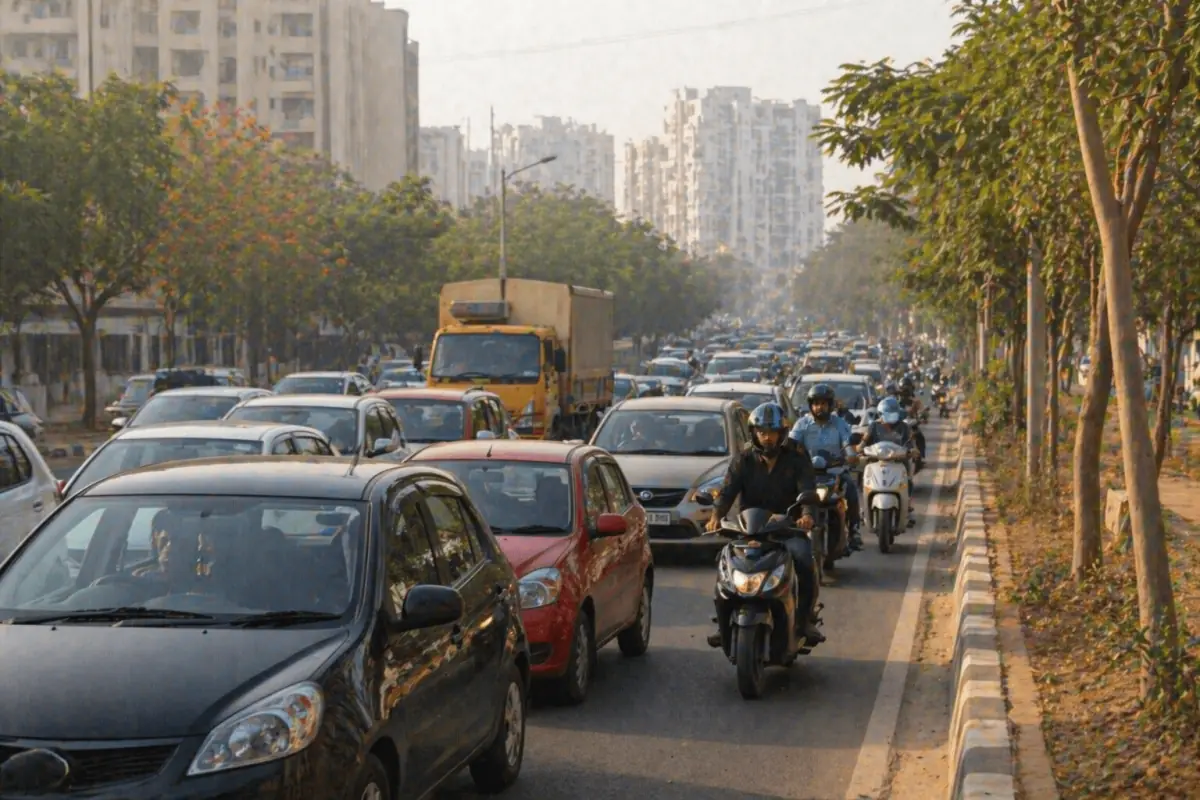
The commonest source of buyer regret on Sarjapur Road isn’t the price. It’s the commute. The gap between what a brochure implies and what a resident experiences is wide enough to warrant its own section.
A brochure drive time is almost always a clear-road drive time — the run at 11 PM on a Sunday, not the run at 8:30 AM on a Tuesday. SUYUG publishes no drive times or distances, here or anywhere else on this site, for the same reason: a journey time is not a fact about a property. It moves with the hour, the direction, the route, the school term and whatever roadwork is live that week, and the only version of it that matters is yours.
How to establish your own commute before you book:
- Drive it from the actual site gate to your actual office gate, on a working Tuesday or Wednesday morning — not a weekend, not a public holiday, not during a school vacation
- Drive the evening return as well. The two directions are rarely symmetrical on this corridor
- Do both twice, a few weeks apart. One run tells you about one morning
- Note which route you were pushed onto, and whether it passes a school gate, a narrow village stretch or an active worksite — those are the choke points that do not clear on their own
- Ask residents of a completed project nearby what their own morning looks like. They have no reason to flatter it
How to think about this:
If you work on-site five days a week and your office is in Whitefield, be honest about the mental cost of a long daily commute compounded over months and years — the one you measured yourself, not the one a brochure implied. If you work from home three or more days a week — or if your office is within the corridor itself at Wipro HQ or RGA Tech Park — the commute calculus shifts decisively in favour of the location.
The PRR, once operational, is designed to move traffic around the city core rather than through it, and it is the sanctioned project most likely to change inter-zone movement here. Until it opens, the commute is a real variable, not a footnote.
The Investment Case: Rent, Value, and the Long Horizon
The 3 BHK on Sarjapur Road is increasingly being evaluated as a dual-purpose asset: a place to live today and a performing investment over a 5–7 year horizon. That framing is reasonable. What follows is how to test it with your own numbers, because we do not publish ours.
How to establish the rent, rather than read it off a page:
- Rents are highest at the Kaikondrahalli and Bellandur end, where the completed stock and the employment cluster are densest — but so is the entry cost, and the two largely cancel out
- Mid-corridor, near Wipro HQ and RGA Tech Park, the tenant base is the corridor’s own workforce; ask two brokers who work that stretch what the last three 3 BHK lets in the neighbouring towers actually closed at
- Towards Sarjapur Town and Sompura, both rents and entry costs fall, and the risk shifts to how long a unit sits empty between leases
- To turn any of that into a yield: multiply the verified monthly rent by twelve, subtract maintenance and your expected void months, and divide by your own all-in cost rather than the base price. That number is yours and a stranger can check it; a published yield range is neither
The value case, stated as a mechanism rather than a forecast:
Sarjapur Road prices move when employment lands and when road and rail capacity is added, and both are still in progress here. A rail line tends to be reflected in the market before it commissions rather than after it opens, which is why the entry window and the completion window are not the same thing. Metro Phase 3A is the longest-dated catalyst on the corridor; anyone buying for it is taking a horizon measured in years, not quarters. We do not put a number on any of that, and you should be sceptical of anyone who does.
The practical question for a buyer today: does the entry price already reflect too much of that future value? At the top of the corridor’s range, where the sub-zone is mature and the infrastructure is already built, that is a fair concern. In the middle band — particularly in sub-zones like Dommasandra and Carmelaram, where the road and metro work is still ahead — more of the case is still to come. Which of those you are looking at is something the developer’s own launch-to-today rate will tell you, if you ask for it.
What to Look For When Evaluating a Project
The quality of 3 BHK inventory on Sarjapur Road is uneven. Price is not a reliable proxy for build quality or long-term liveability.
Design and Layout — Non-Negotiables
No shared walls between apartments. This is the difference between genuine privacy and borrowed peace. It’s rarer than it should be at this price point, and worth specifically asking for on any site visit.
Cross-ventilation and natural light. The orientation of a flat relative to the building affects your electricity bill and your daily mood more than any clubhouse feature. Ask which direction the living room faces and where the wind runs through.
Balcony size. Anything under 50 sq ft is functionally decorative. At 80 sq ft and above, a balcony becomes a usable secondary workspace, a morning coffee zone, or a reading corner — which is what it’s supposed to be.
Sustainability — What to Actually Check
- IGBC status: ask which of three different things a developer means — a final certificate, awarded only after a completed building has been verified against what was submitted; a pre-certification, which is a design-stage assessment; or a design that merely aligns with IGBC guidelines and has never been assessed at all. Any of them can track to better water management, energy efficiency and lower long-term maintenance costs. Only the first two come with a document, so ask to see it
- STP technology: projects with Phytorid or Soil Bio Technology systems handle Bengaluru’s water stress significantly better than conventional sewage treatment; tanker dependency is a real quality-of-life issue in this corridor
- Rainwater harvesting capacity: ask for the system’s capacity relative to the project’s total occupied area, not just whether the system exists
Due Diligence Checklist
- RERA registration and stage-wise approvals — confirm online, don’t rely on the sales team
- Builder’s delivery track record specifically (not just finish quality)
- Open space to built-up area ratio — below 40% feels dense in practice regardless of what the render shows
- Carpet area certificate (RERA-mandated) — always ask for this separately from the super built-up area figure
Suyug’s Saffron project — designed to align with IGBC guidelines though not assessed by IGBC, with no shared walls and planned specifically for long-term usability on Sarjapur Road — is a useful reference point for what responsible development in this corridor can look like, regardless of whether it makes your shortlist.
Thinking about buying a 3 BHK on Sarjapur Road? Suyug’s team can walk you through current inventory, floor plan options, and what to ask before you commit to any project on the corridor. It’s a conversation, not a pitch.
One Thing Worth Sitting With
The Sarjapur Road story is genuinely compelling. The employment base is real and already occupied. The school belt is real. The sanctioned road and rail work is real. What’s also real is that this corridor rewards buyers who go in with clear eyes about what exists today — the traffic, the dust, the infrastructure that’s years away — versus what will exist when the metro arrives and the roads are finally finished.
The buyers who make the best decisions here aren’t the most optimistic. They’re the ones who’ve modelled both versions of the future and concluded that even the less convenient one is worth it.
Frequently asked questions
We publish no price bands and no forecast, so treat anyone who does — a sales desk included — as offering a guess rather than a fact. What you can check instead is specific: ask the project you are looking at for the rate it is quoting you today against the rate it launched at, which a developer can show you and a corridor average cannot. Then look at what actually drives demand here — an employment base already built and occupied, a school belt already running, and road and rail work that is sanctioned but not delivered. Whether that is worth today’s entry cost is a judgement about your own horizon, and not a market call we can make for you.
Ask for the plinth elevation (600mm above road level is the minimum) and request the stormwater drainage plan. Cross-check your shortlisted project’s land against BBMP’s storm water drain maps — the 2022 ORR flooding is a useful reference point for which areas are genuinely at risk.
Longer at peak than any brochure implies, and we do not publish a figure for it — a journey time changes with the hour, the route, the season and whatever roadwork is live that week, so a number on a page is not a fact about a home. Drive it yourself from the site gate to your office gate on a working Tuesday morning, then again on the evening return, before you decide. If Whitefield is your destination five days a week, that test is the decision. Sanctioned road and metro work may change it later; check the current status with BMRCL and the relevant government notification rather than with a sales estimate.
Target at least 1,300 sq ft of carpet area — super built-up figures carry loading factors of 25–35%, so always ask for the RERA carpet area certificate separately. Anything under 1,200 sq ft of usable carpet starts to feel tight if two people are working from home simultaneously.
For a long-horizon investor, the 2033 timeline works as a thesis only if you are genuinely comfortable holding that long — and you should confirm the current sanction status and alignment with BMRCL rather than with a sales deck, because that is where it can change. For an end-user motivated by commute relief, don’t let it drive the decision at all: buy the location on what exists today, and treat the metro as the upside.
Check concrete slab thickness (125mm minimum for sound insulation), whether waterproofing in wet areas is internal or surface-applied, and ask for plumbing fixture warranties. A site visit during construction tells you far more than any finished sample flat will.
Was this useful?
Comments
Was this useful?
Schedule a site visit
Leave your details and the team will call back to fix a convenient date.