
Apartments for Sale in Sarjapur Road vs. Whitefield, Electronic City, and Beyond: The 2026 Corridor Comparison

SUYUG Infra
Long guide · 3,787 words · 17 min read · 6 questions answered
In this article · 10 sections
Every serious buyer in Bengaluru eventually arrives at the same question: why this corridor over that one? The city has no shortage of residential options — Whitefield, Electronic City, Bellandur, Devanahalli — each has its own growth story, its own infrastructure timeline, and its own version of the lifestyle pitch. Making a sound decision requires cutting through those pitches and comparing what can actually be checked.
Apartments for sale in Sarjapur Road sit at an interesting position in this comparison. The corridor is neither the cheapest option nor the most expensive. It isn’t the most established, but it isn’t speculative either. What it offers is a specific combination of employment proximity, social infrastructure density, and sanctioned infrastructure still to be delivered — which suits some buyer profiles and not others.
This guide puts that position to the test. It compares Sarjapur Road against Whitefield, Electronic City, and Bellandur across the variables that actually determine long-term value — what the rate is buying, rental demand, commute, social infrastructure, and infrastructure timing — and gives you a framework to decide which corridor fits your situation.
TL;DR
- Sarjapur Road combines rental demand from employers on the road itself, a built-out school belt, and infrastructure that is sanctioned but not yet delivered — all three verifiable, none of them a forecast
- Whitefield is the most mature and stable corridor, and the one where the most of what you pay for is already built — its metro is already running
- Electronic City is quoted the lowest of the corridors compared here and has deep employer-driven tenant demand, but limited lifestyle infrastructure
- Bellandur has high immediate demand and a deep tenant pool, but significant congestion and limited school access
- Devanahalli asks for the longest horizon — its case rests on airport-led growth rather than on near-term liveability
- Which of these is right for you turns on your employment location, your family’s needs and your holding period; we publish no rates and no rankings of value, because both would be stale and neither would be checkable
Table of Contents
- The Framework: What Actually Determines Corridor Value
- The Price Comparison: What Each Corridor Costs in 2026
- Rental Yield: Which Corridor Earns More
- Employment Proximity: Where the Demand Comes From
- Social Infrastructure: Schools, Hospitals, and Daily Life
- Infrastructure Timelines: Who Benefits Most and When
- The Water Question: How Each Corridor Manages It
- Corridor Profiles: Who Each One Is Right For
- The Sarjapur Road Sub-Zone Advantage
The Framework: What Actually Determines Corridor Value
Before comparing numbers, it’s worth being clear about what the numbers are measuring. Real estate value in Bengaluru is determined by four compounding variables — and the corridors that perform best over a 5–7 year horizon are the ones that score well across all four, not just one.
The four variables:
- Employment gravity: The density and diversity of job clusters within commutable distance. Corridors anchored to a single employer or sector are more exposed to demand shocks than those sitting at the intersection of multiple employment zones
- Social infrastructure maturity: Schools, hospitals, retail, and daily life amenities. These are the variables that determine whether a corridor can sustain a family for 10–15 years without requiring frequent travel to other parts of the city
- Infrastructure timing: The gap between where a corridor is today and where sanctioned infrastructure would take it. That gap is also the risk, since a sanctioned project is not a delivered one
- Entry price relative to fundamentals: How much of what you are paying for is already built, and how much of it you are waiting on
With that framework in place, here is how the corridors compare.
The Price Comparison: What Each Corridor Costs in 2026
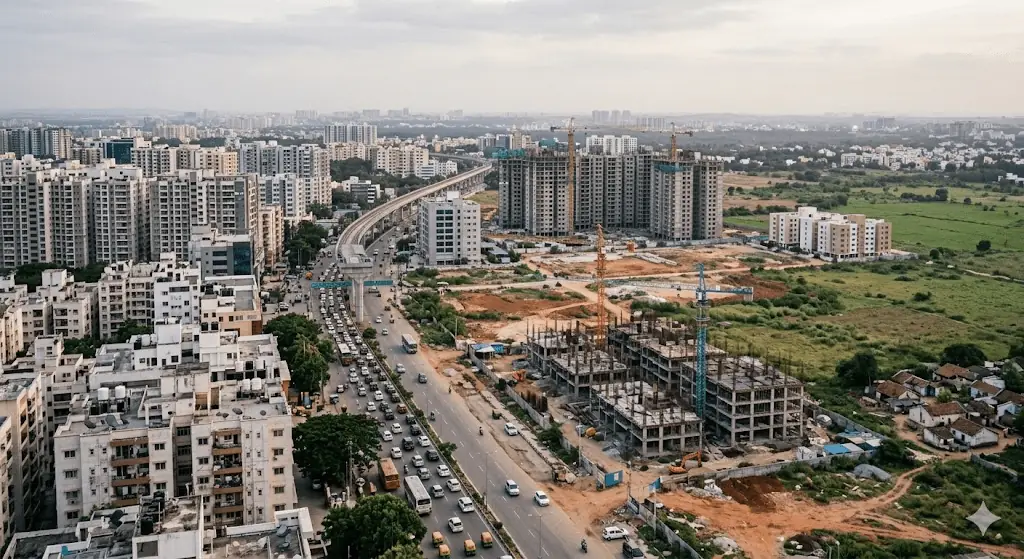
Price is the first filter for most buyers, and the variance across Bengaluru’s corridors is significant enough to materially change both the buyer profile and the investment thesis for each location.
| Corridor | Entry point, relative to this set | What the price is buying | Investment Profile |
|---|---|---|---|
| Sarjapur Road | Upper-middle; close to Whitefield | Employment density, school belt, catalysts not yet built | Growth-oriented; 5–7 year horizon |
| Whitefield | Highest of the four established corridors | Delivered metro and mature retail — already in the rate | Stable; mature; least left to be delivered |
| Electronic City | Lowest of the established corridors | Campus proximity; thin lifestyle infrastructure | Value entry; yield-focused |
| Bellandur | Below Sarjapur Road and Whitefield | ORR adjacency, discounted for congestion | High demand; congestion-constrained |
| Devanahalli | Widest internal spread of any corridor here | Airport thesis, little current liveability | Speculative; long horizon only |
What the price comparison actually tells you:
Rates move often enough that any figure printed here would be stale before it was useful, and corridor averages hide sub-zone spreads wide enough to make them misleading anyway. The stable part is what each price is buying. Whitefield sits at the top of this set because it is the most established — buyers are paying for delivered infrastructure and brand recognition, all of it already in the rate. Electronic City’s lower price reflects genuine infrastructure gaps rather than undervaluation; the corridor lacks the social ecosystem that sustains long-term family living. Bellandur’s pricing looks attractive until you account for congestion, which is structural rather than cyclical — road widening helps, but the junction geometry at Iblur and Silk Board constrains how much improvement is possible.
Apartments for sale in Sarjapur Road are quoted above Electronic City and Bellandur, and what that difference buys is checkable: employment density, school access, and a more mature social ecosystem. Whether the gap against Whitefield is closing is not something we can assert without a source, and we do not have one to give you. To check any of this for yourself, compare the rate a specific project is quoting today against what the same unit type launched at — a developer can produce that, and it tells you far more than an average.
Rental Yield: Which Corridor Earns More
For investors, rent is the part of the return that arrives every month and can be checked before you buy. The corridors differ meaningfully here, and the differences are driven by the density of the tenant pool at each location.
How the tenant pool differs by corridor:
- Sarjapur Road: the widest internal spread of the five, because the corridor is five markets, not one — the Bellandur-adjacent zones and the eastern pockets have different tenants, different rents and different entry costs, so run the numbers for the pocket rather than the corridor
- Whitefield: stable and consistent; a mature market means lower vacancy, and also less upside in the rent
- Electronic City: strong, driven by Infosys and Wipro campus proximity, but capped by the absence of the lifestyle infrastructure premium tenants will pay for
- Bellandur: demand is high and so is tenant turnover, driven by congestion fatigue — the vacancy between leases is what erodes the realised yield
- Devanahalli: the weakest of the five; airport-adjacent demand is real but not yet deep enough to sustain premium rents
The yield formula that matters:
Gross rental yield = (annual rent ÷ your all-in cost) × 100 — all-in cost, not base price, or the number flatters itself by a tenth or more. Get the rent from what comparable units in the same or neighbouring towers are actually letting for, not from a projection. Both inputs are checkable in an afternoon, which is more than can be said for any corridor-level yield figure.
What investors should know:
Rent and price movement are not the same variable, and a corridor rarely leads on both. Electronic City draws its rent from two campuses. Whitefield’s tenant demand is stable because everything around it is already delivered. Sarjapur Road draws rent from employers on the road itself while its sanctioned infrastructure is still being built — which is a description of the position, not a prediction about it. Work the rent-to-cost ratio yourself, for the specific unit, before you treat any of this as a reason.
Employment Proximity: Where the Demand Comes From
Rental demand and resale liquidity are both downstream of employment density. Corridors that sit near one major employer are more exposed than those near several.
Employment gravity by corridor:
Sarjapur Road sits at the intersection of three major employment zones:
- The ORR tech belt (RMZ Ecoworld, Ecospace, Bagmane) — reached from the western end
- Wipro’s corporate campus — directly on Sarjapur Road at Sompura Gate
- Electronic City — reached via Dommasandra
Whitefield is anchored primarily to its own IT cluster — ITPL, International Tech Park, and a dense concentration of mid-size tech offices. Strong and established, but less diversified than Sarjapur Road.
Electronic City is anchored almost exclusively to the Infosys and Wipro campuses in Phase 1 and Phase 2. Deep employer concentration means strong rental demand from those employers’ workforces but limited diversification if hiring patterns shift.
Bellandur sits at the ORR junction and benefits from spillover demand from Koramangala, HSR Layout, and the ORR tech belt. High demand but constrained by the corridor’s congestion, which pushes some tenants to prefer living further out and commuting in.
Devanahalli is anchored to the airport, aerospace park, and the KIADB industrial zone. Strong long-term thesis but thin current employment density relative to the south and east corridors.
The employment diversity advantage:
For buyers of apartments for sale in Sarjapur Road, the multi-employer catchment means rental demand doesn’t collapse if a single company downsizes or relocates. This diversification is a meaningful risk mitigant that single-anchor corridors like Electronic City or Devanahalli cannot match.
Social Infrastructure: Schools, Hospitals, and Daily Life
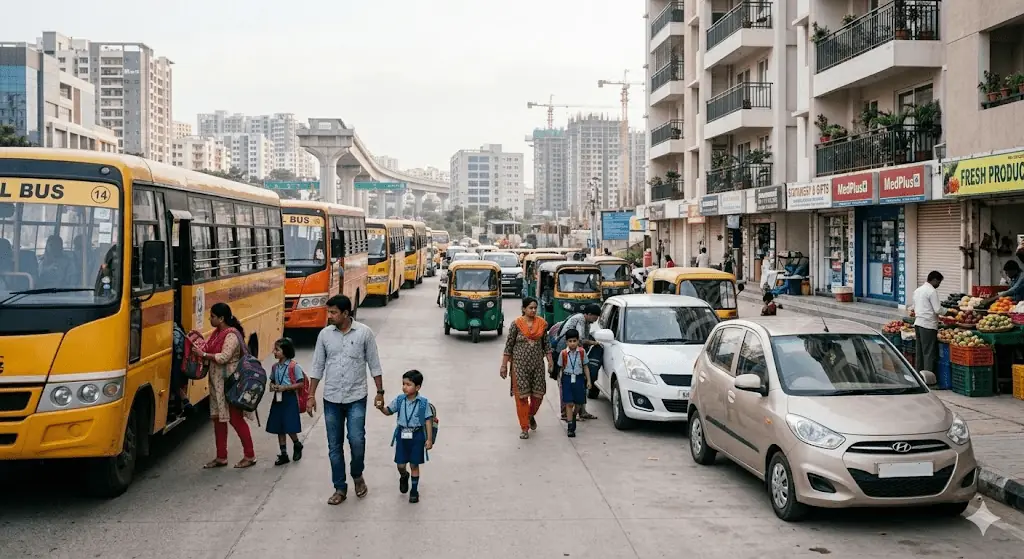
This is where Sarjapur Road most clearly differentiates itself from every other corridor in this comparison — and where the gap is widest.
School ecosystem comparison:
| Corridor | School Density | Notable Institutions | Curriculum Coverage |
|---|---|---|---|
| Sarjapur Road | Very High | Oakridge, Indus, Greenwood High, TISB, NPS East, Inventure | IB, IGCSE, ICSE, CBSE, Cambridge |
| Whitefield | High | Inventure Academy, Chrysalis, Delhi Public School | CBSE, ICSE, IB |
| Electronic City | Low | Limited international options | Primarily CBSE |
| Bellandur | Moderate | Some options; proximity to HSR schools | Mixed |
| Devanahalli | Very Low | Developing; limited current options | Early stage |
For families evaluating a 10–15 year stay, this table largely decides the corridor. Sarjapur Road’s school belt — covering every major curriculum across a wide fee range — is unusual in Bengaluru on the list alone. What the list cannot settle is the school run: drive it from the specific project gate on a working morning, in both directions, before you decide the cluster is close enough.
Healthcare and daily life:
- Sarjapur Road: Manipal Hospital, Sakra World, Motherhood, Columbia Asia; D-Mart, Decathlon, Market Square; dense dining and cafe ecosystem
- Whitefield: Phoenix Marketcity, Inorbit Mall, Columbia Asia Whitefield; well-developed retail and healthcare
- Electronic City: Limited premium healthcare; basic retail; daily needs met but lifestyle infrastructure thin
- Bellandur: Dense commercial; retail strong; healthcare improving; school access limited
- Devanahalli: Developing; residents typically travel to central Bengaluru for premium healthcare and schooling
Infrastructure Timelines: Who Benefits Most and When
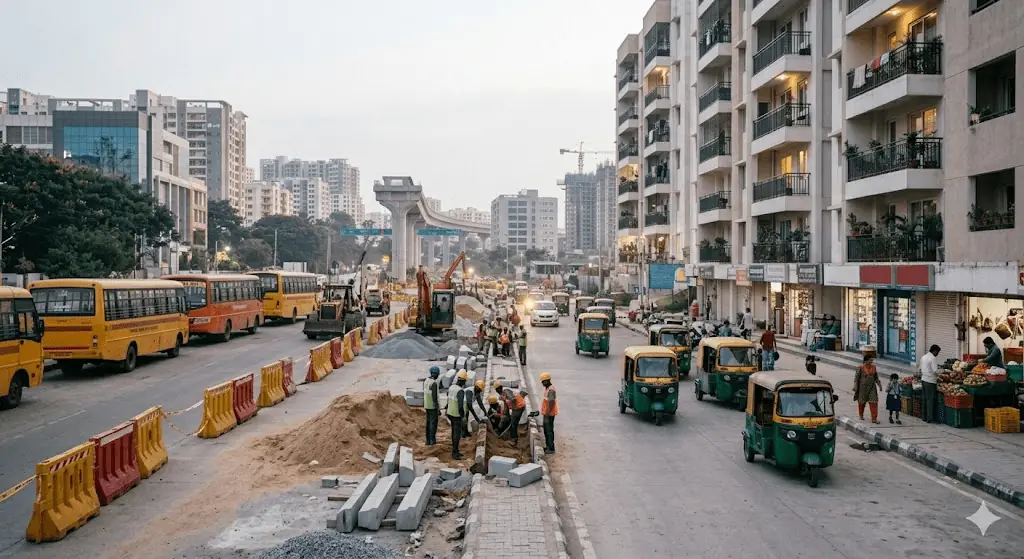
Infrastructure is where most forward-looking pitches are made — which is exactly why the timelines have to be read from the implementing agency rather than from a brochure.
Metro status by corridor:
- Sarjapur Road: Metro Phase 3A (the Hebbal–Sarjapur corridor) — 28 stations; Union Cabinet approval anticipated late 2026/early 2027; construction 2029–2031; realistic operational window 2031–2033. Two things still have to happen — the clearance and the build — and neither is certain until it does
- Whitefield: Purple Line fully operational — the metro is delivered, and what it is worth is already inside what buyers pay there
- Electronic City: Yellow Line operational — same situation as Whitefield; the line exists and is already in the rate
- Bellandur: Blue Line (ORR) under construction; Iblur station expected late 2026 — the nearest-term delivery of the five, though metro only partly addresses the corridor’s congestion
- Devanahalli: Blue Line airport extension in progress — the longest-dated of the five, with an operational timeline far enough out that everything resting on it is still a thesis
The infrastructure timing insight:
The corridors where metro already runs are ones where the buyer pays for a line that exists. Flats for sale in Sarjapur Road sit in the opposite position: the line is approved in DPR and moving toward Cabinet clearance, but not built — so the entry number is lower and the delivery risk is the buyer’s. We do not tell you which side of that trade wins, because that depends on whether the line is delivered on schedule and nobody can promise you that. What you can do is check the current status on BMRCL’s own record before you weigh it.
Road connectivity:
- Sarjapur main road widening: active, with grade separators and flyovers at key junctions; take the completion target from the implementing agency rather than from a sales office
- Peripheral Ring Road (BBC): Phase 1 tendering began 2026; when operational, it gives North Bengaluru and airport access without routing through the city core
- STRR: Operational in phases from 2027; diverts freight from the corridor
The Water Question: How Each Corridor Manages It
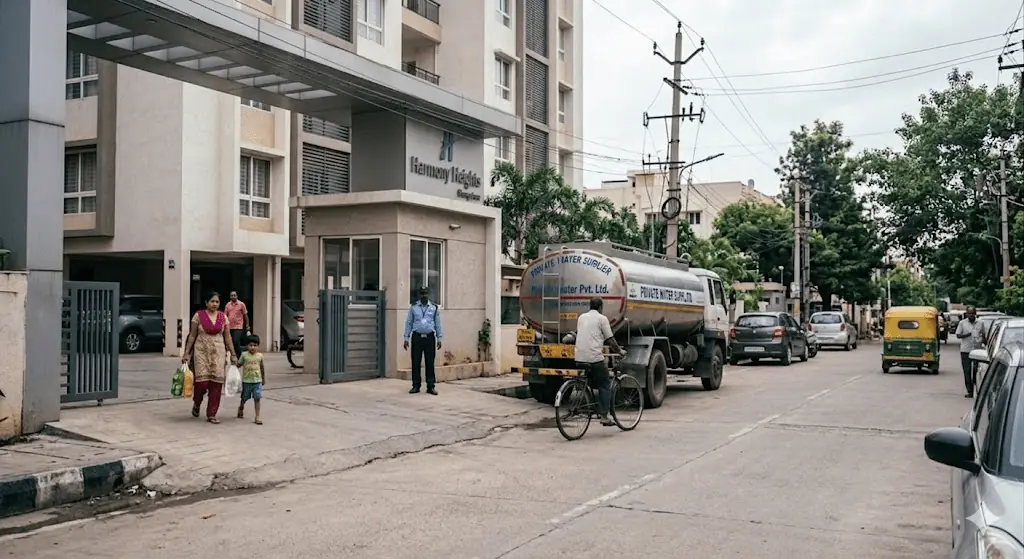
Water supply is the infrastructure variable buyers most consistently underestimate — and it varies significantly across corridors.
Water supply status by corridor:
- Sarjapur Road: Mixed; western end has better BWSSB connectivity; mid and eastern stretches more dependent on borewells and tankers. BWSSB’s Sanchari Cauvery Scheme and its ₹1,700 crore pipeline expansion are directed at this; confirm the sanctioned reach for your specific sub-zone with BWSSB. Projects with IGBC certification and functioning RWH systems are materially better positioned
- Whitefield: More established BWSSB connectivity in core zones; eastern fringe pockets still tanker-dependent. Cauvery Stage 5 (775 MLD added in late 2024) has improved supply
- Electronic City: BWSSB connected in Phase 1 and 2 core areas; newer developments further out face similar tanker dependency to Sarjapur Road’s eastern zones
- Bellandur: Better BWSSB connectivity given proximity to ORR infrastructure; tanker dependency lower than eastern corridor zones
- Devanahalli: Most exposed to water stress; significant groundwater depletion in the northern zone; dependent on BWSSB expansion that is still years from completion
The practical implication for buyers:
Water infrastructure is a monthly cost variable, not just a livability consideration. Where a project buys tanker water, that is a recurring household cost that appears in no base price calculation and is felt immediately after possession. We publish no figure for it — the honest one moves with the season and the sub-zone, so get it from residents of a completed project in the same pocket. For apartments for sale in Sarjapur Road, verifying BWSSB connection status and RWH capacity before booking remains essential regardless of which sub-zone you’re buying in.
Corridor Profiles: Who Each One Is Right For
Rather than a single recommendation, here is how each corridor maps to a specific buyer profile:
Sarjapur Road — best fit for:
- IT professionals working within the corridor or ORR tech belt seeking commute reduction and lifestyle quality
- Families with school-going children who need curriculum breadth and school proximity for a 10+ year stay
- Investors with a long horizon who are prepared to wait out Metro Phase 3A and can hold comfortably if it slips
- NRI buyers seeking managed assets with strong tenant demand and improving legal infrastructure
Whitefield — best fit for:
- Buyers prioritising stability over growth; mature infrastructure and established social ecosystem
- End-users who work in the Whitefield IT cluster and want to eliminate commute entirely
- Conservative investors who want a settled tenant market and few moving parts
Electronic City — best fit for:
- First-time buyers working in Electronic City’s Infosys or Wipro campuses, for whom the lowest entry number in this comparison is the deciding factor
- Investors focused on monthly rent and comfortable with thinner lifestyle infrastructure
- Buyers who prioritise entry price over lifestyle quality or what gets built around them later
Bellandur — best fit for:
- Professionals working in the ORR tech belt who prioritise office proximity above all else
- Investors willing to manage a high-demand, high-turnover tenant pool, and to price the vacancy between leases into their own numbers
- Buyers with tolerance for current congestion in exchange for established demand
Devanahalli — best fit for:
- Long-horizon investors (10+ years) with conviction on airport-led economic growth
- Buyers in the aerospace or hospitality sectors whose employment anchors are in North Bengaluru
- Those willing to accept current liveability limitations in exchange for the lowest entry into a zone where almost nothing is built yet
The Sarjapur Road Sub-Zone Advantage
One dimension this corridor comparison can’t fully capture is the internal diversity of Sarjapur Road itself. Unlike Whitefield or Electronic City — which are relatively uniform markets — flats in Sarjapur Road span five distinct sub-zones with different entry prices, yield profiles, and growth trajectories.
The sub-zone spectrum:
- Gunjur / Kasavanahalli (nearest the ORR): the dearest of the five and the most mature; almost everything you pay for is already built; strongest rental demand; suits buyers who want it working from day one
- Carmelaram / Doddakannelli (the next stretch out): one tier below; Phase 2–3 transition; a sanctioned Metro Phase 3A station falls here; suits buyers prepared to wait on a line that is approved but not built
- Hosa Road Belt: developing; Yellow Line metro connection; suits families weighing what is built against what it costs
- Dommasandra (mid-corridor): materially cheaper than the western end; PRR impact zone; most of its infrastructure still ahead of it; suits buyers with a long horizon and no dependence on it arriving
- Sarjapur-Attibele Road (the eastern arm): the cheapest entry on the corridor and the least built out; suits the longest horizons only — how this arm differs from Sarjapur Road proper
This internal range means a buyer can choose how much of what they are paying for is already delivered — from the fully-built western end to the eastern stretch where most of it is still a plan. No other corridor in this comparison offers that much internal choice along one road.
Suyug’s projects — including The 1 at Sompura Gate and Saffron in the mid-corridor — sit in the mid-corridor sub-zones, which trade the ORR end’s immediacy for a main-road address with a major IT employer on it. We do not publish a rate here or claim one is competitive; ask for the current price against a specific unit in writing and compare it against registered sale considerations for the same survey number on Kaveri Online Services.
Evaluating apartments for sale in Sarjapur Road and want to understand how a specific sub-zone or project fits your situation relative to other corridors? Suyug’s team works through exactly these comparisons with buyers — reach out for a straightforward conversation.
One Thing Worth Sitting With
Every corridor in Bengaluru has a version of the story that sounds compelling. The honest comparison isn’t about which corridor has the best pitch — it’s about which one best fits your employment situation, your family’s needs, your investment horizon, and your tolerance for the trade-offs that come with each location. Sarjapur Road wins that comparison for a specific and meaningful set of buyers. Understanding whether you’re one of them is the most useful thing this guide can do.
Frequently asked questions
The structural difference is what each rate has already absorbed. Whitefield’s Purple Line is operational, so the buyer there is paying for a metro that exists. Sarjapur Road’s Metro Phase 3A is sanctioned but not built, so the buyer here is paying less and waiting. We do not forecast which of those ends up ahead — that depends on whether the line is delivered on schedule, which nobody can promise you. Whitefield offers stability and an established social ecosystem today; Sarjapur Road offers employment density and a school belt today, plus a line you can verify the status of on BMRCL’s own record.
Electronic City is quoted the lowest of the corridors in this comparison, which is a real advantage for a first purchase. What flats in Sarjapur Road add at a comparable number — particularly in Dommasandra and the eastern stretch — is social infrastructure that is already built and a school belt covering more curricula. Neither of those is a return; they are things you can go and look at. The right choice depends on whether you are optimising for the entry number or for what surrounds the home once you live in it.
The two corridors are closer on yield than most buyers assume, and the difference that matters is not the headline percentage but turnover. Bellandur’s congestion drives tenants to move more often, which raises vacancy risk and management overhead for an investor. Apartments for sale in Sarjapur Road near the ORR end draw tenants tied to employers on the corridor itself, who stay longer. Work the yield out from the rent actually being paid in the towers next door against your own all-in cost, not from a corridor average.
Metro Phase 3A (the Hebbal–Sarjapur corridor) has a realistic operational window of 2031–2033, with Union Cabinet approval anticipated in late 2026 or early 2027. Whitefield’s Purple Line is already operational, so what a buyer pays there includes it. Buyers of flats for sale in Sarjapur Road are entering before the line is built rather than after — which means a lower entry number and a delivery risk they are carrying themselves. Confirm the current status against BMRCL’s own Phase 3A documentation before you weigh it either way.
Sarjapur Road, on the one measure that is checkable: curriculum breadth. Its school cluster — Oakridge, Indus International, Greenwood High, TISB, NPS East, Inventure Academy — covers IB, IGCSE, ICSE, CBSE, and Cambridge, which no other corridor in this comparison matches on the list alone. What that list cannot tell you is the school run, so drive it yourself from the specific project gate on a working morning. For families planning a 10–15 year stay, a school already placed is the thing that makes a family stay put.
Devanahalli’s case rests on airport-led economic growth that is still years from delivering liveable density — a thesis rather than a fact on the ground. For buyers with a 10+ year horizon and employment in North Bengaluru, it’s a coherent choice. For most buyers comparing it against apartments for sale in Sarjapur Road, the current liveability gap — schools, healthcare, retail, daily infrastructure — makes Sarjapur Road the stronger choice unless the buyer has specific reasons to be anchored to the northern corridor.
Was this useful?
Comments
Was this useful?
Schedule a site visit
Leave your details and the team will call back to fix a convenient date.