
What Your Money Actually Buys in Sarjapur Road, and What to Check

SUYUG Infra
Short briefing · 1,634 words · 7 min read · 6 questions answered
In this article · 8 sections
Introduction
Sarjapur Road has settled into a pattern where demand remains steady because of its proximity to major employment hubs. Locations around Wipro SEZ, RMZ Ecoworld, and the Outer Ring Road continue to influence where people choose to live, especially when daily commute starts affecting how time is spent across the week.
At the same time, buyer expectations have become more specific. A budget is no longer treated as a blanket indicator of quality. It is treated as a working range that needs to be evaluated against space, location, and how the home will function over time.
That is where most confusion begins. Two homes quoted at similar numbers can deliver very different living experiences. Understanding what actually sets those numbers helps reduce that uncertainty and makes comparisons more meaningful.
TL;DR
- Sub-location moves the rate on this corridor more than configuration does
- The same budget can land on a 2 BHK, a 2.5 BHK, or a compact 3 BHK depending on where it sits
- Location significantly affects size, pricing, and convenience
- Layout efficiency matters more than total square footage
- Emerging areas offer more space but slower ecosystem maturity
- Long-term usability matters more than initial impressions
What Actually Sets the Number on This Corridor
Sarjapur Road continues to see consistent demand due to its connection to IT corridors and planned infrastructure improvements. What that demand does to any individual project’s rate depends on things you can check: which stretch of the corridor it sits on, what infrastructure is sanctioned versus built near it, how clean the title and approvals are, how much the land under it cost, how much competing supply is launching around it, and what the specification and the developer’s delivery record actually are.
Within that, a mid-corridor budget sits in a transition range. It allows access to better-planned communities and newer developments, but it still requires trade-offs across key factors.
- Rates rise as you move toward the ORR and ease as you move outward. We do not print the rates themselves: they move by quarter, and the number that matters is the one on your specific unit, in writing, checked against registered sale considerations for that survey number on Kaveri Online Services.
- Buyers in this range are often moving from smaller homes or upgrading from long-term rentals into ownership.
- Options include both under-construction projects and ready-to-move apartments, each with different implications for timing and certainty.
In the short term, a wider budget expands available choices. Over time, the effectiveness of that choice depends on how well the budget has been distributed.
What Configurations You Actually Get
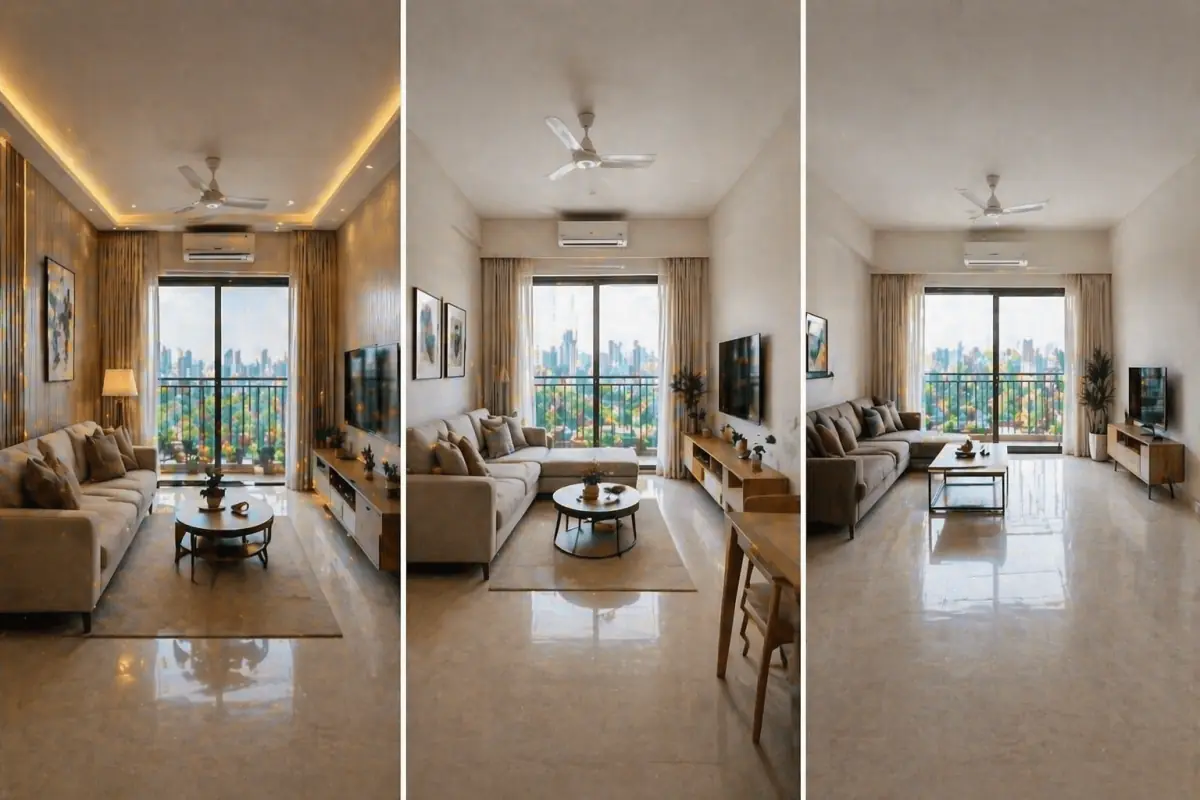
Configuration expectations need to be grounded in how projects are actually designed and priced. The outcome varies depending on layout efficiency and location.
| What You Are Optimising For | Configuration | Typical Usable Range | Where You’ll Find It | What It Feels Like |
|---|---|---|---|---|
| Room proportion | 2 BHK | ~900–1100 sq ft | Established pockets | More open living, better room sizes, easier daily use |
| Flexibility | 2.5 BHK | ~1100–1300 sq ft | Mid-zone developments | Extra flexibility without major compromise |
| Room count | 3 BHK | ~1200–1400 sq ft | Mixed locations | More rooms, tighter individual spaces |
| Total space | 3 BHK | ~1400–1600 sq ft | Emerging stretches | Larger layout, depends on future infrastructure |
This variation exists because the rate per square foot changes with location, and developers adjust layouts to match the number they are targeting. Confirm the usable area for your specific unit type against the RERA carpet area certificate rather than the brochure.
- Carpet area is a more reliable indicator of usability than super built-up area, which can overstate actual space.
- Room proportions affect how comfortably bedrooms, living areas, and kitchens function together.
- Storage and circulation space influence how the home feels once fully occupied, especially in compact layouts.
In the first few months, these differences may not feel significant. Over time, they start influencing how smoothly daily routines fit within the home.
Answer Block
Configuration is less about the number of rooms and more about how usable those rooms are. Efficient layouts tend to support daily living better than larger but poorly planned spaces.
How Location Changes Your Buying Outcome
Sarjapur Road is made up of multiple micro-markets that differ in connectivity, infrastructure readiness, and pricing. The same budget behaves differently across these areas.
| Factor | Established Location | Emerging Location |
|---|---|---|
| Apartment Size | Smaller within same budget | Larger within same budget |
| Daily Convenience | Immediate access to essentials | Limited in early years |
| Commute | Shorter and predictable | Longer or inconsistent |
| Infrastructure | Already functional | Still developing |
| Resale Demand | More stable | Depends on growth |
| Living Experience (2–3 years) | Settled and predictable | Improves gradually |
Projects closer to established infrastructure and employment hubs are quoted higher, which is what reduces the space a fixed budget reaches there.
- In stronger pockets, buyers get homes that are easier to use immediately due to better connectivity and ecosystem support.
- In developing areas, larger homes are available but require adjustment as infrastructure catches up.
- Planned improvements such as metro connectivity may improve access over time, but timelines can extend beyond initial expectations.
In the short term, location differences may feel manageable. Over time, they shape daily experience more consistently than configuration.
Decision Block
Choose a stronger micro-location if:
- Your daily commute impacts your schedule significantly
- You prefer immediate access to schools, offices, and essentials
Choose an emerging micro-location if:
- You are buying for a long holding period and can wait out the infrastructure that is sanctioned but not yet built
- You are comfortable with gradual development
What You Gain and Lose in Each Trade-Off

Every decision here involves balancing space, location, and project quality. It is difficult to optimise all three simultaneously.
| What You Prioritise | What You Gain | What You Adjust Later |
|---|---|---|
| Larger Space | Immediate comfort and flexibility | Longer commute, slower ecosystem |
| Better Location | Daily convenience and accessibility | Smaller rooms, tighter layouts |
| Higher Specification | Amenities and finish level — check them against the spec sheet, not the render | Reduced usable space inside home |
These trade-offs are often not fully visible during the buying stage.
- Larger homes may appear more comfortable initially but can introduce inconvenience through longer travel times and limited nearby infrastructure.
- Smaller homes in stronger locations provide convenience but may feel restrictive if needs expand.
- Amenities may enhance perception during visits but do not always compensate for layout or space limitations.
After one to two years, these trade-offs begin to shape daily routines.
Answer Block
The impact of the decision becomes clearer with time. Small compromises made during purchase often turn into recurring adjustments in how the home is used every day.
How These Homes Hold Up Over Time
The performance of a home changes as routines evolve. What feels manageable during the first few months may require adjustments later.
In the short term:
- Space allocation feels sufficient
- Commute adjustments seem manageable
After one to two years:
- Work-from-home or hybrid schedules may require additional functional spaces
- Storage needs increase as households grow
- Movement within the home becomes more structured
After three to five years:
- Layout limitations become harder to adjust
- Location begins to influence resale and rental demand
- Maintenance quality affects long-term satisfaction
Homes that are designed with better planning tend to adapt more easily. Developers like SUYUG focus on layout efficiency and usability, which helps reduce long-term friction and repeated adjustments.
Answer Block
Long-term comfort depends on how well the home adapts to change. Homes that balance layout, location, and usability tend to remain more stable and easier to live in over time.
A Practical Way to Evaluate Options

When comparing projects that sit at the same number on a cost sheet, simplifying the evaluation helps bring clarity.
Decision Framework
- Define whether your priority is daily living or long-term investment
- Compare carpet area and layout rather than total size
- Evaluate commute during peak hours instead of relying on distance
- Consider how your needs may evolve over the next few years
Decision Block
Lean toward larger space if:
- Your household requirements are already expanding
- You expect to stay in the same home long-term
Lean toward better location
Whatever the number on the cost sheet, the outcome depends on how the budget is distributed across space, location, and planning. The differences between options become clearer over time, especially when daily routines start interacting with the home and its surroundings.
Frequently asked questions
Less than you expect at the ORR end and more than you expect further out, because sub-location moves the rate more than configuration does. The same budget can land on a 2 BHK, a 2.5 BHK or a compact 3 BHK depending on where along the corridor the project sits. Ask each developer for the rate against a specific unit in writing, and compare on carpet area rather than on the BHK label.
Compare the carpet area and the room proportions, not the room count. A compact 3 BHK in a developing stretch and a well-proportioned 2.5 BHK in an established pocket can sit at the same number on a cost sheet and behave very differently once the home is fully occupied.
Location tends to influence daily convenience and long-term value more consistently. Larger space may feel beneficial initially but depends on how it supports routine over time.
They can offer more space and future potential, but infrastructure timelines and daily convenience should be evaluated carefully before deciding.
Focus on layout efficiency, connectivity, and long-term usability rather than only price or square footage.
Start with location, layout, and developer credibility. Once those are clear, compare pricing and amenities to make a more informed decision.
Was this useful?
Comments
Was this useful?
Schedule a site visit
Leave your details and the team will call back to fix a convenient date.