
Specifying a home without natural wood: what replaces it, and what you give up
SUYUG Infra
Short briefing · 1,745 words · 8 min read · 3 questions answered
In this article · 7 sections
A specification that excludes natural wood is a real materials decision with real consequences, and the industry publishes only one half of them. This post is the other half: what actually replaces timber, how each substitute behaves in Bengaluru's humidity over years rather than months, what can be repaired, what has to be replaced, and where a buyer should insist on knowing the exact product rather than the category.
What "no natural wood" means in practice
Timber appears in an apartment in more places than most buyers list. A zero-natural-wood specification touches all of them:
- Door frames — the fixed member set into the wall, traditionally hardwood.
- Door shutters — the leaf itself, traditionally a solid or panelled timber leaf, or a flush shutter with a timber core.
- Window frames and shutters, where the building does not already use aluminium or uPVC.
- Fitted joinery — wardrobe carcasses and shutters, kitchen cabinetry, vanity units, storage lofts.
- Trims and beading — skirtings, architraves, the small pieces nobody specifies and everybody notices.
A specification claim that covers the doors but not the joinery is a narrower claim than it sounds. This is the first thing to establish, item by item.
The substitutes, and what each one actually is
Engineered wood boards
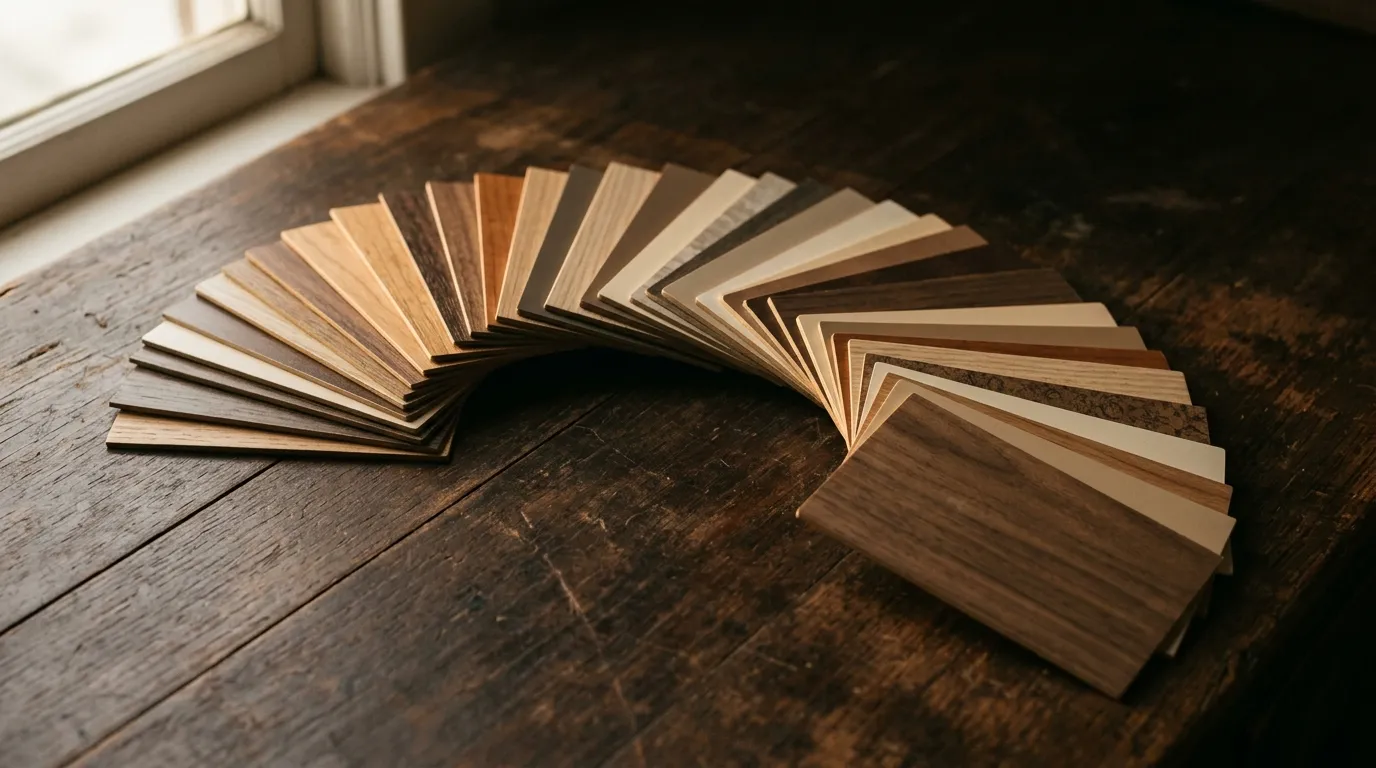
Plywood, blockboard, MDF and HDF are all made by breaking timber down and reconstituting it with adhesive. That makes them dimensionally stable — they do not have the grain direction that causes a solid plank to cup and twist — and it lets them use faster-growing plantation species rather than slow-grown hardwood. Note the vocabulary point: these are engineered wood products, so a specification using them is a specification without natural or sawn timber rather than one without wood fibre altogether. A promoter who says "no wood at all" while fitting plywood carcasses is being loose with words.
Grade is everything here. The Indian Standard for plywood for general purposes is IS 303, which is where the familiar boiling-water-resistant and boiling-water-proof gradings come from, and IS 710 covers marine plywood. A wardrobe carcass in an internal-grade board and one in a boiling-water-proof board look identical on handover day and behave very differently after a leak.
WPC and PVC composites
Wood-plastic composite is wood flour bound in a polymer, extruded or moulded into boards, frames and shutters. Foamed PVC boards do the same job with no wood content at all. Both are effectively unaffected by water, which is why they have taken over bathroom doors, utility doors and vanity units almost completely. They are also lighter than timber and they hold screws less well, which matters for hinges and heavy shutters.
Metal and uPVC frames
Pressed steel or galvanised sections for door frames and aluminium or uPVC for windows remove timber from the frame entirely. They are dimensionally stable, termite-proof and durable. The trade-off is thermal and acoustic: a metal frame conducts and rings in a way a timber one does not, which is why the sealing detail and the gasket matter more with these than with wood.
Surfaces
Whatever the substrate is, the visible surface is usually a laminate, a veneer, a foil or a factory-applied paint or acrylic finish. A veneer is a thin slice of real timber, so a home finished in veneer is not free of natural wood in the strict sense. Again — the honest specification says which.
Bengaluru humidity, year one and year seven

Bengaluru is milder than the coast but it has a long monsoon, and the failure modes here are moisture-driven rather than heat-driven. Materials sort themselves out over years, not months.
- Solid timber moves with humidity for its whole life. Well-seasoned, well-detailed hardwood moves acceptably; poorly seasoned timber, which is what a value-engineered project usually gets, warps, and a warped door is a door that does not close in July and rattles in February.
- Plywood and blockboard are stable if the grade suits the location and the edges are sealed. The failure is almost always at an unsealed edge or a cut-out where water reached the core.
- MDF and HDF are the most vulnerable to standing water. In a dry internal application they are excellent and take a finish beautifully; under a leaking sink they swell irreversibly.
- WPC and PVC are effectively indifferent to water, which is their whole argument. Their weakness is mechanical — sag in a long unsupported shelf, and screw fixings that loosen if repeatedly removed.
- Metal frames are stable, and their failure mode is corrosion at a damaged coating, typically at the floor junction where mopping water sits.
The practical implication is that the correct specification is not one material everywhere. It is the right material per location: composite in the wet rooms, engineered board in the dry ones, and a frame material that suits the wall and the leaf it carries.
Repairability: what a carpenter can fix
This is the trade-off least often stated, and the one that shows up years later.
Solid timber is forgiving. A damaged edge can be planed, a hinge position can be re-cut and plugged, a swollen bottom rail can be trimmed, and the whole thing can be re-finished. A carpenter with hand tools can do all of it in place.
Engineered and composite products are less forgiving in a specific way: they are manufactured items with a skin and a core, and once the skin is breached the repair is usually cosmetic. A laminate that has lifted can be re-glued, but a delaminated board, a swollen MDF panel or a cracked composite shutter is generally replaced rather than mended. That is not a defect — it is the nature of a factory-made component — but it changes what a maintenance budget looks like, and it makes one question important: is the product still available to buy in ten years? A discontinued shutter profile means replacing a set rather than a piece.
Feel, weight and acoustics — the honest losses
Three things are genuinely given up, and a buyer should hear them named.
- Weight and swing. A heavy leaf on good hinges closes with a particular authority. Lighter composite leaves do not, and the difference is noticeable every day.
- Sound. Mass is what stops sound. A lighter door transmits more voice and more corridor noise than a heavier one of the same size, unless the specification compensates with a solid core, a proper rebate and gaskets.
- Surface character. A laminate reproduces a pattern; a timber surface has depth. This is a matter of taste and there is no arguing anyone into or out of it — but it should be a choice, not a discovery at handover.
Each of the three can be designed around. A composite leaf with a dense core and a proper seal can outperform a hollow timber flush door. The point is that the compensation has to be specified, and it costs money, which is why it is worth asking about rather than assuming.
Why the specification exists at all
Three reasons, all defensible, and worth separating from the marketing.
- Sourcing. Hardwood of dependable quality is increasingly hard to procure in volume with a clean chain of custody. Engineered products are made from plantation species on much shorter cycles.
- Dimensional stability. For a promoter, a warped door is a snag, a callback and a reputational cost. Engineered components behave predictably across hundreds of identical units.
- Consistency and speed. Factory-made components arrive finished and identical, which suits a project handing over many homes at once.
Note what is not on that list: a claim that the choice is automatically better for the environment. It can be, particularly where it displaces poorly sourced hardwood — but the comparison depends on the specific product, its adhesives, its transport and its lifespan, and it is not settled by the word "engineered". Treat any environmental claim about a material the same way you would treat any other performance claim: ask for the boundary, the basis and the source.
What to ask for in writing, product by product
Ask for the specification schedule — most projects have one — and check that it answers all of these:
- For each door: frame material and section, shutter construction and core, thickness, and finish.
- For each wet-area door: what the shutter and frame are, and why that product was chosen for a wet location.
- For joinery: carcass board type and grade, shutter material, edge-banding, and hardware make.
- For windows: frame system, glass specification, and gasket type.
- For everything: the manufacturer and the product name, not just the category. "WPC door" is a category; a named product with a datasheet is a specification.
- Whether any veneer or natural-timber element remains anywhere in the home, so that the phrase used in the brochure matches the schedule.
A promoter who can answer that list has made deliberate choices and can defend them. One who cannot has bought whatever was available, and the specification claim on the brochure is a description of the purchasing department rather than of your home.
How materials, water and green cover are treated across SUYUG's developments — stated per project, with the IGBC status each one actually holds — is set out on the sustainability page, and the questions buyers ask most often before handover are answered on the FAQ page.
Frequently asked questions
That no solid sawn timber is used in the parts of the home a buyer normally expects it in — door shutters, door frames, window frames and fitted joinery — and that engineered or composite products are used instead. It is a materials specification, so the honest version of it names the actual product for each application rather than making a blanket claim.
Better at some things, worse at others. Engineered and composite products are more dimensionally stable in humidity, more consistent from piece to piece, and generally easier to source responsibly. Solid timber is more repairable, holds a screw better over decades, and feels and sounds different. The right question is not which is better but which trade-off you prefer in which part of the home.
A product-by-product specification list: what each door shutter, frame, window, wardrobe carcass and shutter is made of, in what grade, and by which manufacturer. A specification that names materials but not grades is not checkable, and it is the grade that decides how the item behaves in its seventh monsoon.
Was this useful?
Comments
Was this useful?
Schedule a site visit
Leave your details and the team will call back to fix a convenient date.