
High-End Apartments in Bangalore: What to Check in 2026
SUYUG Infraupdated
Short briefing · 2,405 words · 11 min read · 6 questions answered
Luxury Apartments in Bangalore: What to Look for in 2026
Knight Frank’s Wealth Report ranks Bangalore eighth among the world’s fastest-growing prime residential markets, up 32 places on its previous edition. The same report puts the city’s ultra-high-net-worth population at approximately 19,877 individuals, 63% higher than in 2021. Both figures are the report’s, not ours — read them there before you lean on either.
That growth has consequences. The same report tracks how much prime residential floor area a fixed budget buys in each city, and the Bangalore figure fell year on year while remaining well ahead of Mumbai’s. We do not reprint those rate figures here — they are listing-derived and they move — but the direction they describe is the one every buyer in this segment is negotiating against: more competition for the same floor area than there was a year ago.
For a buyer shortlisting the best luxury apartments in Bangalore in 2026, the evaluation framework matters more than the project list, because the label itself is unregulated and settles nothing. This guide covers the parameters the word is normally shorthand for and how to verify each, the submarket comparison across Bangalore’s key corridors, specific project profiles with their actual drawbacks alongside their strengths, and the due diligence checklist before committing.
TL;DR
- Knight Frank’s Wealth Report ranks Bangalore eighth among the world’s fastest-growing prime residential markets — their figure, checkable in their report
- Neither “luxury” nor “premium” is a regulated category — test the claim against carpet area registered with RERA, units per acre from the filed site plan, and construction methodology
- Q1 2026 saw 27,055 new units launched in Bangalore per JLL, with 69% of Bengaluru’s launches falling in the segments JLL classifies as high-end and above
- Sarjapur Road carries catalysts — Metro Phase 3A, the Peripheral Ring Road, SWIFT City — that are sanctioned and not yet delivered, which is a different proposition from a corridor whose infrastructure is already built
- The Clubhouse Factor and open space percentage are the two metrics most buyers underuse when evaluating luxury apartments in Bangalore
- RERA registration, CC and OC status, density verification, and water infrastructure are the four non-negotiable checks before any booking
The 2026 Luxury Benchmark
Before evaluating individual projects, buyers need a framework for testing the luxury claim — because nothing in law defines it, and the word costs a developer nothing to use. The parameters below are the ones the label is normally shorthand for, and each is verifiable from a filed document rather than a brochure.
| Label as marketed | Min. Carpet Area claimed | Max. Density claimed | Where to verify it |
|---|---|---|---|
| Premium | 1,500 sq ft | Under 60 units/acre | RERA carpet area; units ÷ land area on the filed site plan |
| Luxury | 2,500 sq ft | Under 40 units/acre | Same two filings, plus construction methodology in the spec sheet |
| Ultra-Luxury | 4,000 sq ft+ | Under 20 units/acre | Same, plus lift lobby, service scope and delivery condition in the agreement |
The density parameter is the most consequential of the three, and the one the label hides most easily. A project can sit at the top of a corridor’s range and still run 80 units per acre if the overall site is large enough — the total is impressive while the space per resident is not. Low density is the structural prerequisite that makes everything else work: the privacy, the amenity quality, the noise insulation. Calculate it yourself from the filed site plan; nobody quotes it against themselves.
Cushman and Wakefield’s Q1 2026 Bangalore Residential Report records that the segments it classifies as high-end and luxury represented 68% of all new launches in the quarter, up from 53% the previous quarter, with East submarkets accounting for 57% of launches.
Submarket Comparison
Bangalore’s high-end market is not uniform across corridors. Each submarket sits at a different point in its own build-out, and that is what separates them — how much of the infrastructure attached to the address already exists.
| Submarket | Where it sits in the cycle | Key Driver | What to check |
|---|---|---|---|
| Whitefield | Mature — most catalysts delivered | Purple Line metro, ITPL corridor | Approach roads off the main corridor |
| Sarjapur Road | Mid-cycle — catalysts sanctioned, not built | ORR IT hubs, Wipro SEZ, SWIFT City | BWSSB feasibility in the specific sub-zone |
| Budigere Cross | Early — social infrastructure still thin | Airport access, NH 75, PRR | Where the nearest school, hospital and grocery actually are — drive to each |
| Bellandur and ORR | Fully priced — infrastructure premium already in the rate | Prime office concentration, MNC density | Ambient noise and peak-hour access at the tower itself |
The useful question is not which corridor has moved most, but how much of what a corridor is going to get has already been built. Bellandur asks among the most in the city and has the office concentration behind it — which also means that concentration is already in the rate. Whitefield’s metro and IT park infrastructure is largely delivered. Budigere Cross is early: the airport and road case is real, the schools, hospitals and retail are not there yet. Sarjapur Road sits between the two, with employment depth that already exists and road and metro catalysts that have been sanctioned but not built.
How to Read a Project Profile: Strengths and the Catch
Every luxury project in Bangalore has a constraint its own marketing leaves out. The strengths are on the brochure; the catch is what you find after you move in. Four of them come up often enough to check by name on any shortlist.
The approach road, not the address. A project can look adjacent to an employment hub on a map and still take a long time to reach it, because the final stretch is a two-lane internal road shared with construction traffic. We publish no drive times, because yours will not match anyone else’s. Drive the approach yourself at 9am on a weekday, from the tower gate to the office gate. A Sunday site visit tells you nothing about this.
Ring road adjacency cuts both ways. Proximity to the ORR buys commute time and costs quiet. Stand on the balcony of the actual tower and floor you are being offered, at peak hour, before you accept the noise trade.
What a corridor asks reflects what it has already built. The corridors that ask the most in Bangalore are the ones whose metro, roads and offices are standing today. That is what the rate is buying, and it is also why less remains to arrive. A corridor whose catalysts are still under construction asks less and hands you the execution risk instead. Neither is the better bet in the abstract — they are different bets, and the sanctioned-versus-delivered status of each project is published by the agency running it.
Emerging corridors are short on retail and dining for years. Density, open space and construction quality can all be excellent while the nearest restaurant worth going to is a drive rather than a walk. If walkable high-street retail matters to how you actually live, walk the streets around the site on a weekday evening and see what is open, before the clubhouse renders decide it for you.
The Clubhouse Factor and Density Metrics
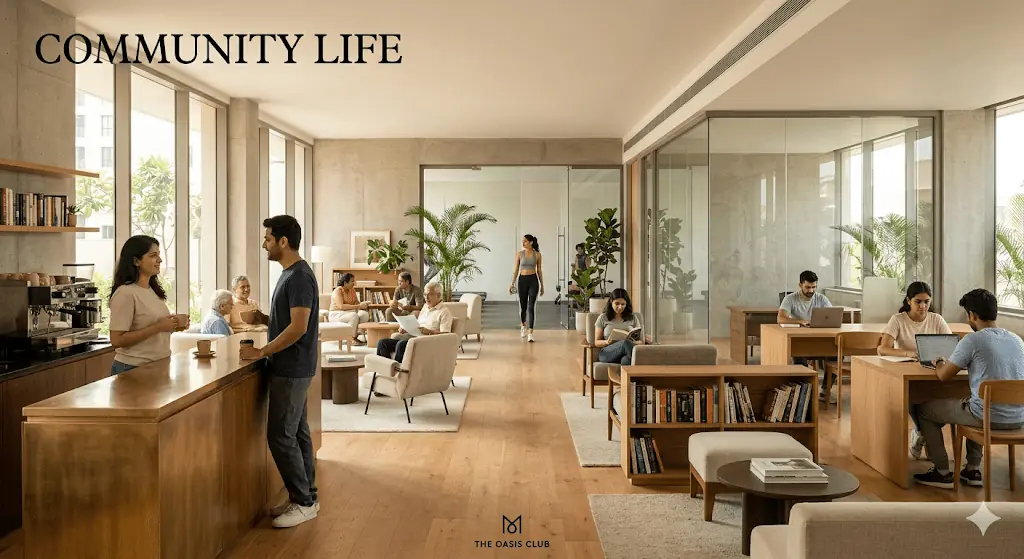
Most buyers evaluate luxury projects by the amenity list. The more useful metric is the Clubhouse Factor: total clubhouse square footage divided by the number of units. A project with a 30,000 sq ft clubhouse across 500 units delivers 60 sq ft per unit. A project with 20,000 sq ft across 100 units delivers 200 sq ft. The second project delivers a materially better amenity experience regardless of which has the larger clubhouse in absolute terms.
The open space percentage is the companion metric. Premium projects typically dedicate 60 to 70% of the site to open space. Projects claiming the luxury label target 72 to 82%. Anything below 60% in a project making claims about green living is worth challenging, whatever the label on the hoarding says.
Both metrics are derivable from the RERA filing. The approved building plan shows the built-up and total site area, from which open space percentage is calculable. The clubhouse area is typically disclosed in the project specifications or agreement of sale.
Sarjapur Road: The Gated Community Case
Within Bangalore’s high-end landscape Sarjapur Road occupies a specific position: employment depth and a school ecosystem that already exist, alongside infrastructure programmes that are sanctioned and unbuilt. That combination is the thing to evaluate, and both halves of it are checkable — the first by driving it, the second from the agencies that publish the status.
The tenant pool draws on Wipro’s campus at Sompura Gate, the ORR tech belt, and Electronic City, so it is not dependent on any single employer — which is what shortens void periods, and what you should be counting when you assess vacancy risk. Metro Phase 3A, the Peripheral Ring Road, and SWIFT City are sanctioned programmes at different execution stages. Treat each as sanctioned-but-undelivered and check its current status with BMRCL and the state agencies before you weigh it in.
Suyug’s projects at Sompura Gate, The1 (235 units, RERA: PRM/KA/RERA/1251/310/PR/051224/007268) and Saffron (110 units, RERA: PRM/KA/RERA/1251/308/PR/140825/008000), carry MIVAN construction, no shared walls, and tower-level RERA registration. On green building: THE1 holds IGBC pre-certification — a design-stage assessment by the Indian Green Building Council, ahead of the final certificate awarded on completion. Saffron is designed to align with IGBC guidelines and has not been assessed by IGBC. These are different claims and we do not use them interchangeably.
Schedule a virtual site visit with Suyug’s team to review floor plans, RERA documentation, and pricing across The 1 and Saffron at Sompura Gate.
Due Diligence Checklist
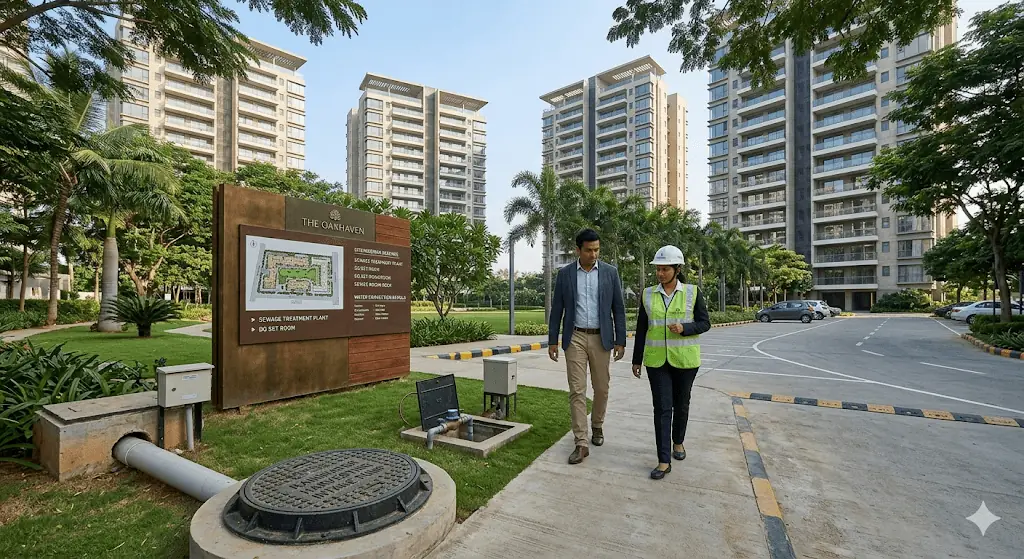
Four checks before booking any luxury apartment in Bangalore regardless of developer brand.
1. RERA registration tower-wise: Visit rera.karnataka.gov.in and search by the project’s RERA number. Confirm your specific tower has its own registration. Check the registered completion date, approved building plan, and buyer complaint history.
2. CC and OC status: For ready-to-move units, confirm the Occupancy Certificate has been issued. For under-construction projects, verify the Commencement Certificate and the developer’s OC track record on completed projects.
3. Density and open space: Request the approved site plan and calculate units per acre and open space percentage from the RERA-disclosed figures rather than the developer’s marketing materials.
4. Water infrastructure: Verify the BWSSB feasibility certificate confirming grid connectivity. Confirm operational rainwater harvesting and an STP capable of recycling at least 60 percent of wastewater. Peripheral Sarjapur Road sub-zones remain partially dependent on borewells despite Cauvery Stage 5.
One Thing Worth Sitting With
The best luxury apartments in Bangalore in 2026 are not always the ones with the largest clubhouse or the most prominent developer brand. They are the ones where low density, verified construction methodology, RERA compliance, and a corridor with employment demand that already exists all hold up when checked against the filings rather than the brochure. “Best” is not a category anyone can award you. It is what is left after you have tested every claim on the shortlist and seen which ones survive.
Frequently asked questions
Not through a forecast, ours or anyone else’s — we do not publish a view on where prices go next. What you can check is what the demand is resting on: GCC expansion, the size of the ultra-high-net-worth population as reported in Knight Frank’s Wealth Report, and IT sector employment. Each is tracked publicly, so you can watch it yourself rather than take a projection on trust. Supply matters equally: count the concurrent launches close to the project you are considering, because that is the stock a resale would have to compete against.
No. “Luxury” is not a regulated category in India and no threshold triggers it, which is why the word appears on projects with almost nothing in common. Test the specification instead: carpet area as registered with RERA rather than super built-up, units per acre calculated from the RERA-filed site plan, and the construction methodology. Projects claiming the label commonly cite figures such as 2,500 sq ft carpet area and under 40 units per acre — treat those as claims to check against the filing, not a standard anyone is obliged to meet.
The Clubhouse Factor is total clubhouse sq ft divided by total project units. It measures amenity space per resident rather than absolute size. A project with 30,000 sq ft across 500 units delivers 60 sq ft per unit. One with 20,000 sq ft across 100 units delivers 200 sq ft. The higher the factor, the less crowded the amenity experience at peak hours.
Mainly in how much of what the corridor is going to get has already been built. Bellandur and Whitefield are mature: the office concentration and the metro are largely delivered, so what you are buying is in place and verifiable today. Budigere Cross is early — the airport and road case exists on paper while schools, healthcare and retail are still thin, so check each of those on the ground yourself. Sarjapur Road sits in between, with employment depth that already exists and road and metro programmes that are sanctioned but not built. None of that is a ranking; it is a description of what each corridor asks you to take on trust.
Tower-wise RERA registration on K-RERA; Commencement Certificate from BBMP or BMRDA; Occupancy Certificate for ready-to-move units; approved site plan confirming density and open space; and BWSSB feasibility certificate confirming water grid connectivity. These five documents are independently verifiable and cover the majority of post-purchase complications.
It is a different risk, not automatically a worse one, and the trade is explicit: an under-construction unit is usually quoted below a comparable ready-to-move one because you are carrying execution and delay risk that the ready buyer is not. Ask for both quotes on the same configuration and see what the discount actually is before deciding whether it pays you for that risk. Verify RERA escrow compliance, the developer’s OC track record on completed projects, and ensure the payment plan is construction-linked rather than time-linked.
Was this useful?
Comments
Was this useful?
Schedule a site visit
Leave your details and the team will call back to fix a convenient date.