
Save Fuel, Save Time: Living Closer to Where You Work in Bengaluru
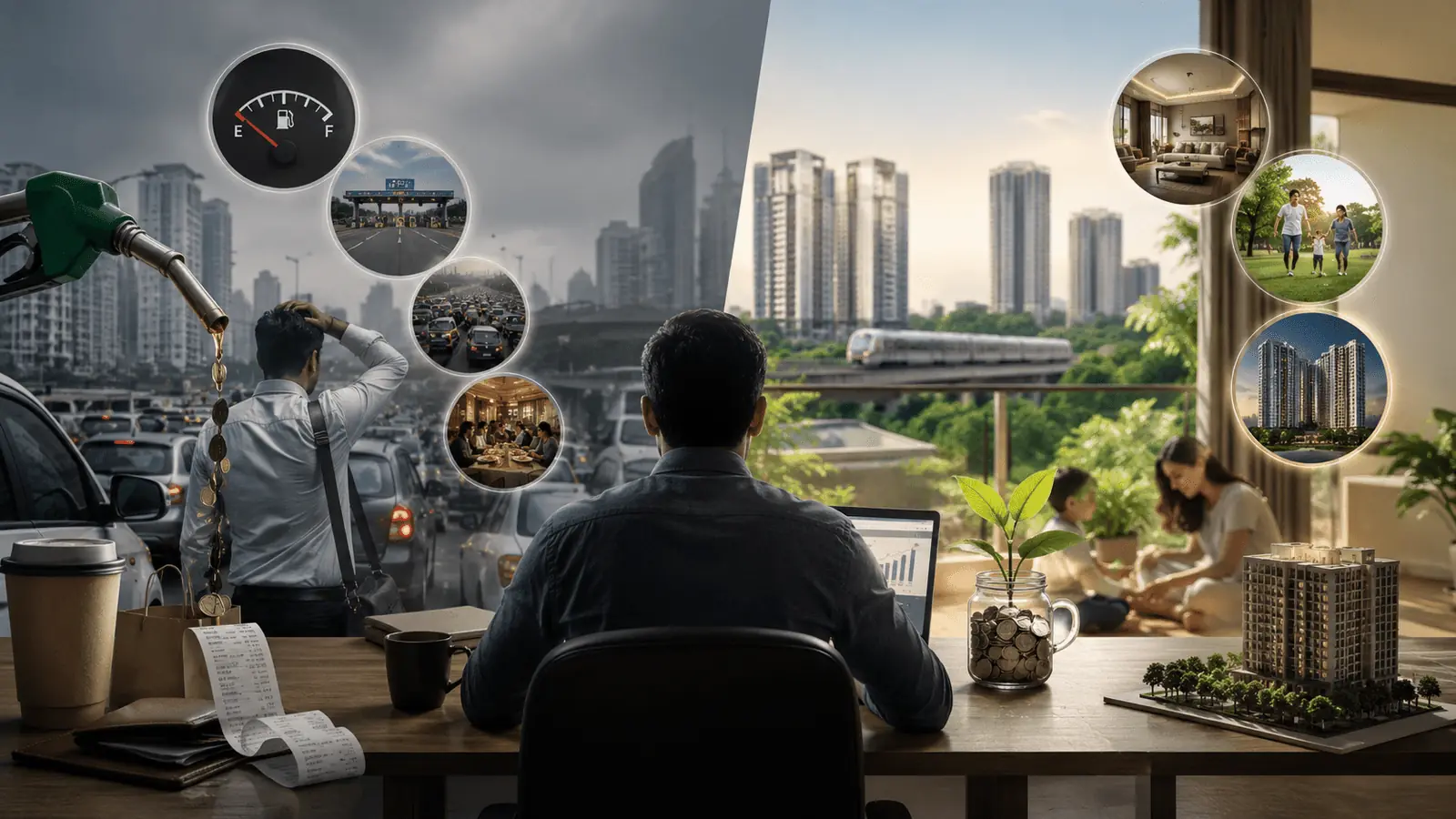
SUYUG Infra
Short briefing · 1,627 words · 7 min read
In this article · 13 sections
Why Bengaluru Professionals Are Turning Daily Savings Into Real Estate Investments
The modern urban lifestyle is changing.
Across Bengaluru, especially in technology-driven locations like Sarjapur Road, Whitefield, Electronic City, and Outer Ring Road, professionals are rethinking how they spend, save, and invest.
The shift toward hybrid work culture and work-from-home flexibility has reduced daily commuting, unnecessary fuel expenses, impulsive lifestyle spending, and time lost in traffic.
At the same time, rising inflation, fuel costs, urban congestion, and economic uncertainty are pushing many families toward smarter financial planning.
Instead of spending heavily on short-term lifestyle expenses, more Bengaluru professionals are now focusing on:
- Real estate investment in Bengaluru
- Premium apartments in Sarjapur
- Future-ready homes near IT hubs
- Asset creation through property ownership
- Owning an asset rather than renting one
- Financial planning that holds up through an inflationary period
- Connected urban living
This is creating a new urban mindset:
Spend less on temporary consumption. Invest more in long-term assets.
The Hidden Cost of Daily Urban Spending
For years, city life normalized high recurring expenses.
A typical urban professional in Bengaluru often spends significantly on:
- Daily office commute
- Fuel expenses
- Cab services
- Eating outside frequently
- Lifestyle subscriptions
- Weekend discretionary spending
- Traffic-driven productivity loss
- Frequent upgrades and impulse purchases
Individually, these costs may seem manageable.
But over 5–10 years, the total financial outflow becomes substantial.
Monthly Lifestyle Leakage Comparison
| Expense Category | Traditional Office Lifestyle | Hybrid / Smart Living Lifestyle |
|---|---|---|
| Monthly Fuel Cost | Five commutes a week — check your own last three fuel bills | Two or three, so a fraction of the same bill |
| Daily Commute Time | A full daily round trip, five days a week | A short local run on office days only |
| Food & Dining Expense | High | Moderate |
| Stress & Fatigue | High | Lower |
| Savings Potential | Limited | Significantly Higher |
| Investment Capacity | Lower | Higher |
This shift is encouraging professionals to redirect monthly savings toward long-term wealth creation.
Why Work From Home Changed Investment Thinking
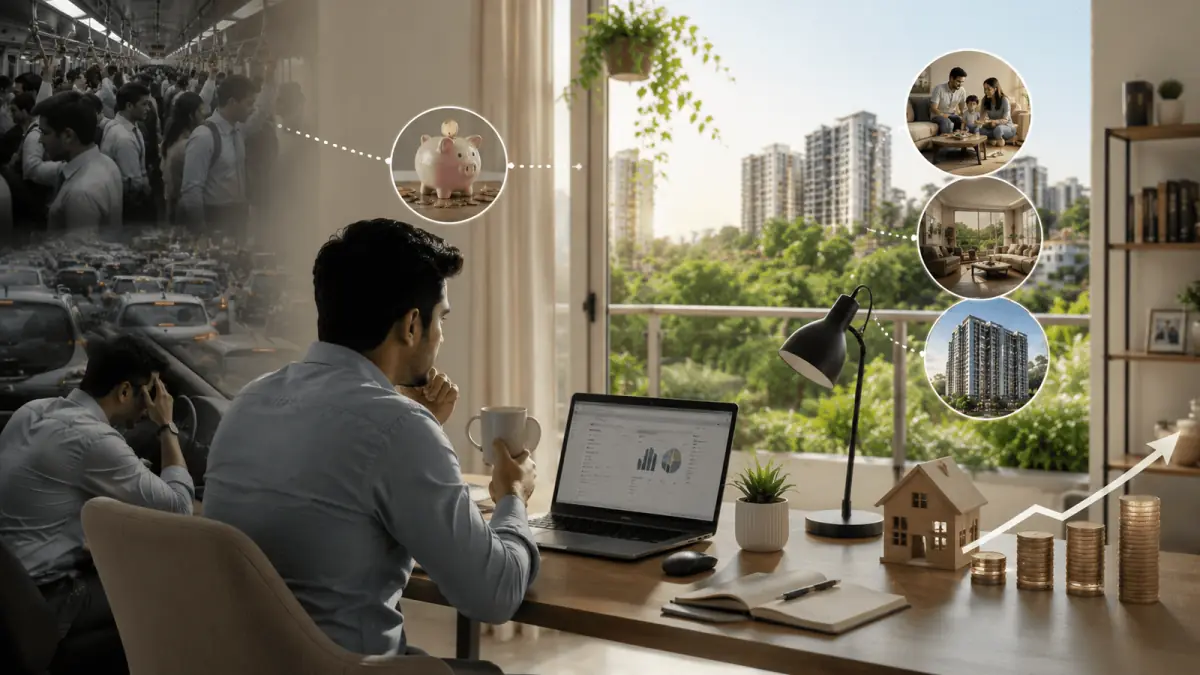
Work-from-home and hybrid work culture changed more than office routines.
It changed financial priorities.
People started realizing:
- Time is an asset
- Commute fatigue affects quality of life
- Repeated spending disappears quickly
- Ownership creates long-term stability
- Connected homes matter more than proximity alone
As a result, Bengaluru homebuyers are increasingly searching for:
- Premium apartments in Sarjapur Road
- Larger homes near tech parks
- Real estate investment opportunities in Bengaluru
- Future-ready gated communities
- Smart homes for hybrid professionals
- Properties near upcoming metro connectivity
- Apartments with workspace-friendly layouts
The definition of urban luxury is evolving.
Luxury today means:
- Better work-life balance
- Smart connectivity
- Reduced stress
- Access to green spaces
- Efficient mobility
- Knowing exactly what you own, and being able to prove it on paper
Save Fuel Today. Build Assets Tomorrow.
One of the biggest behavioral shifts happening across Bengaluru is the transformation of monthly savings into long-term investments.
Professionals are increasingly asking:
“Instead of spending repeatedly, why not invest strategically?”
Work It Out on Your Own Numbers
| Daily Commute Load | How to price it, for your household |
|---|---|
| Short local run | Your own fuel bills for the last three months, multiplied out to a year |
| Cross-town, one office | The same, plus tolls and parking you currently absorb without noticing |
| Cross-city, both directions | The same again, plus what the vehicle’s servicing interval costs at that mileage |
We print no figures in that table on purpose. Fuel prices move, your route is yours, and a number invented on a developer’s page would be worse than no number at all. Run it on your own bills, over five years, and compare the total against a down payment.
Doing that arithmetic yourself is what changes buyer behaviour. Being told the answer does not.
What Owning Property Actually Does, and What It Does Not
Unlike recurring consumption, a home is an asset that stays on your balance sheet. What that means in practice is narrower than the pitch usually suggests:
- It converts rent, which is gone, into equity, which is not
- It is an asset you can live in, which no financial instrument offers
- It is illiquid — selling takes months, not minutes, and that is a real cost
- Its future value is unknown, and anyone who tells you otherwise is guessing in public
- It can be passed on, which is why holding period matters more here than in most asset classes
- It changes where and how you live, which for most buyers is the actual reason
This is especially relevant in infrastructure-driven urban corridors.
Across Bengaluru, areas connected to:
- Metro expansion
- IT growth corridors
- Peripheral Ring Road development
- Commercial ecosystems
- Future infrastructure projects
continue attracting both end-users and long-term investors.
What Is Actually on Sarjapur Road
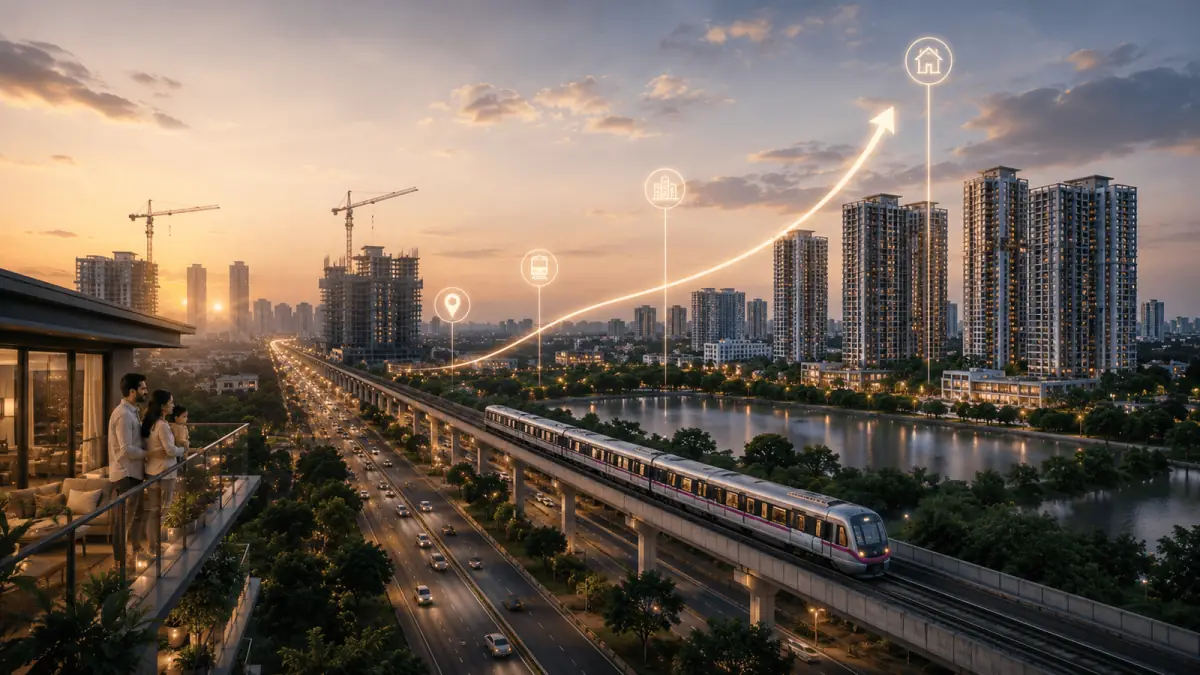
Sarjapur Road has become one of Bengaluru’s denser residential and technology corridors. Here is what that consists of, in terms a stranger could go and confirm.
The location combines:
- Access to more than one IT cluster, rather than dependence on a single campus
- A tenant pool backed by several employers
- Road works delivered, and ring roads still at earlier stages
- New residential launches in larger formats
- International schools, named individually elsewhere on this blog
- Commercial and co-working supply still being added
- A metro line proposed and not yet approved by the Union Cabinet
- Land still available at the outer end of the corridor
This makes Sarjapur increasingly attractive for:
- IT professionals
- Hybrid workers
- Young families
- Premium homebuyers
- Real estate investors
Sarjapur Growth Drivers: What Stage Each One Is At
| Growth Factor | Stage it has actually reached |
|---|---|
| IT Corridor Connectivity | Delivered — the campuses are built and occupied, and you can drive the routes |
| Metro Expansion | Proposed. Awaiting Union Cabinet approval; nothing under construction on the alignment |
| Ring Road Infrastructure | Phase 1 tendering began in 2026; no stretch open to traffic, and the corridor has slipped before |
| Rental Demand | Present, and backed by several employers rather than one. Test it against live listings for your configuration |
| Residential Supply | Being launched now, in larger formats. Check each project’s RERA registration and milestones |
| What it will all be worth | Not knowable, and not published here |
Comparing the Three Corridors Without an Index
What Separates Sarjapur Road, Whitefield and Electronic City
A demand index stood here. We have taken it out rather than dressed it up: every number in it was an estimate against a basket nobody published, and a chart that looks precise is the most misleading thing a developer can put on a page. What follows instead is the comparison in terms you can verify at a named source.
| Corridor | Employment base | Metro status | Where to check it |
|---|---|---|---|
| Sarjapur Road | Multi-directional — Wipro at Sompura Gate, the ORR tech belt to the west, Electronic City via Dommasandra | Phase 3A proposed; awaiting Union Cabinet approval, nothing under construction | BMRCL for the alignment and stage; drive the employment routes yourself |
| Whitefield | ITPL and the surrounding tech parks, occupied for years | Operational | BMRCL for the line and stations; the tech parks are there to visit |
| Electronic City | One large cluster rather than several | Yellow Line, RV Road to Bommasandra, serving the cluster | BMRCL for the current operating status of the line |
Read down the metro column and the difference between the three corridors is a difference in stage, not in sentiment. That is the comparison worth making, and it is the only one we can stand behind.
The Rise of Intentional Urban Living
Modern homebuyers are no longer buying only square footage.
They are investing in:
- Better quality of life
- Future-ready infrastructure
- Smart urban connectivity
- Time efficiency
- Wellness-focused environments
- Sustainable living patterns
- Long-term financial growth
This is creating a major shift in premium real estate demand.
Today’s buyers increasingly prefer:
- Premium gated communities in Sarjapur
- Apartments with work-from-home flexibility built into the layout
- Smart homes near Bengaluru IT parks
- Apartments with lifestyle amenities
- Investment-friendly real estate projects
The market is shifting from reactive purchases to intentional urban positioning.
Why Smarter Spending Creates Better Long-Term Wealth
The difference between consumption and investment becomes more visible during uncertain economic periods.
Repeated expenses disappear.
Strategic investments compound.
This is why many Bengaluru professionals are:
- reducing unnecessary expenses
- improving monthly savings
- prioritizing asset ownership
- investing in connected urban corridors
- focusing on long-term financial stability
The future of wealth creation is increasingly linked to intentional decision-making.
The Future Belongs to Connected Urban Communities
As Bengaluru continues expanding through:
- metro connectivity
- infrastructure development
- technology ecosystem growth
- smart urban planning
future-ready residential communities will play an increasingly important role in shaping urban lifestyles.
The next decade of Bengaluru real estate will likely be defined by:
- connected living
- hybrid work culture
- premium infrastructure
- strategic locations
- sustainable growth corridors
- intelligent urban development
Why Buyers Are Looking Beyond Short-Term Spending
Today’s homebuyers are asking smarter questions:
- Is this location future-ready?
- Will connectivity improve over time?
- Does the project support hybrid lifestyles?
- Would I still want this home if the infrastructure never arrived?
- Which of the things I have been told here are delivered, and which are approvals?
These questions are reshaping premium real estate decisions across Bengaluru.
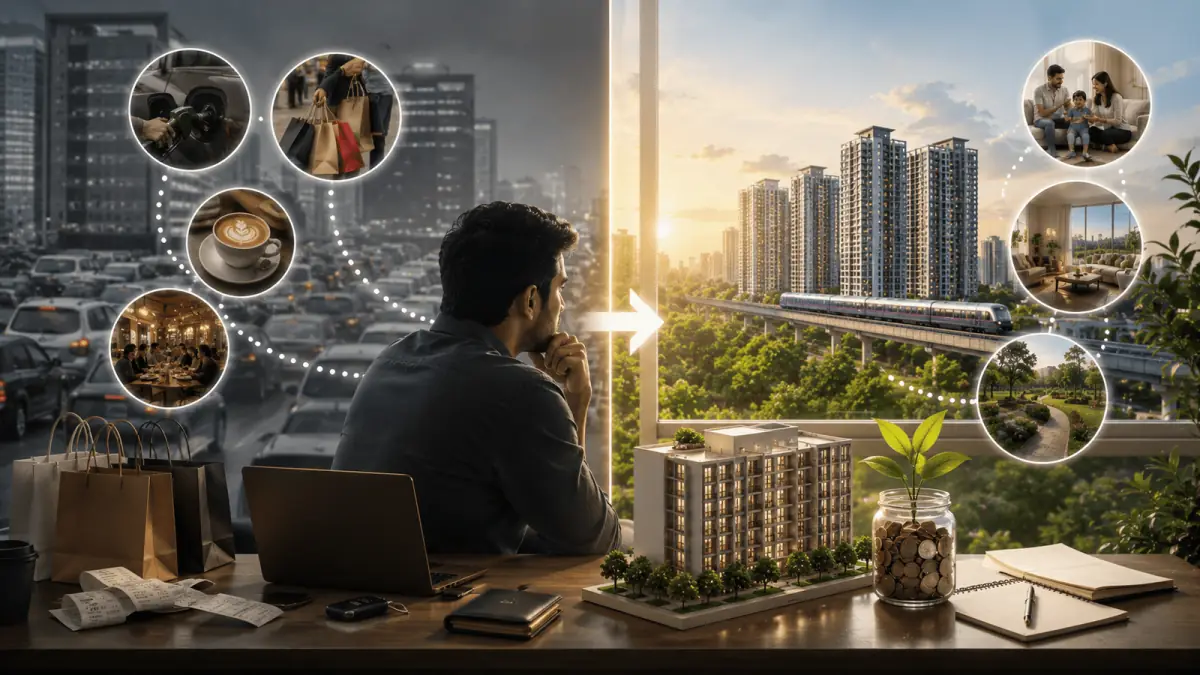
Build the Future Through Smarter Financial Choices
The modern urban mindset is changing.
Less unnecessary spending.
Less time lost in traffic.
Less financial leakage.
More intentional living.
More connected lifestyles.
More long-term investments.
For many Bengaluru professionals, the future is no longer about spending more.
It is about investing smarter.
Discover Future-Ready Living with Suyug
Located within Bengaluru’s evolving growth ecosystem, Suyug developments are designed around the future of connected urban living.
With a focus on:
- strategic connectivity
- premium architecture
- modern lifestyle planning
- future-ready communities
- long-term value creation
Suyug represents a smarter approach to urban living in Bengaluru.
As Sarjapur continues to build out, the decision in front of a buyer here is not only which home to buy.
It is which claims about this corridor you have actually checked, and which ones you have merely been told.
Was this useful?
Comments
Was this useful?
Schedule a site visit
Leave your details and the team will call back to fix a convenient date.