
Real Estate Investment in Bangalore: The 2026 Data Guide
SUYUG Infraupdated
Long guide · 3,357 words · 15 min read · 6 questions answered
By Editorial team, SUYUG InfraReviewed by the SUYUG Infra legal & compliance desk
In this article · 9 sections
Every major Indian city has a version of the real estate pitch. Mumbai leads with legacy and liquidity. Hyderabad leads with affordability and emerging infrastructure. Pune leads with IT corridor diversification. Bangalore’s pitch rests on variables that other people publish and date: employment depth, rental yield, and an infrastructure pipeline whose approvals are a matter of public record.
This guide makes the case for real estate investment in Bangalore in 2026 by pointing at where each claim can be checked rather than by printing figures that date within a quarter. It covers the IT economy that anchors demand, what the last six years on Sarjapur Road actually consisted of, where to source a yield comparison against the competing metros, where NRI capital is concentrating, and the stage each infrastructure project has reached — with specific focus on Sarjapur Road as the corridor where these variables converge.
TL;DR
- Bangalore led India in Q1 2026 office leasing with a 24.8% share of national volumes; GCCs accounted for the dominant share of leasing activity, per JLL.
- Sarjapur Road has re-rated materially since 2020. We publish no per-sq-ft series and no percentage — for a dated figure, use a quarterly residential report from JLL, Knight Frank or Anarock, or the registered sale considerations on the Karnataka Department of Stamps and Registration’s Kaveri Online Services portal, which record what was actually paid.
- The yield and entry-price comparison against Mumbai, Hyderabad and Pune is published quarterly, dated and with methodology attached, by JLL, Knight Frank and Anarock. Take it from them; we print no figure of our own.
- Anarock has homes above ₹1.5 crore taking 53% of new launches in Q1 2026 — a structural shift in what is being built, and Anarock’s finding rather than ours.
- For an NRI weighing Indian metros on employment depth, yield consistency and sanctioned infrastructure, Bangalore is the city this guide makes the case for — on those variables, and stated as an argument rather than as a ranking
- Metro Phase 3A (the Hebbal–Sarjapur corridor), PRR Phase 1 tendering, and SWIFT City are the three infrastructure projects on the record for Sarjapur Road — each at a different stage of approval, none of them delivered
Bangalore’s IT Economy and Population Growth

The foundation of any real estate investment in Bangalore thesis is the employment base, specifically the depth, diversity, and growth trajectory of the technology sector that drives residential demand.
The clearest dated measure of that base is leasing, and it is published by people other than us. In Q1 2026, the city recorded gross office leasing of approximately 5.3 million sq ft, a 52% increase year-on-year, with GCCs and flex space accounting for the dominant share of absorption, per JLL data. Bangalore led all Indian cities with a 24.8% share of national leasing volumes in this period.
Why employment depth matters for real estate investors:
- A city anchored to a single sector or a small number of employers is exposed to demand shocks if hiring slows. Bangalore’s IT employment spans MNCs, product companies, GCCs, startups, and fintech firms across multiple ORR corridors, which provides demand diversification that no other Indian city matches at the same scale
- The link between commercial office absorption and residential rental demand is direct: when GCCs expand leasing, the people filling those desks have to rent within commuting distance of them. That is the mechanism behind a corridor’s tenant pool, and it is why leasing announcements deserve more attention than launch-day marketing
- Sustained population inflow keeps that tenant pool replenished. What a specific unit can actually let for is a separate question, answerable only against live listings for the same configuration nearby — not against a city-level average, and not against a figure on a page like this one
The RBI’s cumulative 125 basis point reduction in the repo rate since February 2025 has further eased home loan conditions — The loan-to-value an NRI applicant can access is capped by RBI norms and by the lender’s own credit policy; ask the lender for its current NRI LTV in writing rather than working from a figure on a page like this one.
What the Last Six Years on Sarjapur Road Consisted Of: 2020–2026
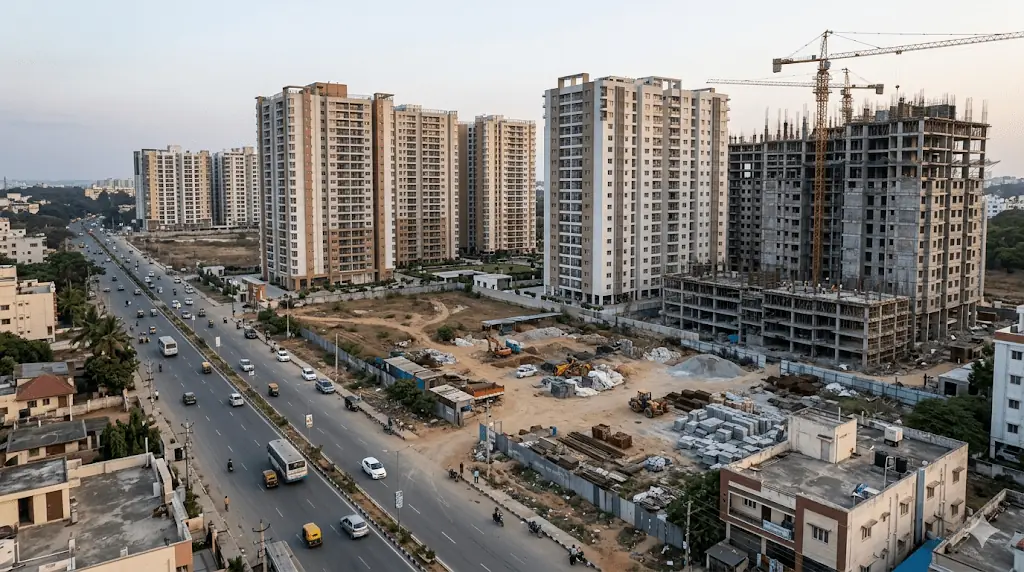
Sarjapur Road’s six-year trajectory is documented — and it is documented by other people, not by us. We publish no per-sq-ft series, no year-by-year table and no cumulative growth figure, because every version of that series in circulation is an estimate against a basket of projects the estimator chose. What the sequence shows, and what you can check for yourself, is the order of the catalysts: ORR tech expansion, then post-pandemic demand for larger homes, then the infrastructure announcements, then the premium-segment acceleration and the Metro Phase 3A planning. For the numbers attached to that sequence, use a dated quarterly report from JLL, Knight Frank or Anarock, and cross-check it against registered sale considerations on the Kaveri Online Services portal.
The pattern is not uniform across Bangalore. Whitefield matured earlier and at higher price points. Electronic City remains a value zone but carries thinner lifestyle infrastructure. Sarjapur Road sits between the two, with sanctioned infrastructure that has not yet been delivered. We attach no figures and no runway to that description — where a corridor sits relative to its own infrastructure is a structural observation; how much of it is already in the price is a forecast, and we do not publish forecasts.
Knight Frank’s quarterly residential data has shown the premium and luxury segment holding its growth momentum while the affordable segment moderated. That is a shift in where the market’s activity sits, and it is Knight Frank’s finding rather than ours — take the current quarter’s figures from the report itself.
Rental Yield Comparison: Bangalore vs. Competing Metros
For NRI investment in Bangalore specifically, rental yield is the part of the return you can measure while you hold, and any change in capital value is only settled on the day you sell. Both are city-level averages when a consultancy publishes them, and neither is a fact about a specific apartment. We publish no yield table and no per-sq-ft comparison across metros; JLL, Knight Frank and Anarock all issue that comparison quarterly, dated, with their methodology attached, and that is the version to work from.
What the comparison actually turns on:
The comparison turns on tenant pools rather than on headline figures. Mumbai’s entry point puts many salaried NRI buyers outside the market before yield is even discussed. Hyderabad’s rental market has not yet deepened to the point where professional tenant pools are as reliably replenished. Pune is stable but does not carry the same concentration of employers, which is what makes a corridor’s demand structural rather than cyclical. Each of those is a structural observation you can test against employment and leasing data at the sources above.
On Sarjapur Road, larger amenity-rich configurations let to a different tenant pool from standard stock, and rent accordingly. For an NRI investing in Bangalore, the case is that combination — an entry point that remains reachable on a salary, a tenant pool with more than one employer behind it, and infrastructure that has been sanctioned but not delivered — rather than any particular number, which is why we do not print one.
NRI Demand Surge: What Post-2022 Data Shows
NRI participation in Indian residential real estate has accelerated materially since 2022, driven by three converging factors:
Exchange rate leverage: For an NRI earning in USD, AED or GBP, what an Indian property costs is two numbers multiplied together, and the second one is not ours to publish. Take the rupee-to-your-currency series from RBI reference rates, apply it to the quote you have actually been given in writing, and do the arithmetic across your own holding period. Anyone who hands you a converted figure has fixed a rate that will not hold.
Premiumisation of supply: Anarock has reported the luxury segment taking the larger share of new residential launches in Bangalore, and the tier-1 developers have concentrated new supply there, which is exactly where NRI capital is active. The alignment between the supply mix and the NRI demand profile has deepened the market.
Regulatory simplification: The 2026-27 Union Budget removed the TAN requirement for NRI property transactions, replacing it with a PAN-based TDS system. The introduction of the Income Tax Act, 2025, specifically Section 393(2), which replaces Section 195 of the 1961 Act, has further simplified the TDS deduction framework for NRI sellers. Together, these changes have reduced the administrative friction that once made remote transactions feel prohibitively complex.
NRI buyers are increasingly concentrating in Bangalore’s eastern and southeastern corridors — Sarjapur Road, Whitefield, and Bellandur. Here, the combination of IT employment proximity, school ecosystem, and infrastructure pipeline aligns with both investment return requirements and eventual relocation intent.
Why This Guide Concentrates on Sarjapur Road
Within Bangalore’s residential market, Sarjapur Road is the corridor where the variables this guide has been describing sit closest together — and where the most of them are still at a stage rather than at a conclusion.
The employment anchor
Wipro’s corporate campus sits directly on Sarjapur Road at Sompura Gate. RMZ Ecoworld, Ecospace, and the broader ORR tech belt are accessible from the western end of the corridor. Embassy Tech Village and the Electronic City Infosys campus are reachable via Dommasandra. This multi-employer catchment means rental demand doesn’t collapse if a single company downsizes, a structural diversification that single-anchor corridors like Electronic City cannot match.
The school ecosystem
Oakridge International, Indus International, Greenwood High, TISB and NPS East all sit on or beside this corridor — five named schools you can look up and drive to, which is a different kind of claim from a ranking. For NRI families planning eventual relocation, school proximity to this belt is a primary purchase driver, one that sustains residential demand independent of IT sector fluctuations.
Where the corridor sits: Sarjapur Road is less built out than Whitefield, and its eastern sub-zones are less built out than its own western end. The sanctioned infrastructure — Metro Phase 3A, the PRR, SWIFT City — is approved but not delivered. Those are the checkable facts. What they are worth, and when, is not something we forecast, and any figure attached to that runway did not come from SUYUG.
Suyug’s projects at Sompura Gate on Sarjapur Road sit within this corridor. Both are K-RERA registered, with no shared walls, and THE1 holds IGBC pre-certification — a design-stage assessment by the Indian Green Building Council, ahead of the final certificate awarded on completion. Saffron is likewise IGBC pre-certified at the design stage; the final certificate for each follows on completion. Ask SUYUG for the price against a specific unit in writing; it is not published here.
The Infrastructure Pipeline: Metro, ORR, and PRR
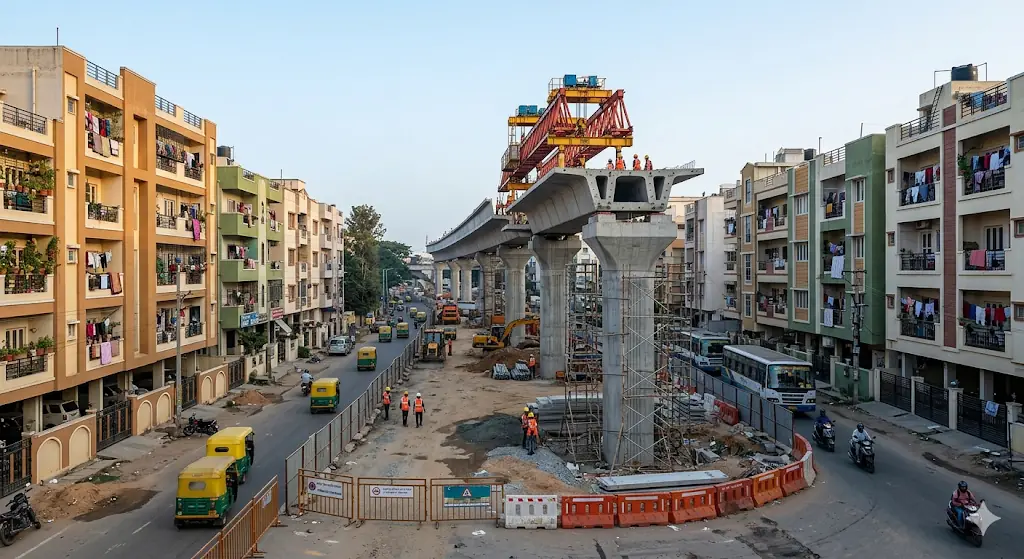
Infrastructure is the variable buyers hear about often and can verify easily, because each project is executed by a named body that publishes its own status. Here is what is on the record for Sarjapur Road, and how far each one has actually got:
Metro Phase 3A — the Hebbal–Sarjapur corridor
BMRCL has not announced a line colour for Phase 3A; the corridor is reported in the press as the Red Line, which is shorthand rather than an official designation. The proposed 36.59 km, 28-station line connects Sarjapur Road to Hebbal in North Bangalore via key interchanges at Iblur (Blue Line), Agara (Blue Line), Dairy Circle (Pink Line), and KR Circle (Purple Line).
– There is no sanctioned cost to quote: the Union government has not approved the DPR, and the state’s estimate has already been revised downward once after the Centre asked for it to be rationalised. Take the current figure from BMRCL rather than from here.
– Union Cabinet approval has not been granted; nothing is under construction on this alignment.
– The construction and operational dates in circulation — broadly 2029–2031 and 2031–2033 — are estimates, not commitments, and BMRCL is the only body that can move them.
Check the alignment, the station list and the current stage on BMRCL’s own site rather than in a brochure line reading “metro nearby”, and weigh the timeline as the risk it is.
Peripheral Ring Road (PRR / Bangalore Business Corridor)
Phase 1 tendering began in 2026. The 73-km expressway is aligned to connect Tumakuru Road to Hosur Road, bypassing the city core for inter-zone travel — which, if built as aligned, would give Sarjapur Road a link to North Bangalore that does not exist today. Nothing is open to traffic, and the corridor has slipped before. Treat the timeline, not the road, as the risk, and take the current status from the BDA.
SWIFT City, the Infosys SEZ and the Satellite Town Ring Road. Two paragraphs of forward projections stood here — a job-creation figure for KIADB's SWIFT City on the Sarjapur–Attibele axis, and an operational date for the STRR — and each shipped with an unresolved editorial note attached to it. We have deleted them rather than softened them, because neither of us can check a projection: the employment number was nobody's published estimate and the STRR date was nobody's published commitment. Where these projects actually stand is published by the bodies executing them, and it is worth reading at the source rather than through a developer: the Karnataka Industrial Areas Development Board for SWIFT City at kiadb.in, and the National Highways Authority of India for the Satellite Town Ring Road at nhai.gov.in. Checked 11 August 2026.
City-by-City NRI Investment Scorecard*
| Parameter (per the sources below) | Bangalore | Mumbai | Hyderabad | Pune |
|---|---|---|---|---|
| Entry Price | Reachable | Highest of the four | Reachable | Reachable |
| Gross Rental Yield | Above Mumbai | Lowest of the four | Comparable to Bangalore | Comparable to Bangalore |
| Metro Connectivity | Expanding (Phase 3A) | Established | Expanding | Limited |
| School Ecosystem | Very High | High | Moderate | Moderate |
| NRI Liquidity | High | High | Moderate | Moderate |
| Entry Accessibility | Moderate | Very Low | Moderate | Moderate |
| Where it is strongest above | Schools, liquidity, entry price and yield together | Liquidity and established metro | Entry price and expanding metro | Entry price; limited metro |
**Data sources: Compiled from Anarock, PropTiger, & JLL Q1 2026 Micro-market Indices
Read the scorecard as the argument this guide has been making rather than as a ranking: on the parameters listed, and on the sources cited beneath them, Bangalore is the city where the most of them line up at once. Mumbai is stronger on liquidity and legacy and weaker on entry cost. Hyderabad is a credible alternative that does not carry the same employment diversity or school density. Pune is stable with a shallower concentration of employers. Anyone weighting those parameters differently from us would reach a different answer, which is why they are set out separately rather than collapsed into a score.
Sarjapur Road is one of the corridors where NRI buying is concentrated. See Suyug’s upcoming homes there, for buyers who want documents they can verify, IGBC pre-certification at THE1, and an asset that does not need managing from another time zone.
How to Verify Any Market Data Point Before Acting On It
Real estate data in India is unevenly published, and figures circulate on portals and in broker decks with no source attached far more often than not. Before treating any number — appreciation, yield, absorption, price band — as a basis for a decision, a few checks are worth applying to it regardless of the source:
- Who published it, and what is their incentive? A number from a regulator (RERA, RBI, a state government department) is disclosure-driven. A number from a brokerage or listing portal is frequently marketing-driven, even when it is presented as neutral research.
- What period and what base does it cover? "Prices are up" without a stated start date and a stated area of comparison is not a data point — it's a claim. The same is true of yield and appreciation figures quoted without the period they were measured over.
- Is it a survey estimate or a transacted figure? Portal-quoted asking prices and actual registered transaction prices frequently diverge, sometimes significantly. A figure drawn from listings reflects what sellers are asking, not what buyers are paying.
- Can you trace it to a primary source? RERA portals, municipal and state government publications, and the Reserve Bank of India publish primary data directly. When a number cannot be traced past a secondary summary, treat it as directional at best.
This is the same discipline this guide applies to itself: every specific figure above is sourced, and where a figure could not be verified, it is left out rather than estimated. Apply the same standard to any number you're handed elsewhere before it enters your decision.
One Thing Worth Sitting With
Everything in this guide that can be checked has been pointed at a source that publishes it and dates it: JLL and Anarock on leasing and launches, BMRCL on the metro alignment, the BDA on the ring road, KIADB on SWIFT City, Kaveri Online Services on what was actually paid for a registered transaction. Everything that could not be checked has been left out rather than smoothed over. That is the difference between a decision you can defend to yourself later and one you took because a page sounded confident.
FAQ’s :
Frequently asked questions
On three variables, each of which you can check at a named source rather than take from us: employment depth, rental yield and entry price. JLL put Bangalore ahead of every other Indian city on office leasing share in Q1 2026, which is the employment half of the argument and is JLL’s finding, not ours. On yield and entry price the comparison against Mumbai, Hyderabad and Pune is published quarterly by the consultancies and revised every quarter. We do not publish yield or appreciation percentages — the figures in circulation come from consultancy reports that revise them every quarter, so take the current numbers from the consultancy that publishes them (JLL, Knight Frank, Anarock all issue quarterly residential data) rather than from a developer’s page. The city’s IT employment base is diversified across sectors and employers, making demand structural rather than dependent on any single company or industry cycle.
We do not publish a yield figure, and you should be wary of any developer who does — a yield is a quotient of two numbers that both move, and the one that matters is the one your own unit produces. What can be said structurally is that yields on this corridor are supported by a deep tenant pool of senior IT professionals, and that larger amenity-rich configurations rent to a different, thinner pool than standard ones. For a current corridor yield, use a quarterly residential report from JLL, Knight Frank or Anarock; for a specific unit, ask a local letting agent what comparable flats in that project are actually let at today.
Sarjapur Road has re-rated substantially since 2020 — we do not publish the percentage, because every figure in circulation is a consultancy’s estimate against a basket we did not choose. The direction is not in dispute; the number is. It sits between Whitefield, which built out earlier, and Electronic City, which has thinner lifestyle infrastructure. What is checkable about the eastern sub-zones of Carmelaram and Dommasandra is that they are less built out than the corridor’s western end and that Metro Phase 3A is aligned through them — the alignment is BMRCL’s to publish and confirm. Whether any of that is already reflected in what you are quoted is an opinion, and we do not hold one in public.
Three, at three different stages. Metro Phase 3A (the Hebbal–Sarjapur corridor) has a DPR but no Union Cabinet approval, and no operational date has been committed — treat the 2031–2033 window in circulation as an estimate and check BMRCL for the current position. The Peripheral Ring Road began Phase 1 tendering in 2026; nothing is open to traffic, and the corridor has slipped before, so the timeline is the risk rather than the road. SWIFT City is the KIADB development on the Sarjapur–Attibele axis — we publish no job-creation figure for it, because none of the numbers in circulation is KIADB’s own; its current status is at kiadb.in. What none of the three comes with is a figure for what it does to a home, and we do not supply one.
Yes, every under-construction project must be registered with Karnataka RERA (rera.karnataka.gov.in), which provides statutory protection on completion timelines, plan deviations, and possession commitments. NRI buyers should verify RERA registration tower-wise (not just project-level), check the registered completion date, and review the complaints section for unresolved buyer disputes before booking. RERA significantly reduces the project delivery risk that once made remote NRI purchases feel risky.
Two variables decide this and we publish neither: the rupee value of the asset over your holding period and the movement of the rupee against the currency you earn in. Both are estimates, both are revised, and a page like this one is the worst place to source either — take the property series from a quarterly consultancy report and the currency series from RBI reference rates, then do the arithmetic on your own holding period. Against US index funds or Singapore REITs, Indian premium real estate carries more liquidity risk but offers yield, appreciation, and eventual personal utility (return-to-India option value) that purely financial instruments don’t. For NRIs who intend to maintain a connection to India, the asset class offers a uniquely multi-dimensional return profile.
Was this useful?
Comments
Was this useful?
Schedule a site visit
Leave your details and the team will call back to fix a convenient date.