
Real Estate Investment Myths in India: 7 Things NRIs Get Wrong in 2026

SUYUG Infraupdated
Long guide · 3,536 words · 16 min read · 6 questions answered
By Editorial team, SUYUG InfraReviewed by the SUYUG Infra legal & compliance desk
In this article · 9 sections
Many NRIs who haven’t invested in Indian property aren’t indifferent to the opportunity. They’re hesitant, held back by a set of concerns that were legitimate a decade ago, circulated widely enough that they’ve become received wisdom, and rarely examined against the actual regulatory and market reality existing today.
The Indian real estate landscape in 2026 is materially different from the one that generated these fears. RERA has changed the legal architecture. FEMA has always provided clearer repatriation pathways than most buyers realise. And Bangalore’s IT corridors now generate a documented paper trail — RERA registrations, escrow rules, registered sale deeds — that a buyer abroad can read for themselves, which changes the conversation from trust to verification.
This guide goes through the seven persistent real estate investment myths in India that hold NRI buyers back, from what the concern is, where it came from, to what the current data and regulatory framework actually show.
TL;DR
- NRIs can complete an entire property transaction remotely via a registered Power of Attorney, with no India visit required
- RERA has fundamentally changed developer accountability; escrow requirements, complaint mechanisms, and penalty structures are now statutory
- What a purchase in Bangalore’s IT corridors is worth to you is project-specific, not corridor-wide — the inputs that decide it are the rent next door, your all-in cost, and the rupee rate on the days you actually remit and repatriate
- Professional property management platforms make remote ownership genuinely hands-off
- Green-rated, RERA-registered apartments in Bangalore’s IT corridors are not exclusively HNI territory — but the only figure worth budgeting against is a written all-in quote for a specific unit, not a segment
- NRIs can repatriate up to USD 1 million per financial year from property sales under FEMA.
- Capital gains rates and TDS rates are set by statute and change by Finance Act; we point at the Income Tax Department rather than print them. A lower-deduction certificate obtained before the sale, and the reinvestment exemption, are the two mechanisms that reduce the effective liability.
Myth 1: NRIs Can’t Buy Property Without Visiting India

The myth: Buying property in India requires being physically present for site visits, document signing, and registration, making remote transactions impractical or impossible.
The reality:
A complete property transaction can be executed from abroad without a single visit to India, provided the legal infrastructure is correctly set up. The mechanism is a registered Power of Attorney (POA) — a document that authorises a trusted representative in India to act on your behalf for a specific, defined transaction.
What the process looks like in practice:
- Execute a transaction-specific POA, limited to the particular property and set of actions rather than a general POA that carries broader risk
- Have the POA attested at your nearest Indian mission (consulate or high commission) in your country of residence
- Have it adjudicated at the relevant Sub-Registrar’s office and stamped within three months of its first receipt in Karnataka, before it is used — that period is set by section 18 of the Karnataka Stamp Act, 1957, and section 32 bars an endorsement once it has run
- Your POA holder signs the sale agreement, completes registration, and handles possession paperwork on your behalf
- Further, your representative can digitally upload these documents to Karnataka’s Kaveri portal, minimizing paperwork delays.
The critical distinction is between a registered POA and a notarised-only POA.
A notarised POA holds no legal validity for property transactions in India and can lead to title disputes. Registration at the Sub-Registrar’s office is mandatory.
Beyond the POA, many Tier-1 developers now offer virtual site tours, digital documentation, and NRI-dedicated advisory desks that make the remote buying experience practical rather than theoretical.
Myth 2: Indian Real Estate Is Too Risky and Fraud-Prone
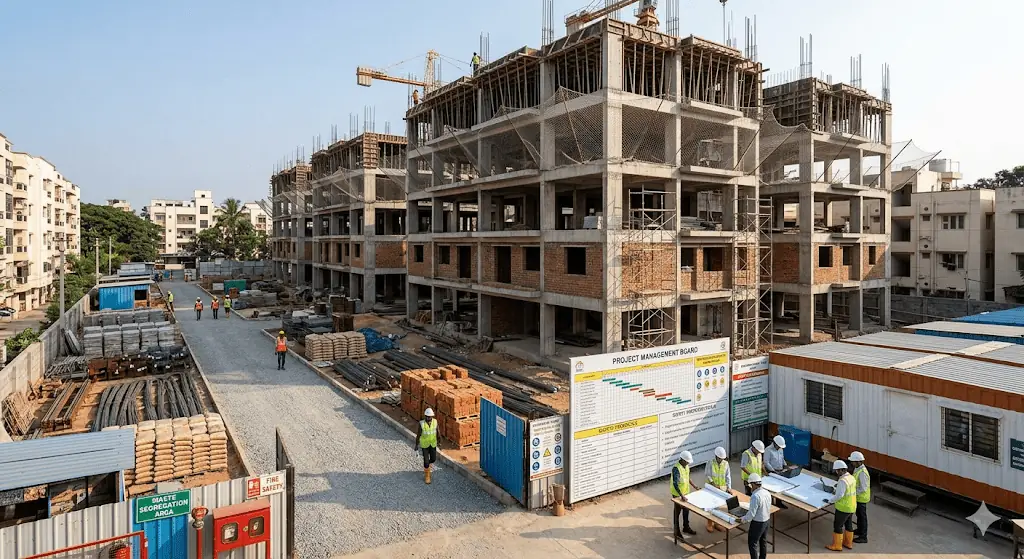
The myth: Stories of builder insolvencies, title disputes, and delayed possession have created a widespread perception that real estate investment in India is structurally unsafe, particularly for buyers who can’t monitor construction in person.
The reality:
The Real Estate Regulatory Authority (RERA), established under the RERA Act 2016 and now operational across all states, has changed the legal architecture of Indian property transactions in ways many overseas buyers haven’t fully absorbed.
What RERA mandates that didn’t exist before:
- Developers must maintain 70% of project funds in a dedicated escrow account, ringfenced for that specific project’s construction, preventing the diversion of buyer funds to other projects
- Every project and broker must be separately RERA-registered; buyers can verify both on the state portal before signing anything
- Possession delays attract mandatory interest payments to buyers at the applicable rate
- Buyers have statutory recourse, they can file a complaint via Form M or Form N basis the grievance on the Karnataka RERA portal (rera.karnataka.gov.in) with a ₹1,000 filing fee, and RERA targets resolution within approximately 60 days.
For NRI buyers specifically, RERA provides the same statutory protections as resident buyers. There is no legal distinction in complaint rights or remedies. Verifying tower-wise RERA registration (not just project-level), checking the developer’s complaint history, and confirming the registered completion date on the state portal takes under an hour and eliminates the majority of project delivery risk that once made real estate investment advice for NRIs so cautious.
Myth 3: Returns Are Low Compared to Global Markets

The myth: Indian real estate delivers modest returns that can’t compete with US index funds, Singapore REITs, or other international investment alternatives, particularly once rupee depreciation is factored in.
The reality:
The myth conflates an average across all Indian real estate with what a specific project in a specific corridor actually does — two different questions, only one of which you are buying. The rupee depreciation concern is real, and it needs handling rather than dismissing.
What actually determines the return, and where each input comes from:
- The rent, not a yield projection. Ask what the same configuration is currently letting for in the neighbouring towers. That is observable. A developer’s projected yield is not.
- Your all-in cost, not the base price. Yield is annual rent over everything you actually paid — stamp duty, registration, GST, corpus, parking, brokerage included.
- The project’s own price history. What did this unit type launch at, and what is it quoted at today? A developer can answer that for their own project. A corridor-wide appreciation percentage answers a different question, one nobody is buying.
- The rupee. A dollar return is the rupee return net of what the currency did over your holding period. The Reserve Bank of India publishes the reference rate daily.
The currency depreciation reality check:
Rupee depreciation is real, and it is the input NRI buyers usually leave out of the comparison. It is also the easiest one to handle honestly. Convert your entry cost at the rate on the day you actually remitted, convert your net exit proceeds at the rate on the day you actually repatriate, and compare those two dollar figures. Anything else — a projected annual depreciation rate applied to a projected annual appreciation rate — is two forecasts multiplied together, and it will be presented to you as a number.
The arithmetic worth running before you commit, in this order:
- Entry. Base price, plus stamp duty and registration at the rates the Karnataka Department of Stamps and Registration currently publishes, plus GST if the unit is under construction, plus brokerage, corpus, advance maintenance, parking and clubhouse entry. That total is your entry cost. The base price is not.
- Holding. Rent received, less management fees, less maintenance, less property tax — the net, not the gross.
- Exit. Gross sale price, less brokerage, less capital gains tax at whatever rate is then in force. Myth 7 below names who publishes that rate, and describes the lower-deduction certificate that changes what is actually withheld at the time of sale.
- Currency. Convert the entry cost at the rate you actually remitted at, and the net exit proceeds at the rate you actually repatriate at.
- Result. The gap between those two dollar figures, annualised over the years you held it, is your real return.
Projections you will be shown routinely skip at least two of these steps — usually the entry friction and the exit tax — which is exactly where the difference between a headline return and a realised one lives.
Myth 4: Managing Property From Abroad Is Too Complicated
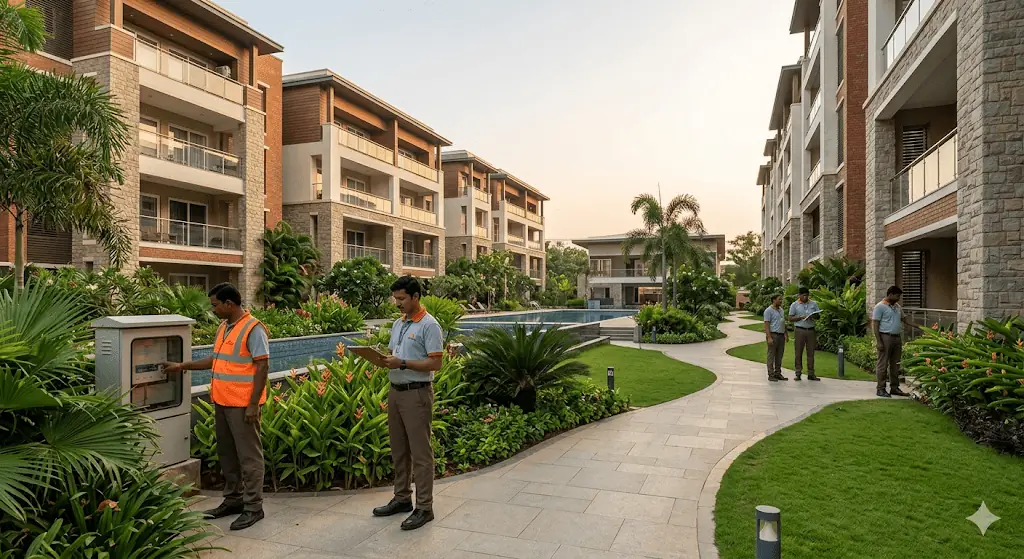
The myth: Tenant disputes, maintenance issues, and the risk of encroachment make it practically impossible to manage Indian real estate from overseas without relying on local family members, or the “trusted relatives trap” that frequently creates its own complications.
The reality:
The combination of professional property management platforms, gated communities with in-house facilities management, and properly-structured legal instruments has made genuinely hands-off ownership a realistic option.
What a functional remote management setup looks like:
- Registered POA for leasing and management: scope-limited to tenant agreements and maintenance authorisation, not broad financial authority
- Professional property management services: handle tenant screening, rent collection, routine maintenance, and legal renewals; fees typically run 8–10% of monthly rent.
- Gated community selection: projects with dedicated facilities management, 24/7 security, and professional maintenance teams reduce the ad-hoc intervention that thinly-managed developments require — ask to see the facilities management contract, not the brochure
High-impact real estate investment advice for NRIs managing assets remotely is project selection. A high-rise with on-site infrastructure and a contracted facilities management team requires dramatically less owner involvement than an older development running on a shared borewell and informal maintenance. The quality of the project determines the quality of the management experience, not the owner’s distance.
Myth 5: Only the Rich Can Invest in Indian Real Estate
The myth: Well-built Indian real estate, particularly in corridors like Bangalore’s IT belt, is accessible only to HNIs and ultra-high-net-worth individuals, and is out of reach for a salaried NRI professional.
The reality:
The assumption behind the myth is that green certification, RERA registration and an established developer are things you buy at the top of the market. They are not — they are compliance and specification, and both are visible on documents rather than inferred from a price tag. A 3 BHK in a green-rated, K-RERA-registered project on Sarjapur Road is a specification you can verify line by line: the IGBC certificate or pre-certification, the tower-wise registration on rera.karnataka.gov.in, the sanctioned plan, the title chain.
What that costs is a question for the developer, in writing, against a specific unit — and it is worth converting at the Reserve Bank of India reference rate on the day you actually remit rather than at a round number, because the rate on the day is the rate you pay. The point is not that Bangalore is cheap; we make no claim either way. It is that the things which make a project worth owning are checkable independently of what it costs, so check them first and let the number be the second question.
Home loan financing is also available for NRI buyers. Indian banks and NBFCs lend against these purchases with EMI payments made from NRE or NRO accounts. How much they will lend against the value of the property is capped by the Reserve Bank of India and, within that, by each lender’s own credit policy — ask the bank you are applying to for its current figure in writing, and work your equity requirement back from that rather than from a number in an article. That equity requirement is not an exclusively wealthy person’s calculation.
Myth 6: Repatriating Funds Is Difficult
The myth: Once capital is invested in Indian property, getting it back out after a sale is a complex, bureaucratically fraught process that can trap funds in India indefinitely.
The reality:
FEMA provides clear, structured repatriation pathways that are less restrictive than most NRI investors realise:
- If the property was purchased using NRE or FCNR account funds, sale proceeds are fully and freely repatriable with no annual cap, after paying applicable capital gains tax
- If purchased through NRO funds or domestic income, repatriation is capped at USD 1 million per financial year after tax, a limit that covers the proceeds of many residential transactions
- The 2026-27 Union Budget removed the TAN requirement for buyers of NRI properties, replacing it with a PAN-based TDS system, reducing the administrative friction that previously complicated secondary market transactions
The practical process is to pay applicable taxes, file returns, obtain a tax clearance if required, and remit through your Indian NRO/NRE account via normal banking channels. The process involves paperwork but no structural barriers. The perception of funds being “blocked” reflects the old framework, not the current one.
Myth 7: High Taxes Eat All the Returns
The myth: Between TDS deductions at sale, capital gains tax, rental income tax, and municipal property taxes, the effective tax burden on NRI real estate makes net returns negligible.
The reality:
The tax picture is more structured than this myth suggests. What it is not is fixed. Every rate that would go in a table here — long-term capital gains, TDS on a sale by a non-resident, TDS on rent, the municipal property tax — is set by statute and amended by the annual Finance Act, and the Income-tax Act, 2025 replaced the Income-tax Act, 1961 with effect from 1 April 2026. A rate printed on a developer's blog is a rate that will be wrong within a year and cited as current for far longer. So we do not print them. Here is where each one is actually published:
| What you need | Who publishes it | Where |
|---|---|---|
| Capital gains treatment on sale, and the holding period that makes a gain long-term | Income Tax Department, Government of India — the Income-tax Act, 2025 as amended by the Finance Act in force | incometax.gov.in |
| Rate of tax to be deducted at source on a payment to a non-resident, including on the sale consideration for a property | Income Tax Department — the deductor is the buyer, not you | incometax.gov.in |
| TDS on rent paid to a non-resident landlord | Income Tax Department — the deductor is your tenant | incometax.gov.in |
| Property tax on a Bengaluru property, and the guidance value it is computed against | The municipal corporation for the ward, and the Department of Stamps and Registration, Karnataka, for guidance value | kaverionline.karnataka.gov.in |
Checked 11 August 2026. Rates change by notification; the authority named in each row is the one that publishes the current figure, and it is the only one worth quoting to a bank or a buyer.
The tools that reduce effective tax. These are mechanisms rather than rates, so they are stable enough to describe:
- A lower-deduction certificate. By default, tax is deducted on the gross sale consideration, not on your actual gain — which on a property held for years is a large difference in immediate cash flow, because the excess only comes back when you file. A non-resident seller can apply to the Assessing Officer for a certificate authorising deduction at a lower rate, computed on the gain rather than the gross value. Apply before the sale closes; it is not retrospective. The application route and the current form are published by the Income Tax Department at incometax.gov.in
- Reinvestment exemption. Capital gains reinvested into another residential property in India, within the timeline the Act specifies, are exempt to the extent reinvested. The timeline is strict and runs from the date of transfer, so it is a thing to plan before you sell, not after
- DTAA relief. India has Double Taxation Avoidance Agreements with a large number of countries, and a resident of one of them can claim credit for tax paid in India against the liability at home. Whether your country of residence has one, and what it says, is published in the Income Tax Department's own list of agreements at incometax.gov.in — check the text of yours rather than a summary of it
The tax framework has friction, but it has structure; and that structure provides tools that any well-advised NRI buyer can use to manage effective liability meaningfully below the headline rates.
If these myths have kept you from investing back home, explore how Suyug makes NRI buying straightforward with K-RERA-registered projects on Sarjapur Road, designed for buyers who need an asset that works reliably from a distance. On the green-building question, we are precise rather than convenient: THE1 holds IGBC pre-certification — a design-stage assessment by the Indian Green Building Council, ahead of the final certificate awarded on completion. Saffron is likewise IGBC pre-certified at the design stage; the final certificate for each follows on completion.
Myth 8: Every Broker's "Verified" Project Is Actually Verified
The word "verified" attached to a listing by a portal or a broker usually means the listing was checked for completeness, not that the project's legal and regulatory standing was independently confirmed. It is worth being precise about the difference, because the word does a lot of reassuring work it hasn't earned.
Genuine verification, for any project anywhere in India, means checking a small number of specific things directly against a primary source: the project's RERA registration number, searched on the relevant state regulator's own portal (K-RERA or TNRERA, depending on where the land sits) rather than taken from a brochure; the promoter name on that registration, which should match the entity you are actually contracting with; and, where the project is complete, whether an Occupancy Certificate has been issued. None of this requires trusting anyone's word — it requires ten minutes on the regulator's own website, checking a number the promoter is legally required to have registered before marketing the project at all.
A portal's "verified" badge, a broker's assurance, or a project's own claim of RERA compliance are all starting points for a question, not a substitute for checking the register yourself.
One Thing Worth Sitting With
The myths that hold NRI investors back from real estate investment in India are not invented. They have roots in real experiences from a decade ago. What has changed is the regulatory framework and the transparency infrastructure around it. The question for a buyer in 2026 is not whether Indian real estate is safe. It’s whether the specific project, developer, and sub-location they’re evaluating can pass the verification steps made possible by the new framework. That answer is findable, and it usually takes less time than the hesitation does.
Frequently asked questions
Yes, via a registered Power of Attorney (POA) attested at your nearest Indian mission — the consulate or high commission — and adjudicated at the Sub-Registrar’s office in India. The POA should be transaction-specific, and not general, to limit risk. Many Tier-1 developers now offer virtual tours and digital documentation for the full process.
RERA mandates that 70% of buyer funds are held in project-specific escrow, requires separate registration for every project and broker, and gives buyers statutory recourse for delays via an online complaint portal. For NRIs, the protections are identical to those of resident buyers. Verifying RERA registration tower-wise on rera.karnataka.gov.in takes under an hour and significantly reduces delivery risk.
The honest answer is that the comparison is project-specific, not corridor-wide. The return has two components — the rent the same configuration is actually fetching in the towers next door, and the price history of the specific project from its launch to today — and both are things a developer can show you, unlike a corridor average. Convert at the rupee rates on your actual entry and exit dates rather than at a projected depreciation rate. Indian real estate also carries option value, that is, the eventual ability to use the asset personally — that purely financial instruments don’t. The comparison is favourable in high-growth micro-markets with confirmed infrastructure tailwinds.
We do not publish the rate, and you should be wary of any developer who does: capital gains rates and the TDS rate on a payment to a non-resident are set by statute, amended by the annual Finance Act, and the Income-tax Act, 2025 replaced the Income-tax Act, 1961 with effect from 1 April 2026. The current figures are published by the Income Tax Department at incometax.gov.in. What is stable is the mechanism, and it matters more than the rate: by default tax is deducted on the gross sale consideration rather than on your actual gain, and you can apply to the Assessing Officer before the sale for a certificate authorising deduction at a lower rate computed on the gain — apply before the sale closes, because it is not retrospective. Reinvesting the gain into another residential property in India within the timeline the Act specifies exempts it to that extent.
Properties purchased with NRE or FCNR funds: sale proceeds are fully repatriable after tax, with no annual cap.
Properties purchased through NRO funds: repatriation is capped at USD 1 million per financial year after paying applicable taxes.
The 2026-27 Budget’s removal of the TAN requirement has reduced administrative friction in secondary market transactions, making the process more straightforward than it has historically been.
Work it from the unit, not from a corridor figure. We publish no price band: what a specific 3 BHK costs on Sarjapur Road turns on the sub-zone, the land the project sits on, its approval status, the specification it is built to and the developer behind it, and any number written for a whole corridor averages all five away. Ask the developer to quote the specific unit in writing. NRI home loans are available against the purchase; the maximum loan-to-value a lender may offer is capped by the Reserve Bank of India and by the lender’s own credit policy, so get that figure in writing from the bank you are applying to rather than from an article. On top of the base price sit stamp duty and registration — set by notification, with the current rates published by the Karnataka Department of Stamps and Registration — plus GST on under-construction units, corpus fund, advance maintenance and parking. Ask the developer for a written all-in statement against your specific unit before you budget.
Was this useful?
Comments
Was this useful?
Schedule a site visit
Leave your details and the team will call back to fix a convenient date.