
How to Choose a 3 BHK on Sarjapur Road
SUYUG Infra
Short briefing · 1,493 words · 7 min read
If you are shortlisting a 3 BHK on Sarjapur Road, you will hear the same handful of names repeated back at you — Whitefield, ORR, Koramangala, HSR — usually with a number attached and rarely with a reason. This guide does the opposite. It sets out what actually separates one 3 BHK from another on this corridor: what to check before you shortlist, how configurations and specifications genuinely differ, and what determines whether a project is worth what it is asking. We publish no price band and no appreciation forecast anywhere on this site, and this page is no exception — neither can be sourced to a document you can re-check a year later.
Why look at Sarjapur Road as a corridor, not as one address
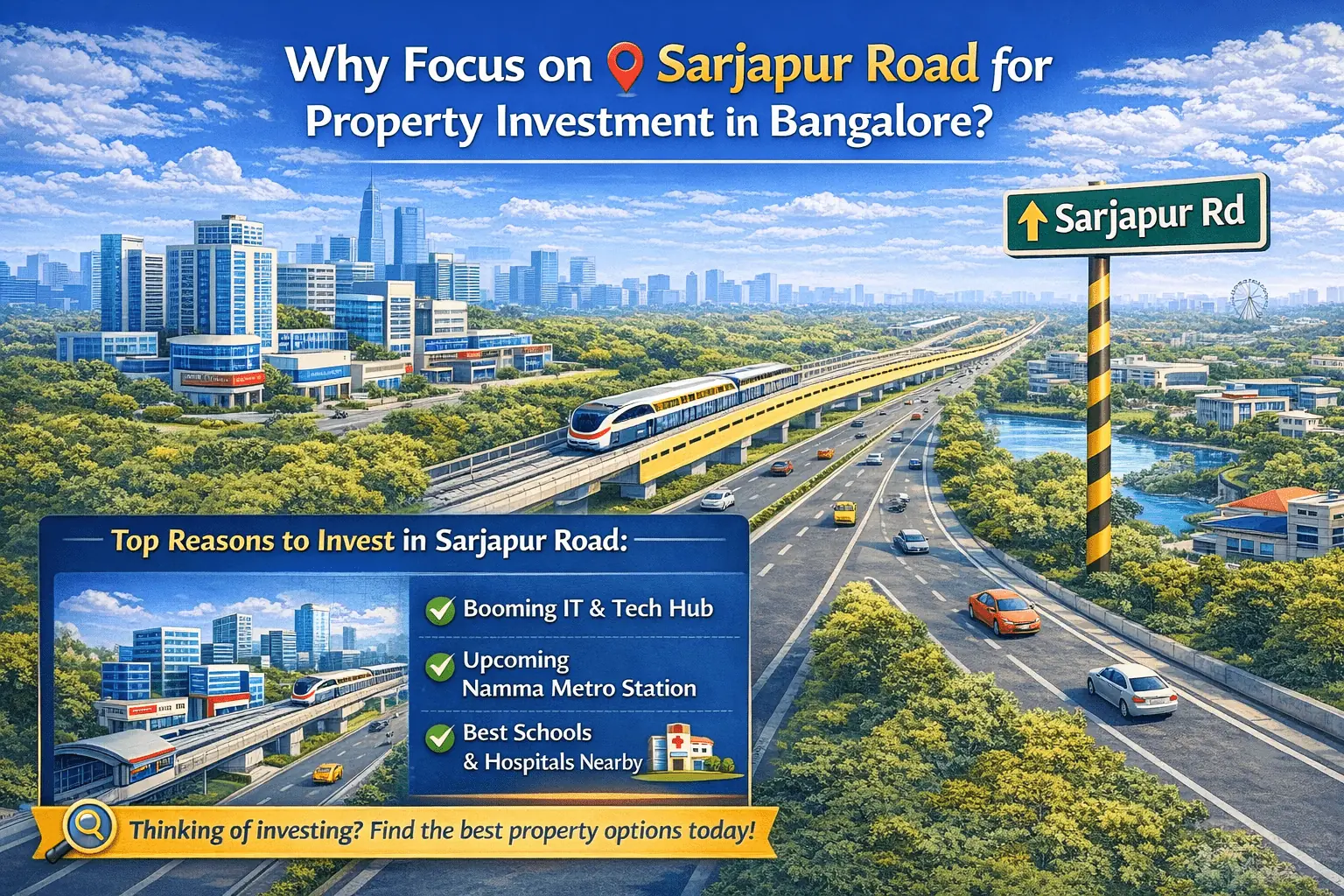
The single most common mistake buyers make here is treating “Sarjapur Road” as one market. It is not. What the corridor does offer is:
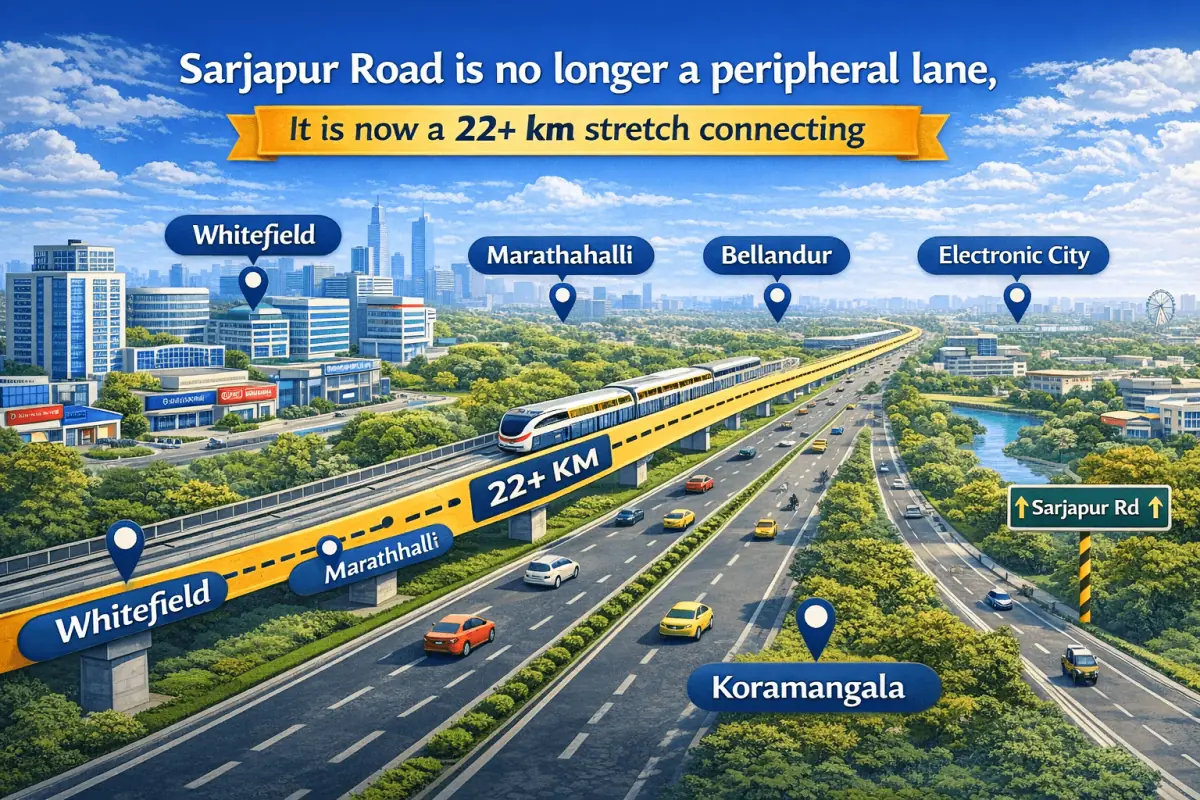
- Direction, not distance: the road runs between the ORR belt at the Bellandur and Marathahalli end and the Attibele and Electronic City side at the other, with Whitefield and Varthur reachable across it and HSR to its west. That matters because it means a household is not locked into one employment cluster. We publish no travel time and no distance: the honest ones vary by route and by hour, and the convenient ones are marketing. Drive your own route, gate to gate, on a working Tuesday morning and again on the evening return.
- Different sub-zones, different rules: the corridor crosses more than one civic jurisdiction. A project at the ORR end and a project further out can carry the same postal address while sitting under different approving authorities, different water infrastructure and different khata regimes. Establish which one your project is in before you compare it with anything.
- Infrastructure that is sanctioned and not built: the Hebbal–Sarjapur metro line (Phase 3), the Peripheral Ring Road and the Satellite Town Ring Road are all on record and none of them is delivered. Treat the timeline, not the catalyst, as the risk you are taking, and take the dates from BMRCL and the state rather than from a brochure.
- A social ecosystem that already exists: established schools including Oakridge and Greenwood High sit along the extended belt, with hospitals and retail grown up around them. Unlike the infrastructure above, this you can go and look at today — which is exactly why it belongs in a different column of your reasoning.
What actually determines what a 3 BHK here is worth
1) The land and the paperwork under it
Before any conversation about specification or amenity, four documents decide whether a project is buyable at all:
- Tower-wise RERA registration on rera.karnataka.gov.in — not a project-level number covering several phases. Check the registered completion date, the approved plan, and the complaint history against the promoter.
- The title chain and the Mother Deed, establishing clear title, together with the Encumbrance Certificate for the period your advocate advises.
- The DC Conversion Order confirming the land is no longer agricultural, and the sanctioned building plan from whichever authority actually approves in that sub-zone.
- Khata status, and what it will be after registration rather than what it is on the developer’s land today.
None of this is glamorous and all of it is verifiable by a stranger. A project that clears these is in a different category from one that does not, regardless of what either is quoting.
2) How 3 BHKs on this corridor actually differ from each other
- Usable area versus quoted area: ask which number you are being quoted on — carpet, built-up or super built-up — and ask for the RERA-registered carpet area alongside it. Two units quoting the same headline area can differ substantially in the space you can put furniture in. The loading factor is the difference, and it is a number the developer can state in writing.
- Room proportion, not room count: a 3 BHK with a long thin third bedroom and a 3 BHK with three squarely proportioned rooms are different products. Take a tape to the sample flat and check the shorter dimension of each bedroom against the bed you own.
- Bathrooms and utility: how many are full bathrooms rather than powder rooms, and whether the utility can actually take a washing machine plus a dryer plus drying space.
- Cross-ventilation and daylight: whether the unit has openings on more than one side, whether the living area faces a light shaft, and whether the corridor outside is single-loaded or has front doors facing each other. Visit the actual floor and orientation you are being sold, in daylight.
- Shared walls: whether your unit shares a wall with a neighbour at all, and if so, which rooms.
- Density and open space: units per acre, and how much of the open space is genuinely usable rather than setback and driveway. This shows up every day in lift waiting times and parking.
Who this corridor tends to suit
1) Daily life: schools, hospitals, retail
- Established schools along the extended belt, including Oakridge and Greenwood High, covering a range of curricula. Check admission cycles and actual availability for your child’s year group rather than assuming proximity equals a place.
- Hospitals and healthcare grown up around the corridor, which is the difference between a corridor that works for a household with elderly parents and one that does not.
- Retail, cafés and leisure, with the HSR, Bellandur and Whitefield clusters reachable across the corridor. This is why a 3 BHK here is a liveable proposition from day one rather than a bet on a future neighbourhood.
2) Specification: what to read on the sheet, not in the render
Projects on this corridor now commonly offer:
- Larger 3 BHK and 4 BHK layouts — evaluate them on proportion and ventilation, not on the headline area
- Clubhouses with gym, pool, indoor sports, co-working lounges and multipurpose halls — ask what the clubhouse costs to run per month, because that lands in your maintenance
- Landscaped gardens, jogging tracks, kids’ play areas and pet zones — ask which of these is in the sanctioned plan and which is in the render only
- Green features: ask whether the project holds an IGBC or comparable certification, whether it is pre-certified at design stage, or whether it is merely described as “aligned” with the guidelines. Those are three different claims and only the first two are assessed by anybody.
A buyer’s checklist, tuned to this corridor
If you are shortlisting 3 BHK flats for sale in Sarjapur Road, use this filter:
- Your own travel grid: drive from the project gate to your office, your school and your parents’ hospital, at the hours you would actually make each trip. Pay particular attention to the last stretch — a project can sit on the main corridor and still take a long approach down a two-lane internal road shared with construction traffic.
- Water: whether there is a sanctioned BWSSB connection or a dependence on borewells and tankers, the rainwater harvesting storage per unit, and the STP recycling arrangement. This is the single most consequential thing on this corridor and the least discussed in sales conversations.
- Open space and density: good open-space ratios with a sensible unit count, verified against the sanctioned plan rather than the brochure.
- Micro-location: prefer sites with a legible relationship to planned metro alignments, ring roads or major junctions over deep, disconnected pockets — while remembering that none of that infrastructure is built yet.
- Developer and execution: RERA registration in the promoter’s own name, a track record you can visit, and visible onsite progress you can photograph on the day.
- The all-in cost: base price is not the purchase price. Ask for a written statement covering stamp duty and registration at the rates the Karnataka Department of Stamps and Registration currently publishes, GST if the unit is under construction, corpus fund, advance maintenance, parking and clubhouse entry, against your specific unit.
The honest summary
Sarjapur Road is a corridor where a great deal of the infrastructure story is still ahead of it rather than delivered — which is a description of its risk as much as of its case. Whitefield and the inner-core localities are further through that same cycle. Which of those suits you is a question about your own horizon, your commute and your tolerance for waiting on a state timetable, and it is not one an article can answer on your behalf.
What an article can do is tell you which questions survive contact with a sales team: tower-wise RERA registration, the title chain, the conversion order, the water arrangement, the RERA-registered carpet area, the shared-wall condition, and a written all-in cost for the unit you are actually buying. Every one of those is a document or a site visit. Together they take about an afternoon, and they are the part of this decision that does not depend on anybody’s forecast — including ours.
Was this useful?
Comments
Was this useful?
Schedule a site visit
Leave your details and the team will call back to fix a convenient date.